
A fault implies an abnormal condition in the electrical power system. Only the failure of insulation causes a fault. A fault causes an excess current to flow through an unintended path. Low insulation reduces system impedance. When the system impedance falls below the lowest load impedance a fault generates.
A power system network consists of generators, switchgear, transformers, transmission and distribution networks. Obviously, some failure may occur somewhere in such a large system network. An overhead power line faces many more faults than an indoor and underground system.
Causes of Faults
Breakdown at Normal Voltage
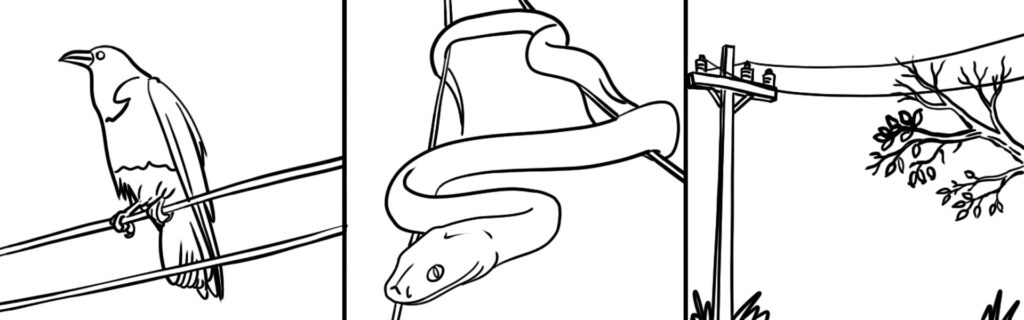
Breakdown may occur under normal operating voltage. One of the main causes is deterioration of insulation. Weak and degraded insulation provides an unwanted low-impedance path for current. There are also many unpredictable external causes for electrical faults even at a normal voltage condition. For example, these causes are birds perching on conductors, snakes causing short circuits, tree branches touching the line, etc.
Breakdown Due to Abnormal Voltage
Even healthy insulation may fail because of an abnormal transient overvoltage. Switching surges and lightning surges cause transient overvoltages.
The modern power utility companies generally provide sufficiently higher insulation levels than nominal voltage levels. However, insulation strength may still decrease because of the following reasons. Pollution is one of the main causes of degradation of exposed insulators. The deposition of dust and chemicals on the insulator body surface degrades the insulators in industrial areas. A moist and salty atmosphere causes the deposition of salt on the insulators in coastal regions. The ageing of insulation is another cause of failure. Voids inside XLPE, PVC, and other solid insulation on cable and other equipment cause partial discharge. This also degrades the insulation badly.
Consequences of Faults
The common consequence of an uncleared fault is heat. Heat causes an abnormal temperature rise. Abnormally high temperature can deform, even destroy, the equipment. The most common consequence of a short circuit is fire. The prolonged fault causes severe reduction of system voltage over a large area, interrupting electrical supply. Overheating and excessive mechanical forces can cause equipment damage.
Typical Distribution of Faults in a Power System
Now that we have understood the nature and causes of faults. Let’s see which types of faults occur most frequently in overhead transmission lines. This is important because, in practice, overhead lines account for nearly half of all the faults that occur in a power system.
Because of this, every protection engineer must have a clear understanding of the different types of overhead line faults.
| Equipment | Percentage of Total Faults |
|---|---|
| Overhead Lines | 50% |
| Cables | 10% |
| Switchgear | 15% |
| Transformers | 12% |
| CTs & PTs | 2% |
| Control Equipment | 3% |
| Miscellaneous | 8% |
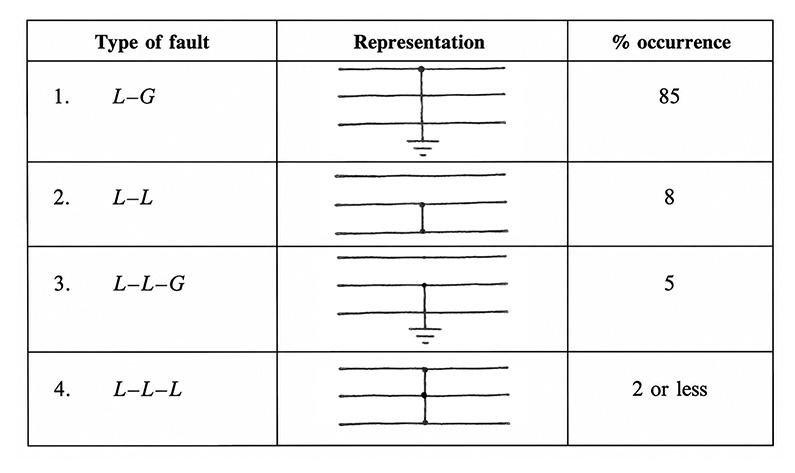
Let’s consider a three-phase power system. Depending on which insulation breaks down, faults are classified into four different categories.
Line – to – Ground Fault (L-G Fault)
This occurs when one phase conductor touches the earth. For example, if any phase accidentally comes into contact with the tower, pole, or tree, then an L-G fault occurs. This is the most common type of fault. Approximately 85% of all overhead line faults are L – G faults.
Line – to – Line Fault (L-L Fault)
The second type is the L-L Fault. Here, the insulation between any two phase conductors fails. Also, when two live phase conductors touch each other, an L – L fault occurs. Approximately 8% of overhead line faults come under this category.
Double Line – to – Ground Fault (L-L-G Fault)
Here, two phase conductors simultaneously come into contact with earth. For example, phases R and Y may both touch a grounded object is the same instant. According to the statistics, this type of fault occurs in about 5% of cases.
Three Phase Fault (L-L-L Fault)
In this fault, all three phase conductors become short-circuited together. In other words, these three phase conductors touch each other instantly. Obviously, this is the least common type of fault. Only 2% or even less of all overhead line faults come under this category. This L – L – L fault does not occur naturally.
This mainly happens due to mishandling. Mishandling means human error during operation or maintenance. For example, suppose the linemen are working on an overhead line. They have connected all three phase conductors together using a bare conductor. This temporary connection protects the workers by ensuring that the line cannot become accidentally energized. However, after the completion of the maintenance work, they forget to remove the temporary shorting. Now, an operator closes the circuit breaker. Consequently, all three live phases become short-circuited. This causes a symmetrical three-phase fault (L-L-L Fault).
Temporary Faults or Transient faults
As we have already come to know that about 85% of all overhead line faults are single line-to-ground faults (L-G Fault). However, we are fortunate enough that most of these faults are temporary, or transient in nature.
For example, suppose a small tree branch comes across a conductor. Hence, it creates a fault. This tree provides a path to ground for the fault current. The excessive fault current burns out the tree branch. This causes instant fault clearance.