Flux Linkage of One Conductor in a Group of Conductors

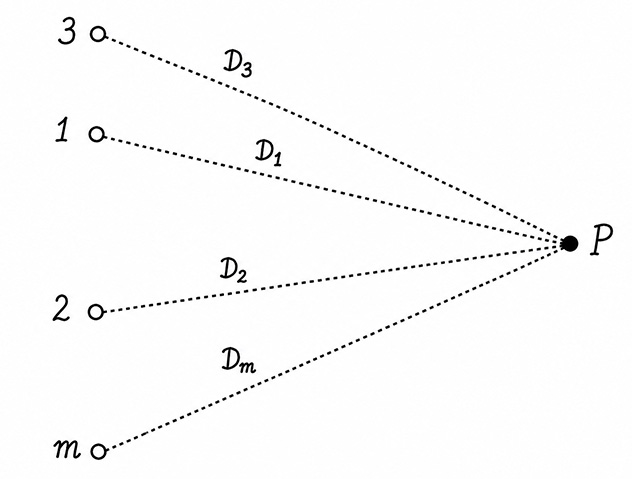
Suppose there are m conductors arranged in parallel. We can mark the conductors as 1, 2, 3, …, m. Current I₁, I₂, I₃, …, Iₘ flow through the conductors, respectively. Also, in a system, we can consider the sum of these currents to be zero. So, we can write,
I1+I2+I3+⋯+Im=0I_1+I_2+I_3+\cdots+I_m=0
We need to calculate the flux linkage of conductor 1 due to its own current I1I_1​ and currents in other conductors. Let us consider a point P in space. This is the reference point. The distances of the conductors from this point are D₁, D₂, D₃, …, Dₘ, respectively.

Flux Linkage of One Conductor in a Group of Conductors

The flux linkage at point P due to the current I1I_1​ in conductor 1 will be
λ11=μ0I18π+μ0I12πln⁡D1R1\lambda_{11} = \frac{\mu_0 I_1}{8\pi} + \frac{\mu_0 I_1}{2\pi} \ln\frac{D_1}{R_1}=2×10⁻⁷I1ln⁡D1R1= 2\times10^{-7}I_1\ln\frac{D_1}{R_1}
The flux linkage of conductor 1 due to the current in conductor 2 will be
λ12=2×10⁻⁷I2ln⁡D2D12\lambda_{12} = 2\times10^{-7}I_2 \ln\frac{D_2}{D_{12}}
Where D12D_{12}​ is the distance between conductors 1 and 2. The flux linkage of conductor 1 due to the current in conductor m will beλ1m=2×10⁻⁷Imln⁡DmD1m\lambda_{1m} = 2\times10^{-7}I_m \ln\frac{D_m}{D_{1m}}
Therefore, the flux linkage of conductor 1 due to all currents will be
λ1=2×10⁻⁷[I1ln⁡D1R1+I2ln⁡D2D12+⋯+Imln⁡DmD1m]\lambda_1 = 2\times10^{-7} \left[ I_1\ln\frac{D_1}{R_1} + I_2\ln\frac{D_2}{D_{12}} +\cdots+ I_m\ln\frac{D_m}{D_{1m}} \right]
=2×10⁻⁷[I1ln⁡1R1+I2ln⁡1D12+⋯+Imln⁡1D1m]= 2\times10^{-7} \left[ I_1\ln\frac{1}{R_1} + I_2\ln\frac{1}{D_{12}} +\cdots+ I_m\ln\frac{1}{D_{1m}} \right]+2×10⁻⁷(I1ln⁡D1+I2ln⁡D2+⋯+Imln⁡Dm)+ 2\times10^{-7} \left( I_1\ln D_1 + I_2\ln D_2 +\cdots+ I_m\ln D_m \right)
Since,I1+I2+I3+⋯+Im=0I_1+I_2+I_3+\cdots+I_m=0
⇒Im=−(I1+I2+I3+⋯+Im−1)\Rightarrow I_m = -(I_1+I_2+I_3+\cdots+I_{m-1})
We can write the second part of the equation as
I1ln⁡D1+I2ln⁡D2+⋯+Im−1ln⁡Dm−1+Imln⁡DmI_1\ln D_1 + I_2\ln D_2 +\cdots+ I_{m-1}\ln D_{m-1} + I_m\ln D_m =I1ln⁡D1+I2ln⁡D2+⋯+Im−1ln⁡Dm−1−(I1+I2+⋯+Im−1)ln⁡Dm= I_1\ln D_1 + I_2\ln D_2 +\cdots+ I_{m-1}\ln D_{m-1} – (I_1+I_2+\cdots+I_{m-1})\ln D_m=I1ln⁡D1Dm+I2ln⁡D2Dm+I3ln⁡D3Dm+⋯+Im−1ln⁡Dm−1Dm= I_1\ln\frac{D_1}{D_m} + I_2\ln\frac{D_2}{D_m} + I_3\ln\frac{D_3}{D_m} +\cdots+ I_{m-1}\ln\frac{D_{m-1}}{D_m}
As we have chosen point P far away from the group of conductors,
D1≈D2≈D3≈⋯≈DmD_1 \approx D_2 \approx D_3 \approx \cdots \approx D_mTherefore,
ln⁡D1Dm=0,ln⁡D2Dm=0,⋯ ,ln⁡Dm−1Dm=0\ln\frac{D_1}{D_m}=0,\qquad \ln\frac{D_2}{D_m}=0,\qquad \cdots,\qquad \ln\frac{D_{m-1}}{D_m}=0
Hence, the entire second part becomes zero. So, the entire second part vanishes. Therefore, the flux linkage of conductor 1 due to all the currents in the group becomes
λ1=2×10⁻⁷(I1ln⁡1R1+I2ln⁡1D12+I3ln⁡1D13+⋯+Imln⁡1D1m)\lambda_1 = 2\times10^{-7} \left( I_1\ln\frac{1}{R_1} + I_2\ln\frac{1}{D_{12}} + I_3\ln\frac{1}{D_{13}} +\cdots+ I_m\ln\frac{1}{D_{1m}} \right)Wb-turn/meter.

Video on Flux Linkage of One Conductor in a Group of Conductors