
Suppose there is a current-carrying conductor. This conductor carries a current of I amperes. Now, we shall consider a small length dx of the conductor. Also, we shall consider a point P as the observation point.
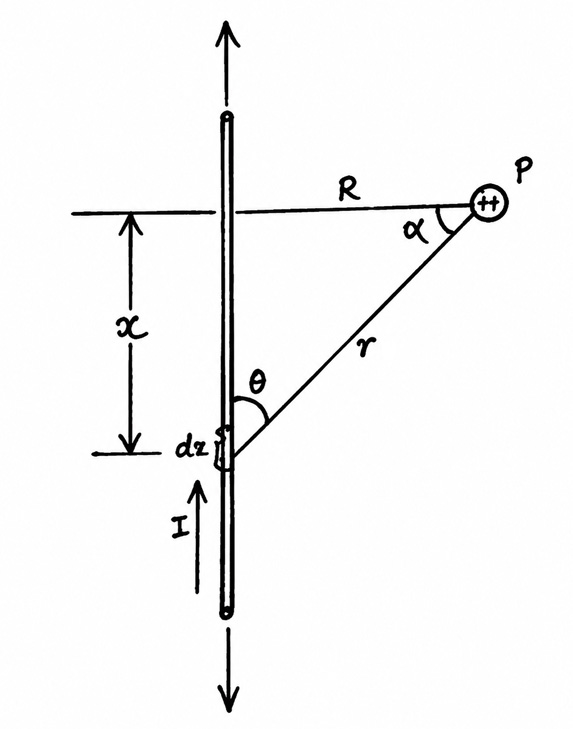
The position vector of that point from the conductor segment dx is r. This means the straight distance between point P and dx is r, and this r creates an angle θ with dx or the axis of the conductor.
If dB is the magnetic flux density at the point P. Obviously, we have considered it as an infinitesimal flux density.
Now, according to Biot-Savart’s law,
Here, μ₀ is the permeability of air surrounding the conductor. Approximately, it is equal to the permeability of free space. Thus, the value of μ₀ is
Now, we shall consider the perpendicular distance of P from the axis of the conductor as R. Additionally, x is the distance of P from dx along the axis of the conductor.
Therefore, we can write,andSo, we can rewrite the Biot-Savart expression as
The expression of flux density for a small segment of conductor dx. Therefore, for a long conductor, the magnetic field flux density at the same point P will be,
Now, we shall derive this integration step by step.
For that, we may first consider Since,Therefore,Since,
Now, we shall integrate the expression around a closed path surrounding the conductor.
Now, we know thatSo, we can write
That means the line integral of H around a conductor is nothing but the current flowing through it. This is nothing but Ampere’s Law.
If there are N conductors, each carrying current I, instead of a single conductor, we can write,From this relation, we can say that for a coil having N turns, if the current varies, the flux lines change.
According to Faraday’s law of electromagnetic induction, we know that this variation of flux linkage with respect to time is proportional to the induced emf.
Magnetic Field Inside the Conductor
Suppose the radius of the conductor is R. The current is uniformly distributed over the cross-section of the conductor. So, if we consider a cylindrical segment inside the conductor of radius r, the current flowing through this cylindrical portion will be
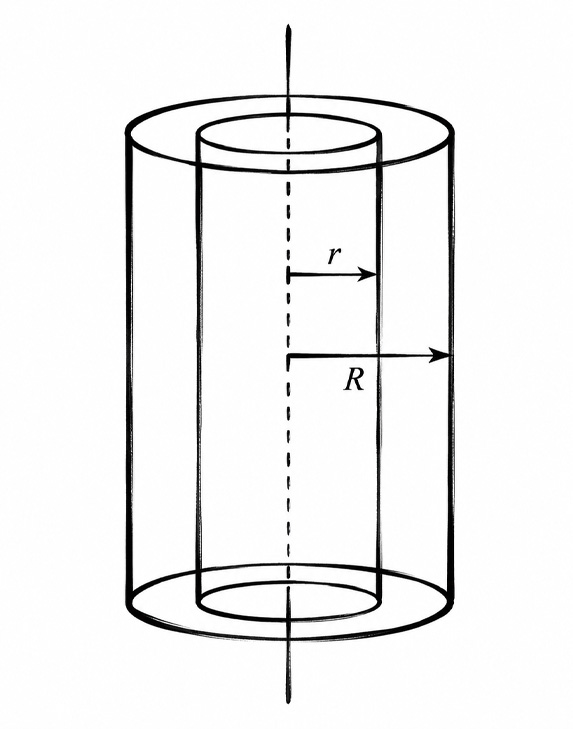
Therefore, the magnetic field intensity at a distance r from the axis of the conductor isBecause
Therefore, we can say that the magnetic field intensity inside a conductor is directly proportional to the distance from the central line of the conductor.
Magnetic Field Outside the Conductor
Now, consider a point outside the conductor. The total current of the conductor is now enclosed. If we apply Ampere’s law, we can write
Here, I is fixed and is the total current flowing through the conductor. Obviously, it does not change with the variation of distance r.
So, we can say that the magnetic field intensity is inversely proportional to the distance from the center of the conductor.
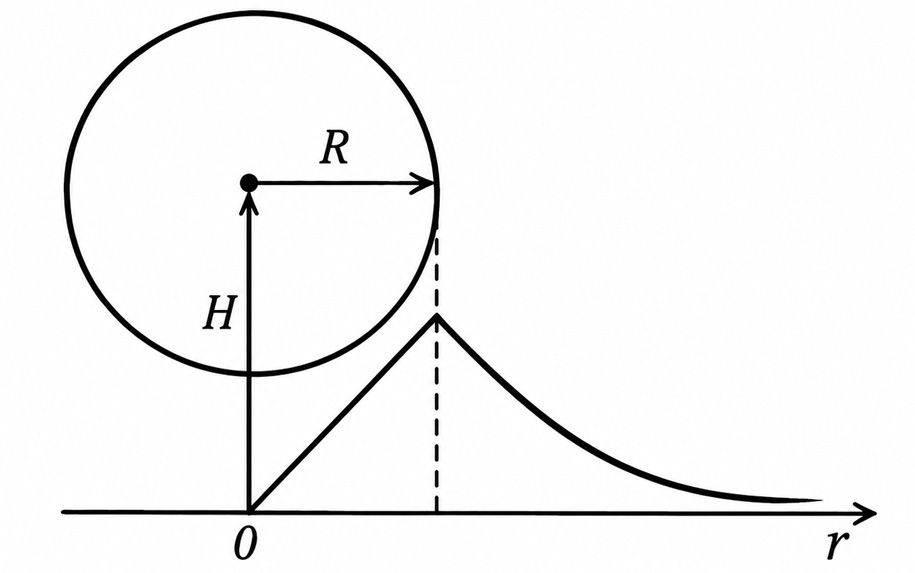
- Vertical axis: Magnetic field intensity H
- Horizontal axis: Distance r from the center of the conductor
- Radius of conductor = R
The magnetic field intensity increases linearly from the center up to R (inside the conductor). After R, the magnetic field intensity decreases inversely with distance, as shown in the graph.