Inductance of Two Conductors Transmission Line

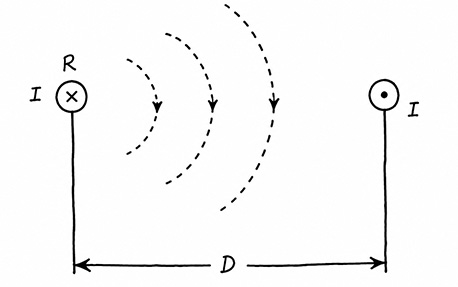
Let A be the cross-section of a conductor. The current I is flowing in the inward direction with respect to the reference plane. Suppose there is another conductor at a distance D. Here, current I is flowing outward with respect to the reference plane. Now, at conductor A, the magnetic field intensity at any point inside the conductor can be expressed as,

Inductance of Two Conductors Transmission Line


H=Ir2πR2H=\frac{Ir}{2\pi R^2}
Where, r is the distance from the center of the conductor. The magnetic flux density at distance r may be written as
B=μ0H=Iμ02πR2rB=\mu_0 H =\frac{I\mu_0}{2\pi R^2}r
So, the flux density varies with r. Therefore, the total flux lines passing through a circular strip of cross-section of thickness dr will bedϕ=Bdrd\phi=B\,dr

We have already told,I=IR2r2I’=\frac{I}{R^2}r^2So, we can writedϕ=Bdr=Iμ02πR2r2R2rdrd\phi=B\,dr = \frac{I\mu_0}{2\pi R^2} \cdot \frac{r^2}{R^2} \cdot r\,dr=Iμ0r3dr2πR4= \frac{I\mu_0 r^3dr}{2\pi R^4}
Therefore, the total internal flux linkage will beϕi=0Rdϕ\phi_i=\int_0^R d\phi=0RIμ0r32πR4dr= \int_0^R \frac{I\mu_0 r^3}{2\pi R^4}dr=Iμ02πR40Rr3dr= \frac{I\mu_0}{2\pi R^4} \int_0^R r^3dr=Iμ02πR4[r44]0R= \frac{I\mu_0}{2\pi R^4} \left[\frac{r^4}{4}\right]_0^R=Iμ02πR4R44= \frac{I\mu_0}{2\pi R^4} \cdot \frac{R^4}{4}=μ0I8π= \frac{\mu_0 I}{8\pi}
Here, you can see that the flux linkage inside the conductor is independent of the radius of the conductor.

Flux Linkage Outside the Conductor

Now, we shall derive the expression for flux linkage outside the conductor. Since one conductor carries current opposite to the other conductor, there will be no flux line that encloses both conductors. Because of that, for any distance greater than D, the total enclosed current is zero. So, there will be flux linkage only within a distance less than or equal to D. Therefore, the external flux linkage only exists from R to D for any of the conductors.
He=I2πrH_e=\frac{I}{2\pi r}B=μ0He=μ0I2πrB=\mu_0 H_e = \frac{\mu_0 I}{2\pi r}
Now, assume the flux density between these two conductors is uniform for a distance dr. If we consider one unit length of conductor,dϕ=Bdr×1=Bdrd\phi=B\,dr\times 1 = B\,dr
Since we are calculating for one conductor only, the number of turns enclosed by this flux is one.
dϕ=Bdrd\phi=B\,dr=μ0I2πrdr= \frac{\mu_0 I}{2\pi r}dr
Therefore, the total external flux will be
ϕe=RDRμ0I2πrdr\phi_e = \int_R^{D-R} \frac{\mu_0 I}{2\pi r}dr =μ0I2πRDRdrr= \frac{\mu_0 I}{2\pi} \int_R^{D-R}\frac{dr}{r}=μ0I2π[lnr]RDR= \frac{\mu_0 I}{2\pi} [\ln r]_R^{D-R}=μ0I2π[ln(DR)lnR]= \frac{\mu_0 I}{2\pi} [\ln(D-R)-\ln R]=μ0I2πlnDRR= \frac{\mu_0 I}{2\pi} \ln\frac{D-R}{R}Now RRR is much smaller than D.

So,DRDD-R \approx DTherefore,ϕe=μ0I2πlnDR\phi_e = \frac{\mu_0 I}{2\pi} \ln\frac{D}{R}

Total Flux Linkage

Therefore, the total flux linkage isϕi+ϕe=μ0I8π+μ0I2πlnDR\phi_i+\phi_e = \frac{\mu_0 I}{8\pi} + \frac{\mu_0 I}{2\pi} \ln\frac{D}{R}
Therefore, the total flux linkage due to two conductors is
2(ϕi+ϕe)=2[μ0I8π+μ0I2πlnDR]2(\phi_i+\phi_e) = 2 \left[ \frac{\mu_0 I}{8\pi} + \frac{\mu_0 I}{2\pi} \ln\frac{D}{R} \right]

Inductance of Two Conductors Transmission Line

Now we know thatLI=ϕNL I=\phi NL=ϕI[N=1]L=\frac{\phi}{I} \qquad [N=1]

Hence,L=2[μ0I8π+μ0I2πlnDR]IL= \frac{ 2\left[ \frac{\mu_0 I}{8\pi} + \frac{\mu_0 I}{2\pi} \ln\frac{D}{R} \right] }{I}=μ04π+μ0πlnDR= \frac{\mu_0}{4\pi} + \frac{\mu_0}{\pi} \ln\frac{D}{R}=μ04π[1+4lnDR]= \frac{\mu_0}{4\pi} \left[ 1+4\ln\frac{D}{R} \right]Now,μ0=4π×107 H/m\mu_0=4\pi\times10^{-7} \text{ H/m}
Therefore, inductance per unit length of the transmission conductor of a two-wire system is
L=μ04π[1+4lnDR]L= \frac{\mu_0}{4\pi} \left[ 1+4\ln\frac{D}{R} \right]=4π×1074π[1+4lnDR]= \frac{4\pi\times10^{-7}}{4\pi} \left[ 1+4\ln\frac{D}{R} \right]=(1+4lnDR)×107= \left( 1+4\ln\frac{D}{R} \right) \times10^{-7}Now,4lne1/4=14\ln e^{1/4}=1Therefore,L=[4lne1/4+4lnDR]×107L= \left[ 4\ln e^{1/4} + 4\ln\frac{D}{R} \right] \times10^{-7}=4×10⁷ln(DRe1/4) H/m= 4\times10^{-7} \ln\left(\frac{D}{R}e^{1/4}\right) \text{ H/m}=4×107ln(DRe1/4) H/m= 4\times10^{-7} \ln\left(\frac{D}{Re^{-1/4}}\right) \text{ H/m}LetR=Re1/4R’=Re^{-1/4}ThenL=4×107lnDR H/mL= 4\times10^{-7} \ln\frac{D}{R’} \text{ H/m}Here, R′ is the radius of a fictitious conductor. Obviously, it has no internal flux linkage, but it has the same inductance as the actual conductor.e1/4=0.7788e^{-1/4}=0.7788
The multiplying factor 0.7788 used to adjust the radius in order to account for internal flux linkage applies only to solid round conductors.