
The storage of fossil fuel like coal is going to be finished in near future. So, we need an alternative source of energy for large scale electric energy generation. This is where nuclear energy comes into picture. Many developed and developing countries have found the tremendous capability of electricity generation of nuclear power.
Theory of Nuclear Reactor
The basic theory of a nuclear power plant is somewhat similar to that of a coal or other kind of thermal power plant. When Uranium-235 faces bombarding with neutrons, fission reaction starts. This fission releases neutrons and heat energy. Then, these released neutrons participate in the chain reaction of fissioning more atoms of 235U.
Moderator
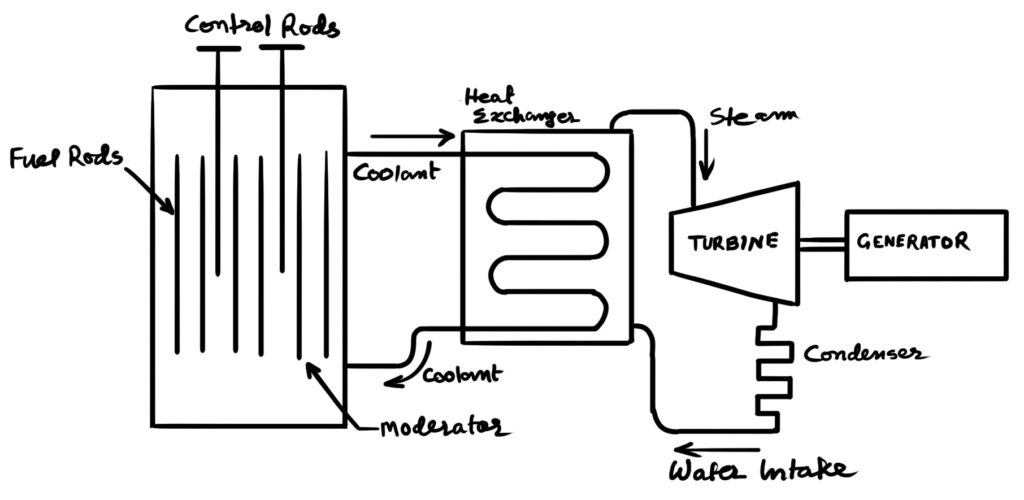
The neutrons that released during fusion are very fast moving. These ultra-high-speed neutrons are not effective for further fission process. So, the fast neutrons first pass through the moderator. The moderator slows them down to thermal neutron speed. These slower neutrons are more effective in causing additional fission reactions. Common moderator materials are ordinary water (H₂O), heavy water (D₂O) or graphite.
Controller
As it is a chain reaction, fission of uranium releases neutrons which cause further fission to release more neutrons. So, very soon the process reaches to a critical situation. Therefore, we need some arrangement to control the reaction within limit. Rods made of neutron-absorbing material (boron-steel) play the role. We refer to these rods as control rod. Whin we insert the rods into the reaction vessel these absorb neutrons to reduce fissions hence reduce nuclear reaction speed.
Heat Exchanger
There is a heat exchanger. The heat exchanger takes the generated heat during nuclear reaction, then transport it to turbine. The heat exchanger uses coolant for the purpose. It commonly uses water as the primary coolant. The coolant circulates in the reactor section and takes heat. This heat exchanger supplies high pressure steam to turbine.
Generation of Electricity in Nuclear Power Plant
This high-pressure steam then rotates a steam turbine. This rotating turbine generates heat in a conventional manner by means of an alternator.