
Hydroelectric power is the oldest and cheapest method of large-scale electricity generation. Remarkably, it runs entirely on water. Furthermore, it produces zero direct emissions. Best of all, it costs almost nothing to operate once built. In addition to power generation, most hydro projects also control floods, store irrigation water, and support navigation — all simultaneously.
Working Principle and Power Formula
Water stored at a height holds gravitational potential energy. When released downward through a controlled path, it gains speed rapidly. That moving water then strikes a turbine. As a result, the turbine spins. Consequently, the coupled generator produces electricity.
The vertical drop between the reservoir surface and the turbine outlet is called the head. Simply put, a greater head means more power. Engineers express this relationship with a straightforward formula:
P = g · ρ · W · H (Watts)
Here, g = 9.81 m/s²,
ρ = 1000 kg/m³,
W = discharge in m³/s, and
H = head in meters.
Notably, modern turbines convert 90–95% of this energy into electricity. Therefore, hydropower ranks among the most efficient energy technologies on earth.
Types of Hydroelectric Power Plants
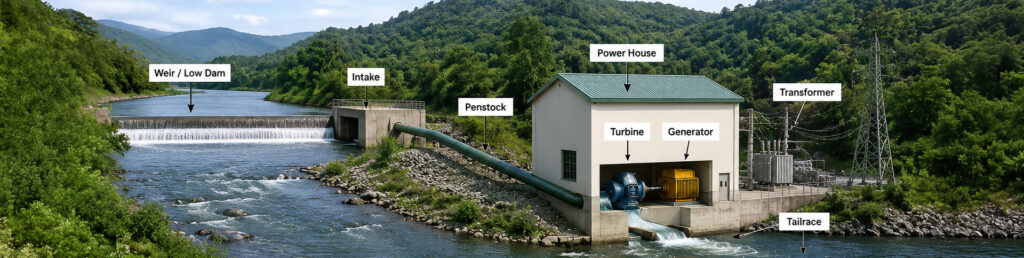
Run-of-River Plants use water exactly as it flows in the river. They store nothing at all. Therefore, output drops sharply during dry seasons. For this reason, these plants suit rivers with stable year-round flow. Specifically, they use Kaplan turbines.
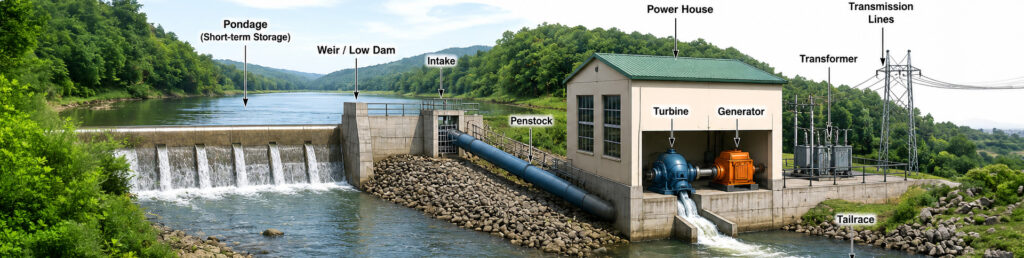
Pondage Plants, on the other hand, store a few days of river flow. Consequently, operators release water during peak demand and hold it back during low demand. These plants use Francis turbines.
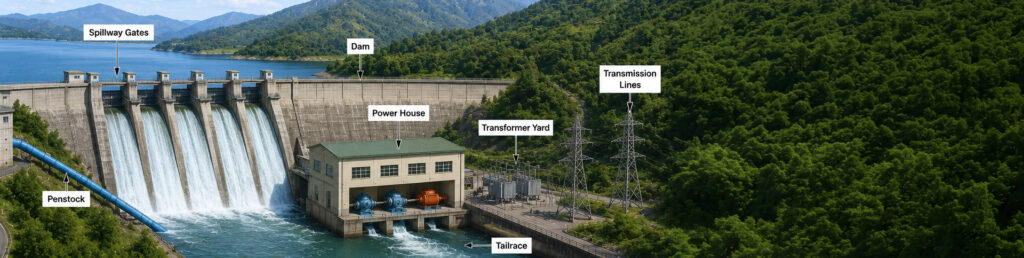
Reservoir Plants store water for weeks or entire seasons. As a result, operators control generation precisely at any time of year. Furthermore, Pelton turbines serve the highest-head reservoir plants. Above all, these plants handle bulk power supply most effectively.
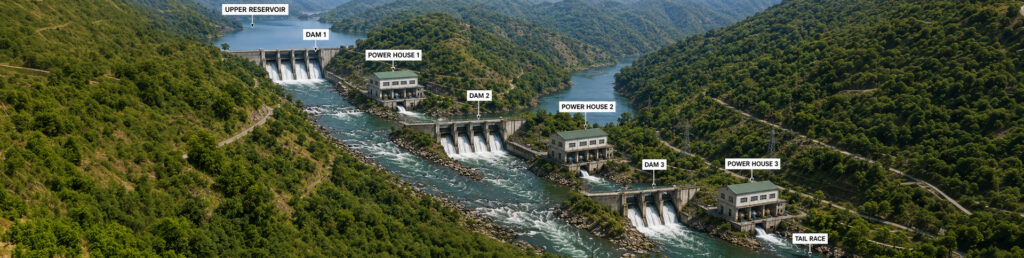
Cascaded Plants sit in series along the same river. Specifically, the tailwater of one plant feeds the next one downstream. In this way, engineers extract maximum energy from the river’s total elevation drop.
Pumped Storage Power Plant
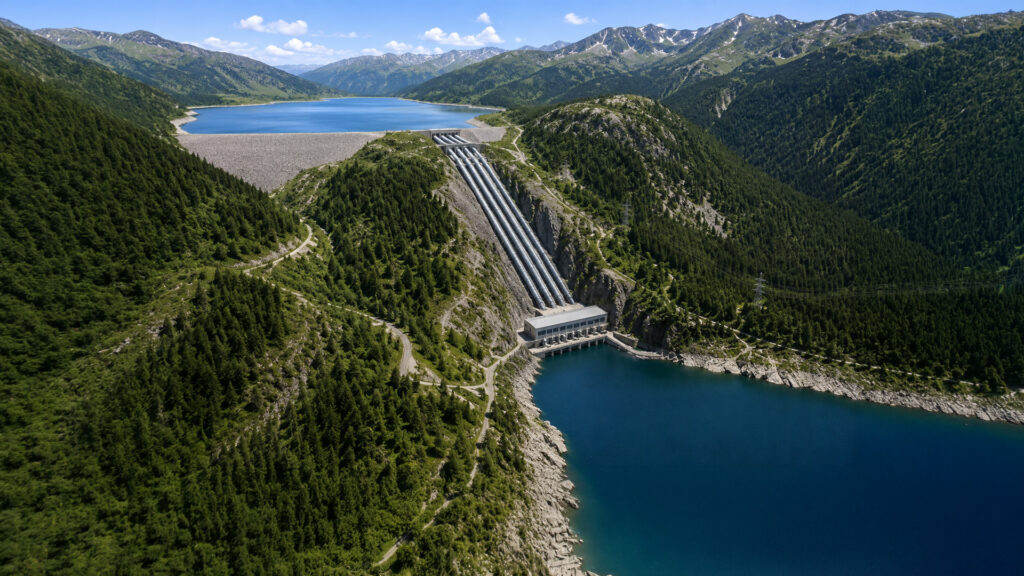
Pumped storage plants work like giant rechargeable batteries. During off-peak hours, they pump water upward from a lower to an upper reservoir. Then, during peak demand, they release that stored water back through the turbines to generate electricity. As a result, the round-trip efficiency reaches 60–70%. Moreover, the machines also supply reactive power to stabilize grid voltage even when idle. For example, India operates the 1,100 MW Srisailam plant in Andhra Pradesh and the 80 MW Bhira plant in Maharashtra as major pumped storage facilities.
Advantages of Hydroelectric Plants
- Fuel costs nothing — water is free and renewable
- Furthermore, operations produce zero direct emissions
- Units reach full load in just ~5 minutes
- In fact, operators connect to the grid in as little as ~2 minutes
- Additionally, load uptake hits ~20 MW/min — ideal for sudden grid emergencies
- Finally, plants operate reliably for 50–100+ years
Challenges of Hydroelectric Plants
- However, initial civil construction demands very high capital investment
- Moreover, projects take 5–8 years from planning to first generation
- Over time, reservoirs silt up progressively — Bhakra’s dead storage silted fully within 30 years
- Meanwhile, seepage weakens dam foundations and causes water loss
- Additionally, dams disrupt river ecosystems and block fish migration
- As a consequence, reservoir flooding displaces communities from their homes
- Finally, without large seasonal storage, plants struggle to supply steady baseload power
Summary
Hydroelectric power delivers clean, efficient, and remarkably durable electricity. Additionally, pumped storage extends its role further by actively balancing the entire grid. However, engineers and planners must seriously address silting, ecological disruption, and community displacement. Nevertheless, when managed responsibly, hydroelectric plants stand as one of the most reliable and cost-effective investments in any modern power system.