
Due to limited resources and pollution concerns, wind and solar power plants are now being integrated into the grid in increasing numbers. As a result, the share of power generated by these non-conventional plants is growing significantly. However, wind and solar generation is uncontrolled, as it is governed mainly by wind and sunlight, respectively. These plants often generate power when demand is low.
Therefore, power systems need ways to store surplus energy and return it when it is required. Compressed Air Energy Storage (CAES) is one of the few technologies, alongside pumped hydro, that can do this. The main advantage of this system is that it can store electrical energy on a much larger scale than BESS. It can operate at a scale of hundreds of megawatts for many hours at a time.
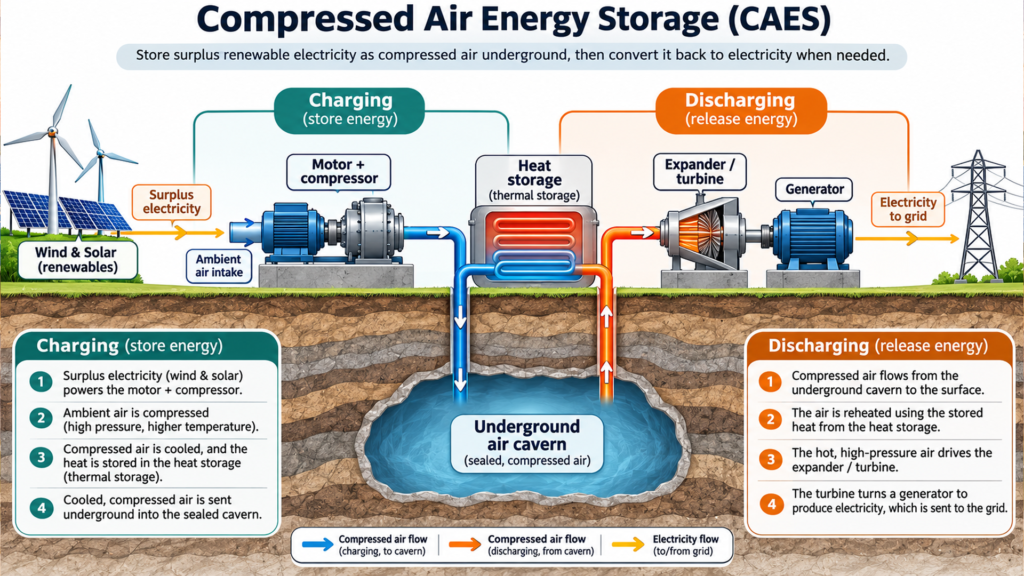
How Does a Compressed Air Energy Storage System Work?
CAES stores electrical energy as potential energy in pressurised air held in a reservoir. When renewable output exceeds demand, a motor-driven compressor pushes atmospheric air into a large reservoir. This is usually an underground salt cavern, a depleted gas reservoir or an aquifer, at pressures of roughly 40–80 bar. When power is needed, the air is released, heated and expanded through a turbine. The turbine is coupled to a generator, which feeds electricity back into the grid.
Compression heats the air strongly, while expansion in the turbine cools it significantly.
Types of CAES
- Diabatic CAES: Compression heat is rejected to the atmosphere through intercoolers. During discharge, the air is reheated by burning natural gas before it enters the turbine. The design is simple and proven, but it depends on fossil fuel and has a round-trip efficiency of only about 42–54%.
- Adiabatic CAES (A-CAES): Compression heat is captured in a thermal store (molten salt, oil, pressurised water or a rock bed) and returned to the air during expansion. No fuel is burned, and efficiencies of 60–70% are targeted.
- Isothermal CAES: The air is kept near a constant temperature through continuous heat exchange, for example with water sprays. It promises high efficiency but remains experimental and small in scale.
Compressed Air Energy Storage Plants in Operation
The world’s first commercial CAES plant opened at Huntorf, Germany, in 1978. It uses two salt caverns and was originally rated at 290 MW. The McIntosh plant in Alabama, USA (1991, 110 MW) can generate for up to 26 hours and adds a recuperator that recovers turbine exhaust heat to cut fuel use. In recent years, China has built several large, advanced, fuel-free plants of 100 MW and more, including a 300 MW salt-cavern facility in Hubei province, marking a revival of the technology.
Advantages of CAES
- It offers large capacity and long discharge duration at a low cost per kWh stored.
- CAES has service life of 40 years or more, with little capacity fade.
- It is built from conventional, well-understood turbomachinery.
- The synchronous generators of CAES provide inertia, frequency support and reactive power, which inverter-based batteries cannot inherently offer.
Limitations of CAES
- Here, suitable underground geology is needed, which restricts where plants can be sited.
- Its round-trip efficiency stays below that of lithium-ion batteries (85–90%).
- Diabatic plants still emit CO₂, because they burn fuel to heat the air before it enters the turbine.
- It has high capital cost and long development timelines.