
We usually assume that the conductors are suspended in free space. This assumption makes the mathematical derivation simple. However, in real-world overhead transmission, conductors are strung above the earth. Therefore, the earth influences the electric field around the conductors. Consequently, it slightly changes the capacitance of the line.
To account for this effect without making the mathematical calculations too complicated, electrical engineers use an elegant technique known as the Method of Images. This method was first proposed by Lord Kelvin and is widely used in electrostatics and transmission line analysis.
In this article, we will understand the effect of the earth on transmission line capacitance, the principle behind the Method of Images, and its application to both single-phase and three-phase transmission lines.
Why Does the Earth Affect Transmission Line Capacitance?
An overhead transmission line is always suspended several metres above the ground. The earth is not an insulating medium; instead, it behaves like a conducting surface maintained at zero electrical potential.
Whenever a conductor carries an electric charge, it creates an electric field around it. If the conductor were suspended in free space, the electric field would spread uniformly in all directions.
However, the presence of the earth changes the electric field distribution because the ground remains at zero potential. Consequently, the electric field lines terminate on the earth, which modifies the voltage between conductors. Since capacitance depends on both charge and voltage, the capacitance also changes.
Therefore, for accurate capacitance calculations, especially in theoretical analysis, the effect of the earth should be considered.
The Challenge in Calculating the Earth Effect
Directly calculating the electric field in the presence of the earth is mathematically difficult because the conducting ground continuously influences the electric field produced by the transmission line conductors.
Instead of solving this complex electrostatic problem, engineers replace the earth with an equivalent mathematical model called the Method of Images.
What is the Method of Images?
The Method of Images is a mathematical technique used to simplify electrostatic calculations involving conducting surfaces.
Instead of considering the actual earth, an imaginary conductor, called the image conductor, is assumed below the ground.
The image conductor has the following properties:
- It is located exactly the same distance below the ground as the actual conductor is above it.
- It carries an equal magnitude of charge.
- Its polarity is opposite to that of the real conductor.
For example, if a conductor carrying a charge of +q is located 10 metres above the ground, an imaginary conductor carrying −q is assumed 10 metres below the ground.
Although this conductor does not physically exist, it produces exactly the same electric field above the ground as the actual earth.
This simple assumption converts a difficult electrostatic problem into a much easier one.
Capacitance of a Single-Phase Transmission Line
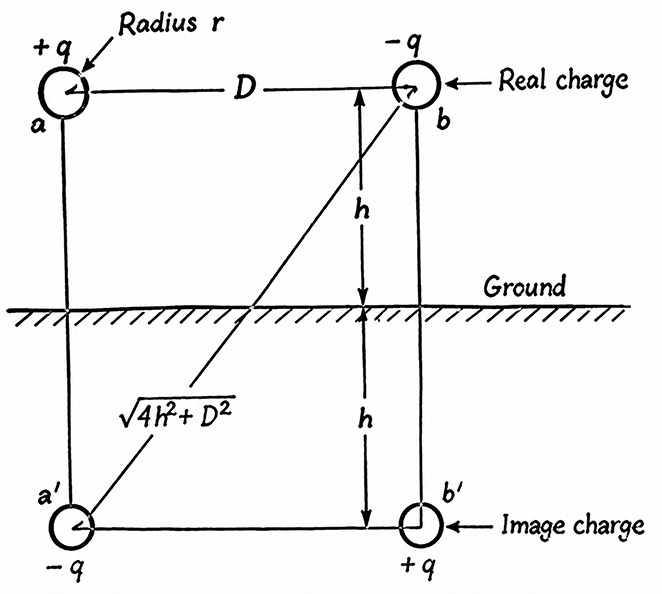
Consider a single-phase transmission line consisting of two conductors separated by a distance D.
One conductor carries a positive charge +q, while the other carries an equal negative charge −q.
When the earth effect is considered, each conductor has its corresponding image below the ground.
Therefore, four charges contribute to the electric field:
- Real conductor A
- Real conductor B
- Image of conductor A
- Image of conductor B
By considering the electric potential due to all four charges, the voltage between the conductors is obtained as
where:
- = charge on each conductor
- = height of the conductor above the ground
- = spacing between conductors
- = conductor radius
Capacitance Between Conductors
Since capacitance is defined asThe line-to-line capacitance becomesSimilarly, the capacitance from one conductor to neutral isThese equations clearly show how the conductor height above the ground affects the capacitance.
Physical Interpretation of the Equation
Rather than memorising the equations, it is important to understand their physical meaning. Notice the additional termThis term appears only because the earth has been considered. The earth modifies the electric field surrounding the conductor, which effectively changes the electrical geometry of the transmission line.
As a result, the voltage between conductors decreases slightly for the same amount of charge. Since capacitance is equal to charge divided by voltage, the capacitance increases slightly. Therefore, the presence of the earth always increases the capacitance of an overhead transmission line.
When Can the Earth Effect Be Neglected?
In practical transmission systems, the conductor height is usually much greater than the spacing between conductors. Mathematically,Under this condition,Becomes extremely small. Therefore,As a result, the capacitance equation becomes almost identical to the equation derived without considering the earth. This is why the earth effect is generally neglected in routine transmission line calculations.
Capacitance of a Three-Phase Transmission Line
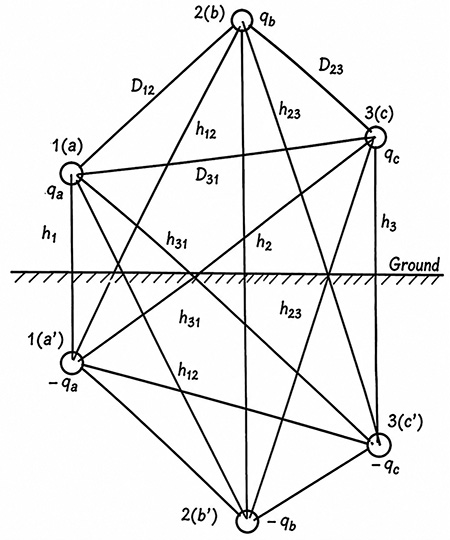
The Method of Images can also be applied to a three-phase transmission line. Each of the three conductors has one corresponding image conductor below the ground. Therefore, six conductors are considered during the analysis. For a fully transposed transmission line, the average voltage over one complete transposition cycle is calculated. The resulting capacitance to neutral iswhere:
- is the equivalent spacing or GMD.
- and are the heights of the three conductors above the ground.
- and represent the distances between each conductor and the image of another conductor.
Although this equation appears complicated, the basic principle remains the same: the earth slightly increases the capacitance by modifying the electric field.
Advantages of the Method of Images
The Method of Images offers several advantages in transmission line analysis:
- It replaces a complex electrostatic problem with a simpler mathematical model.
- It accurately represents the effect of the conducting earth.
- It simplifies the derivation of voltage and capacitance equations.
- It is applicable to both single-phase and three-phase transmission lines.
- It is widely used in electrical engineering, high-voltage engineering, and electromagnetic field analysis.
Video on the Effect of Earth on Transmission Line Capacitance