
A positive charge attracts a negative charge. Also, a negative charge attracts a positive charge. It is needless to say the force of attraction depends upon the quantity of charges. Also, it depends on the distance between the charges. Similarly, similar charges repel each other. That means a positive charge repulses another positive charge. Similarly, a negative charge repulses another negative charge. In the same way, the repulsion force also depends on the quantity of similar charges and the distance between them. We call this force as electrostatic force.
We should introduce some technique to quantify this force. This is where the concept of electric field intensity comes into picture. Suppose, there is a positive charge +Q coulombs.

Now, we place a positive unit charge in a nearby space of the charge +Q. Obviously, this unit positive charge experiences a force due to the charge +Q coulombs. Obviously, this force acts along the straight line connecting the center of charge +Q and the unit positive charge. The force is directed away from the +Q charge.
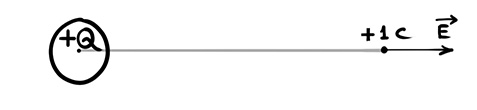
This electrostatic force acting on the unit positive charge, is the electric field intensity at that point. We also refer it as simple electric field. Often we also call it as electric field strength.
Also, we can prove it is equal to the potential gradient at that point. Also, we call it as voltage gradient.
The concept of electric field lines
What are the electric field lines?
We have already told that the electric field intensity is the electrostatic force acting on a positive unit charge. Now, if we allow the positive unit charge to move freely. It will move due to the influence of that force. The trace of the path following which the positive unit charge moves is referred to as electric field line.
Suppose, we place the positive unit charge at any arbitrary point on the surface of the charge +Q. Obviously, that will follow a definite straight path originated from the center of charge +Q. Now, if we relocate the positive unit charge to any other point on the surface of charge +Q, it will follow a new straight path originated from the same center of +Q charge.
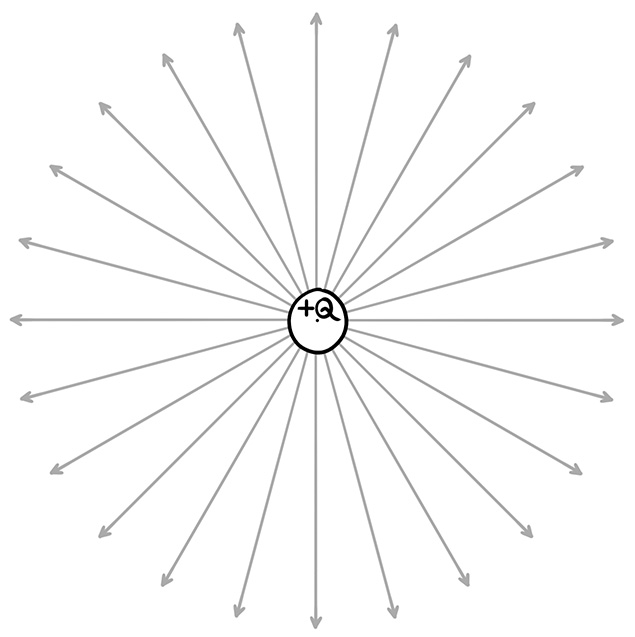
As theoretically there are infinite numbers of points available on the charge body of +Q, there will be virtually infinite numbers of electric field lines generated from the charge +Q. So, quantifying the charge and electric field strength by lines of force becomes confusing. This is where Gauss’s theorem comes.
Concept of Gauss’s theorem
Consider a point on the surface of a sphere surrounding . The electric field intensity, i.e., the electric force experienced by a positive unit charge at that point isSimilarly, we consider one point on the surface of the sphere surrounding charge . The electric field at that point will beSince ,Now, we consider that there is an infinite number of field lines radiated from the centers of both the charges and . In that case, it becomes impossible to quantify the electric field at those points by the number of field lines.
Actually, we can also define an electric field by the number of field lines passing perpendicularly through a unit area with the center of the area at that point, where we are defining the electric field.
In both cases that would be infinity. So, it becomes confusing to predict the field at any point by electric field lines. Gauss’s law overcomes this mathematical confusion by defining the number of field lines passing through a unit area to determine the electric field intensity at that point.
Gauss’s Theorem
This theorem says that the total number of electric field lines, or electric lines of force, radiated from a charge equals the charge divided by the permittivity of the medium surrounding the charge. Suppose there is a charge placed at the center of an imaginary sphere of radius . Therefore, the electric field intensity at a point on the surface of the sphere will beNow, we consider there are numbers of electric lines of force passing through the unit area at that point. The total surface area of the sphere isSo, the total number of lines of force radiated from the surface will beAs we told, electric field is numerically equal to the number of field lines passing through a unit area around that point. So, we can say,Now, from the expression of field intensity at that point,We can write,Therefore, from equation (1),Where \(\epsilon_0\epsilon_r\) is the absolute permittivity of the medium.
So, we have seen that the total number of electric field lines radiated from a charge is the ratio of that charge to the medium permittivity. If we consider an infinitely small area on the surface,Obviously, for a sphere, the total surface isFor any surface, which is irregular, the same equation is valid.
Statement of Gauss’s Theorem
When a charge is enclosed by an imaginary surface, the total number of lines of force, or total electric flux, is the closed integral of the electric field over the entire surface enclosing the space, and that equals the total charge divided by the permittivity of the medium. So,