
Wheatstone bridge is a resistance measurement arrangement. It uses four resistors, out of which one is unknown. It measures the unknown resistance with the help of the rest of the three resistors. The Wheatstone bridge consists of these four resistors as the sides of a square, as shown below.
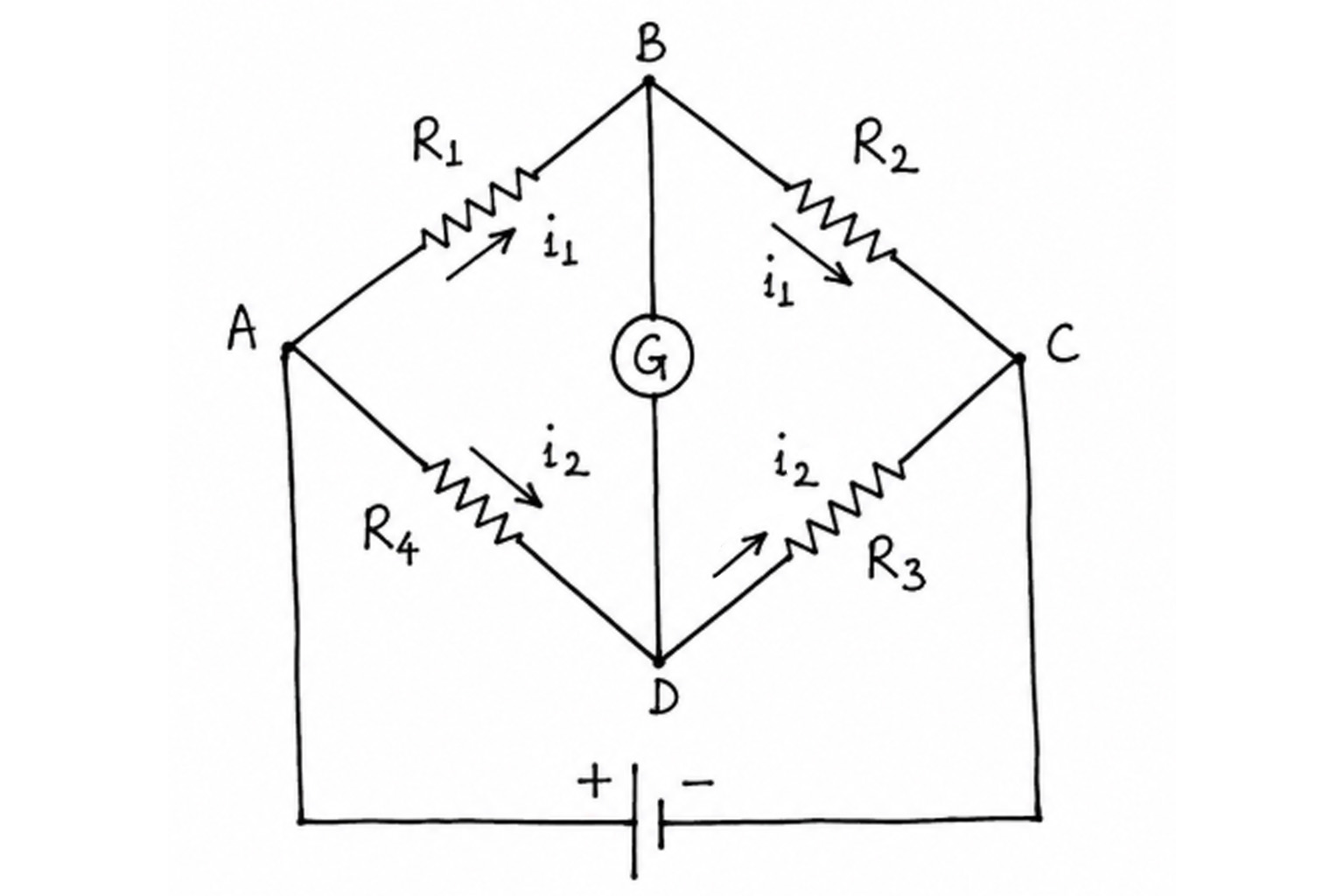
Wheatstone bridge with resistors \(R_1\), \(R_2\), \(R_3\) and \(R_4\). We connect one battery diagonally across the square that is between A and C. Then we connect one galvanometer (G) across the other diagonal BD, of the square.
Galvanometer
A galvanometer is an analog current-measuring instrument. Its needle or pointer deflects whenever there is a current flowing through the galvanometer. So, the pointer points at zero when there is no current flowing through it.
Video Lecture on Wheatstone Bridge
Circuit of Wheatstone Bridge
Now, say current \(i_1\) is flowing through resistor \(R_1\). At the same time current \(i_2\) flows through resistor \(R_4\). The unknown resistance \(R_2\) is connected between B and C. Then, there is a variable resistance connected between D and C. Say, \(R_3\) is the variable resistance. So, for a particular value of \(R_3\), there will be the same potential across both node B and node D. Since, the potential difference across the galvanometer becomes zero, the pointer of the galvanometer shows a null deflection.
Principle of Wheatstone Bridge
At that condition, potential of node B in respect of node A is \(V_{BA}= R_1i_1\). On the other hand, potential of point D in respect of node A, is \(V_{DA}= R_4i_2\). Since, both the potentials are the same, we can write, \[ R_1i_1= R_4i_2\]\[\Rightarrow \frac{i_1}{i_2}=\frac{R_4}{R_1}\cdot\cdot\cdot(1)\]
Now, we calculate the potential level of node B and D in respect of node C. The potential of node B in respect of C is \(V_{BC}=R_2i_1\). The potential of node D in respect of C is \(V_{DC}=R_3i_2\). As the potential of node B and D is equal, we can write, \[R_2i_1=R_3i_2 \]\[\Rightarrow \frac{i_1}{i_2}=\frac{R_3}{R_2}\cdot\cdot\cdot(2)\]
From equation (1) and (2), we can write, \[\frac{i_1}{i_2}=\frac{R_4}{R_1}=\frac{R_3}{R_2}\]\[\Rightarrow \frac{R_1}{R_4}=\frac{R_2}{R_3}\]\[\Rightarrow \frac{R_1}{R_2}=\frac{R_4}{R_3}\]\[\Rightarrow R_2=\frac{R_1\times R_3}{R_4}\]
Here, \(R_2\) is the unknown resistance, and we know the value of \(R_1\), \(R_3\) and \(R_4\). So, we can easily calculate the value of \(R_2\). This is the basic theory of Wheatstone bridge.
Example
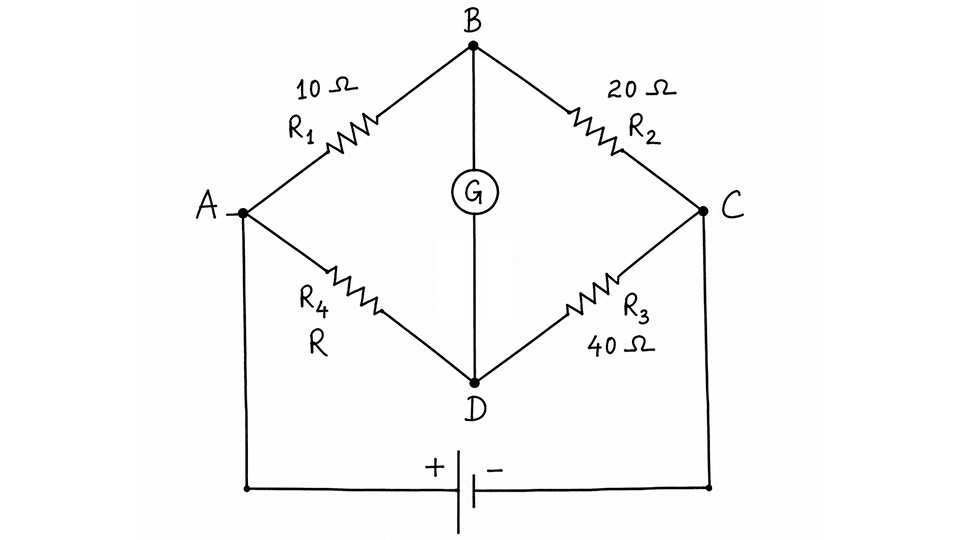
In the above circuit, \(R_1\) and \(R_2\) are two known resistances, say 10 \(\Omega\) and 20 \(\Omega\). \(R_4\) is the resistor whose resistance value is to be determined. By adjusting the variable resistance \(R_3\) at 40 \(\Omega\), the Wheatstone bridge becomes balanced. So, from the principle of Wheatstone bridge, we can write, \[20=\frac{10 \times 40}{R}\]\[\Rightarrow R=\frac{10 \times 40}{20} = 20 \;\Omega \]
From the above experiment, we can conclude that, under balanced conditions, the ratio of the two series resistances connected across the battery source is equal. For each reading, the ratio of the two resistances connected on either side of the galvanometer is the same.
Hence, the common point B connects \(R_1\) and \(R_2\), and the galvanometer. Similarly, the common point D connects \(R_3\) and \(R_4\) and the other terminal of the galvanometer.
Therefore, \(R_1:R_2=R_4:R_3\)
For a different point of null, we can also conclude that, no matter how we connect the resistances, the resistance of one side of the battery equals in ratio to the resistance connected to the other side of the battery.