
What is the main purpose of a power transformer?
A power transformer is mainly used to transfer power from one voltage level to another voltage level for transmission or sub-transmission purposes. Power transformers are of two types: step-up transformers and step-down transformers.
A step-up transformer increases the voltage level of the generated power from the generating station to the transmission network for efficient transmission of power toward the load end. At the load end, the step-down transformer further reduces the voltage level for sub-transmission or distribution purposes.
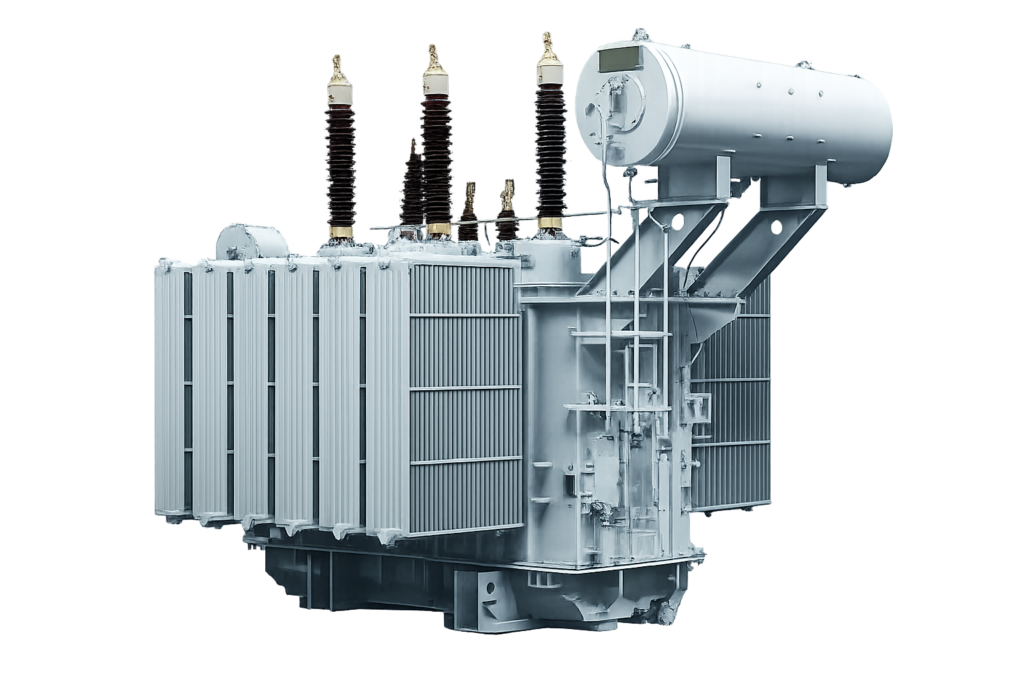
The efficiency level of a power transformer must always be kept very high. This is one of the main criteria of a power transformer. Another important point is that a power transformer generally steps up or steps down the voltage level only for transmission and sub-transmission purposes, usually up to 11 kV. Below this level, transformers that reduce the voltage from the 11 kV sub-transmission system to 415 volts or lower distribution supply voltage are not considered power transformers. These are categorized as distribution transformers.
So, what have we learned? A power transformer only steps up or steps down power for transmission and sub-transmission purposes, and the efficiency level of that transformer is always kept very high.
What is the difference between a power transformer and a distribution transformer?
A power transformer deals with a significant quantity of power, ranging from a few MVA to several hundred MVA, whereas the power handling capability of a distribution transformer is comparatively low. It is generally from a few kVA up to around 1.5 MVA.
Power transformers are mainly used for transmission and sub-transmission purposes. On the other hand, distribution transformers mainly transform the 11 kV voltage level to the supply voltage level, which is 415 volts line-to-line and 220 volts line-to-neutral at the consumer end.
A power transformer is designed to operate always at full-load condition or near full-load condition. Whereas, a distribution transformer is designed to operate around 50% of its full-load condition. The efficiency of a distribution transformer is generally expressed in terms of its all-day efficiency parameter.
These are the main differences between a power transformer and a distribution transformer. In one sentence, we can say that power transformers are used in transmission and sub-transmission networks, whereas distribution transformers are installed between the upstream substations and the final distribution network.
Why are transformers rated in kVA or MVA and not in kilowatts or megawatts?
Actually, the rating, or rather the current rating, of any electrical equipment depends upon its thermal limit, which means the maximum permissible temperature rise limit of the conductor. Therefore, a transformer is designed in such a way that the winding temperature must remain within a limit of around 90 degrees centigrade. That means the transformer can carry only that much current which causes the maximum temperature rise of the winding up to this permissible limit.
Now, let us come to real power. Real power has three factors:
Where cos φ is the power factor. The power factor is not under the control of the transformer. It solely depends upon the reactive nature of the connected load.
The next factor is voltage, which is more or less fixed for a power transformer. Therefore, the temperature rise limit of the transformer mainly depends upon the copper loss, or I²R loss, where I is the load current.
The heating effect depends upon current and not on the power factor.
Again, the core loss of a transformer mainly depends upon the voltage rating of the transformer. Core loss also contributes heat in the transformer. That is why both voltage and current are included in the rating of a transformer, but the power factor is not included. Therefore, transformers are rated in kVA or MVA instead of kilowatts or megawatts.
What are the main parts of a power transformer?
The main parts of a transformer are the core and the windings. The core and winding assembly are immersed in transformer oil for cooling and insulation purposes. The oil is contained inside the main transformer tank.
During transformer operation, heat is generated in the core and windings due to electrical losses. This heat is transferred to the transformer oil. To dissipate the heat into the surrounding atmosphere, natural or forced oil circulation is used. For this purpose, radiator banks are attached to the transformer tank. In large transformers, cooling fans and oil pumps are also used to improve the cooling performance.
As the load on the transformer changes, the temperature and volume of the oil also change. To accommodate the expansion and contraction of oil, a conservator tank is fitted on the main tank. A breather is also connected to the conservator system to prevent moisture from entering the transformer oil.
To regulate the output voltage, tap changers are used in transformers. In large power transformers, On-Load Tap Changers (OLTCs) are commonly used. These OLTC systems generally consist of a tap selector mechanism and a separate diverter switch compartment.
Transformers are also equipped with several protective devices. Among them, the Buchholz relay and Pressure Relief Device (PRD) are very important. The Buchholz relay operates when internal faults inside the transformer generate gas or cause sudden oil movement. The PRD protects the transformer by releasing excessive pressure caused by severe internal faults.
In addition, transformers are fitted with oil temperature indicators and winding temperature indicators for continuous monitoring. These are the main parts and accessories of a transformer.
What is the working principle of a transformer?
The working principle of a transformer is quite simple. It depends upon the mutual induction between two windings linked through a common magnetic core.
When an alternating voltage is applied across one winding, known as the primary winding, an alternating magnetic flux is produced inside the magnetic core. This magnetic flux links with the other winding wound on the same core.
Due to the continuous change of magnetic flux with respect to time, an electromotive force, or EMF, is induced in the second winding according to Faraday’s law of electromagnetic induction. This winding, which is not directly connected to the power source, is called the secondary winding of the transformer.
The output voltage of the transformer depends upon the number of turns in the secondary winding with respect to the primary winding. Therefore, by changing the turns ratio, the transformer can either step up or step down the voltage level.
What is the transformer turns ratio?
Whenever an alternating voltage is applied across a transformer winding, it creates an alternatingly changing magnetic flux inside the core. Because of this changing flux, an EMF is induced in each turn of the winding according to Faraday’s law of electromagnetic induction.
The same magnetic flux links with all the turns wound on the same core. So, in each turn, the rate of change of flux linkage remains the same. Therefore, the same voltage is induced per turn in both the primary and secondary windings.
So, the total voltage induced across the primary winding will be proportional to the number of turns in the primary winding and the rate of change of flux linkage. Similarly, the voltage induced in the secondary winding will be proportional to the number of turns in the secondary winding and the same rate of change of flux linkage. Therefore, the voltage appearing across the secondary winding with respect to the primary winding depends upon the turns ratio of the transformer.
This is called the voltage ratio of the transformer.
Similarly, the current ratio is inversely proportional to the turns ratio.
So, the transformer current transformation ratio is the inverse of the voltage transformation ratio.
What is the relation between voltage ratio and turns ratio?
The voltage ratio and turns ratio of a transformer are ideally equal to each other, but practically they differ slightly. Actually, the turns ratio is equal to the ratio of the induced EMF in the primary winding to the induced EMF in the secondary winding. Therefore, we can write,
This means the ratio of the induced voltages in the primary and secondary windings is exactly equal to the turns ratio of the transformer.
However, in a practical transformer, the voltage applied across the primary winding experiences a voltage drop due to the resistance and leakage reactance of the primary winding. The remaining voltage appears across the winding and is opposed by the induced EMF in the primary winding.
Similarly, the voltage induced in the secondary winding is not completely available at the load terminals. A part of this voltage is dropped due to the resistance and leakage reactance of the secondary winding. Therefore, the actual output voltage across the load is slightly lower than the induced secondary voltage.
So, the ratio of input voltage to output voltage of a practical transformer is slightly different from the actual turns ratio of the transformer. In practical conditions, the relationship can be expressed approximately as:
Where and represent the equivalent impedance of the primary and secondary windings respectively. So, this is the basic idea of the voltage ratio and turns ratio of a transformer in both ideal and practical cases.
What are step-up and step-down transformers?
Step-up transformers are used to increase the voltage from one level to another level. A step-up transformer is generally used in generating stations, where electrical power is generated at a lower voltage level and then stepped up to a higher voltage level for transmission purposes.
Step-down transformers are installed toward the load end, where the transmitted power at high voltage level has to be stepped down to sub-transmission or distribution voltage levels.
The turns ratio of a step-up transformer is always less than one. That means:
Because the number of turns in the secondary winding of a step-up transformer is greater than that of the primary winding.
In a step-down transformer, the number of turns in the secondary winding is less than that of the primary winding. Therefore, the turns ratio of a step-down transformer is always greater than one.
Why is transformer oil used in a transformer?
Transformer oil is mainly used in a transformer for three purposes.
- First, it provides electrical insulation between different live parts of the transformer.
- Second, it acts as a cooling medium by absorbing the heat generated in the core and windings and transferring that heat to the radiators or cooling system.
- Third, transformer oil helps in suppressing arcing and corona inside the transformer, thereby improving the dielectric strength and overall reliability of the transformer.
What is the function of a conservator tank?
Each and every conducting part inside the transformer must remain immersed in transformer oil. Therefore, the oil level must always be maintained above all the live and conducting parts of the transformer.
The conservator performs this function. It can be considered as the vertically extended portion of the main tank mounted at the top of the transformer tank. This is one of the main purposes of the conservator.
In addition, the conservator also provides space for the expansion and contraction of transformer oil due to temperature variations during transformer operation.
Why is a breather used in a transformer?
A silica gel breather is a transparent container that contains dry, loose silica gel. It is connected to the air space of the conservator tank through a pipe connection and an oil pot.
The breather is designed in such a way that atmospheric air enters from the bottom of the container, where the oil pot is attached. Therefore, the incoming air has to pass through the oil in the oil pot before entering the breather.
During the operation of the transformer, the volume of transformer oil changes due to thermal expansion and contraction. When the oil contracts, atmospheric air enters the conservator tank through the breather pipe and breather assembly. If moisture enters with this air, it can degrade the insulation and dielectric properties of the transformer oil.
To prevent moisture from entering the transformer, a silica gel breather is used. The incoming air first passes through the oil pot, where dust and impurities are trapped. Then the air passes through the silica gel, which absorbs the moisture from the air. As a result, only dry air enters the transformer conservator system.
In bellows-type transformers, there is no direct contact between atmospheric air and transformer oil. However, a silica gel breather is still used and connected to the bellows chamber. During the expansion and contraction of the bellows, air enters and leaves the bellows chamber, and the breather ensures that the air inside the bellows remains dry.
What is the purpose of a Buchholz relay?
The purpose of a Buchholz relay is to protect an oil-immersed transformer from internal faults. It is mainly used to detect faults occurring inside the transformer tank, such as insulation failure, winding faults, core faults, or internal arcing.
The Buchholz relay is installed in the pipe connection between the main tank and the conservator tank of the transformer. During an internal fault, heat and arcing inside the transformer decompose the transformer oil and generate gas. This gas accumulates inside the Buchholz relay and operates the alarm switch.
In case of a severe internal fault, sudden movement or surge of oil takes place from the main tank toward the conservator tank. This oil surge operates the trip mechanism of the Buchholz relay and disconnects the transformer from the system. Therefore, the Buchholz relay provides both alarm and trip protection against internal faults in oil-filled transformers.
What is the purpose of a Buchholz relay?
The Buchholz relay is installed in the connecting pipe between the conservator tank and the main tank of the transformer.
What is the function of an explosion vent or pressure relief device?
When heavy arcing occurs inside a transformer due to any internal electrical fault, the surrounding transformer oil gets vaporized and decomposed into explosive gases such as hydrogen, acetylene, and methane. This process happens within milliseconds.
The sudden generation of gas creates excessive pressure inside the sealed transformer tank almost instantly. This excessive pressure can rupture or even explode the transformer tank, resulting in a violent explosion of hot oil and fire.
To prevent such incidents, a Pressure Relief Device (PRD) or pressure relief valve is installed on the top cover of the power transformer.
In smaller transformers, generally up to 6.3 MVA, venting diaphragms are commonly used. In this arrangement, the diaphragm ruptures when excessive internal pressure is created due to internal arcing. The ruptured diaphragm allows hot oil and gas to escape in a controlled manner, thereby reducing the excessive pressure inside the transformer.
In larger transformers, a Pressure Relief Device (PRD) is used. The PRD works similarly to the safety valve of a pressure cooker. A spring-loaded cover is fitted inside the PRD, which opens automatically when excessive oil pressure develops inside the transformer tank pushes it from inside. As a result, hot oil and gas are released rapidly, and the internal pressure of the transformer reduces almost instantly. In this way, the PRD helps prevent transformer tank explosion during severe internal arcing faults inside the transformer.