
In this article, we are going to discuss the Oil Temperature Indicator. In a power transformer, especially in a large power transformer, we generally see three temperature indicators installed. One is for the high-voltage winding temperature, another is for the low-voltage winding temperature, and the third one is the Oil Temperature Indicator. In this article, we will try to understand the Oil Temperature Indicator.
Working Principle of an Oil Temperature Indicator
The working principle of the Oil Temperature Indicator is very simple. Here, a copper test-tube-type bulb is used, and this bulb is filled with mercury. This bulb is connected through a capillary tube to a semi-circular tube. That semi-circular tube is called the Bourdon tube. Generally, we call it the Bourdon tube. This is the actual system of the Oil Temperature Indicator.
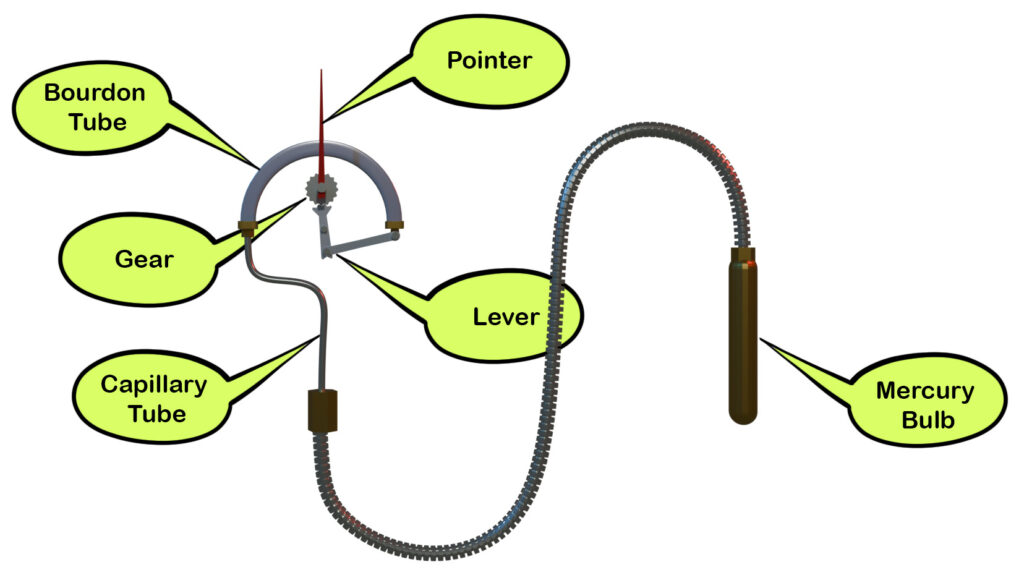
This Bourdon tube is actually semi-circular in shape. But when the mercury expands due to high temperature, the volume of the mercury increases. This increased volume of mercury creates pressure inside the Bourdon tube because the Bourdon tube is also filled with the same fluid, mainly mercury. As a result, the Bourdon tube tries to straighten itself. Due to this, the radius of the arc of the Bourdon tube increases.
One end of the Bourdon tube remains connected with the mercury bulb through the capillary tube, and the other end is mechanically connected with a lever. This lever is again connected to a gear through another vertical lever. Therefore, whenever the Bourdon tube deforms, the lever also moves. This movement is ultimately transferred to the gear, and the gear rotates.
A pointer is rigidly fixed with the gear. Because of that, the pointer also rotates. The pointer is fitted over a dial. Therefore, according to the rotational position of the pointer, we can calibrate the temperature. This is the simple theory.
Now, this complete mercury bulb is inserted into the oil pocket provided on the top cover of the transformer tank and is tightened with nuts and bolts. Since the hot oil inside the transformer main tank always stays at the upper side, the oil temperature around the bulb increases. As a result, the mercury inside the bulb expands, and through the capillary tube, the pressure reaches the Bourdon tube and tries to straighten it. Consequently, the pointer rotates, and from the pointer position, we can understand the actual oil temperature.
Oil Alarm and High Oil Temperature Trip
But an Oil Temperature Indicator also provides automatic oil alarm and high oil temperature trip of the transformer. How is this done?
For this purpose, two mercury switches are used. A mercury switch is very simple. It is a small glass container containing a small drop of mercury, and there are two contacts inside it. If the glass container is tilted in one direction, the mercury stays on one side while the contacts remain separated, so the switch remains open. But if the container is tilted in the opposite direction, the mercury rolls and joins the two contacts together, thereby closing the contact.
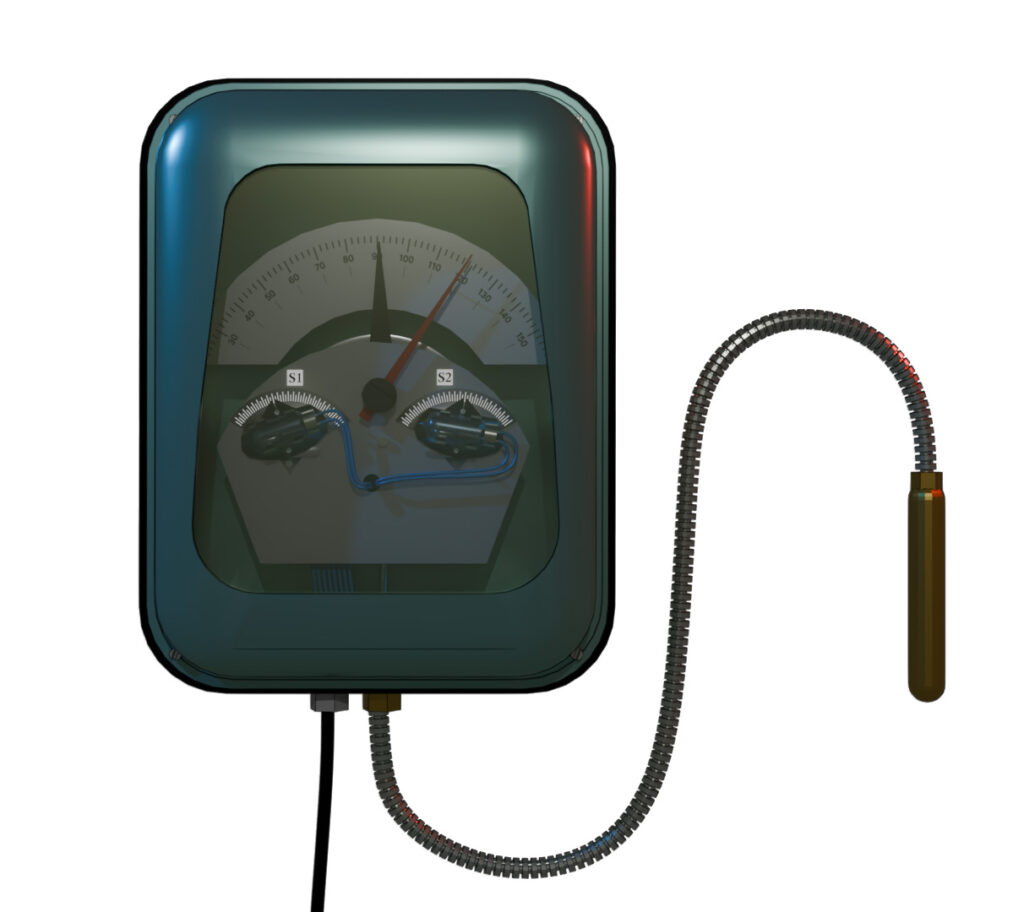
That means a mercury switch is a type of switch whose open and close condition depends on its alignment angle.
These two mercury switches are connected with the pointer through a disc arrangement. The angles of these switches are adjusted in such a way that after a certain temperature, the pointer reaches a specific position, causing the disc alignment to tilt the first mercury switch. As a result, the first mercury switch closes and gives an alarm signal.
If the temperature increases further, the second mercury switch also tilts and closes. Then the trip circuit gets actuated and trips the transformer completely. This is called the High Oil Temperature Trip.