
The primary objective of a power system protection scheme is to isolate only the faulty section of the network while keeping the healthy portions in service. This approach improves system reliability and ensures continuity of power supply to consumers.
Whenever a fault occurs in any part of a power system, it is desirable to disconnect only the affected equipment rather than shutting down the entire system. To achieve this selective isolation, we divide the power system into several protection zones, each supervised by a dedicated protection scheme.
In this article, we will understand the concept of protection zones and the importance of overlapping zones in electrical protection systems.
Protection Zone of a Generator
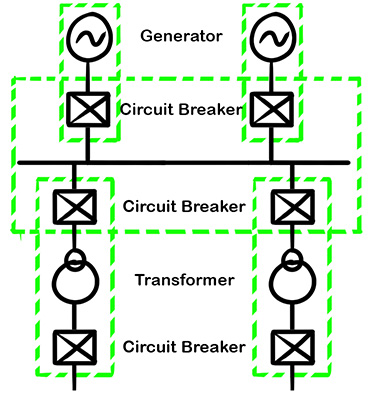
Consider a generator connected to a generating station bus through a circuit breaker. In a practical installation, current transformers (CTs), potential transformers (PTs), isolators, and other auxiliary equipment are also present. For simplicity, we focus only on the generator, the circuit breaker, and the bus.
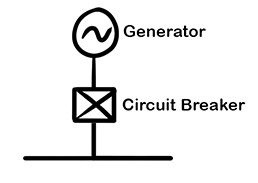
If a short-circuit fault occurs within the generator winding, the generator protection scheme should operate and trip the associated circuit breaker. This action disconnects the faulty generator from the bus while keeping the remaining system in service.
Now suppose the same bus connects another generator and two outgoing feeders through respective circuit breakers. If a fault occurs inside one generator, only that generator should be isolated. The other generator and the outgoing feeders should continue operating normally.
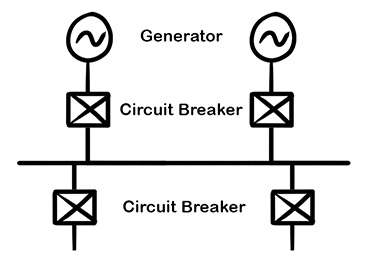
Therefore, the generator and its associated circuit breaker form a separate protection zone.
Video on Protection Zones and Overlapping Zones in Power Systems
Protection Zone of a Busbar
Now consider a fault occurring on the busbar itself. Since the busbar is a common connection point for all generators and feeders, a bus fault must be cleared by disconnecting the entire bus section from the power system. Therefore, all circuit breakers connected to that bus must trip simultaneously.
These breakers include:
- Generator circuit breakers
- Feeder circuit breakers
- Any other breakers connected to the bus
Thus, the busbar protection zone includes all circuit breakers connected to that bus.
Understanding Overlapping Protection Zones
We can observe an observation from the previous example. The generator circuit breaker performs two functions:
- It disconnects the generator when a fault occurs inside the generator.
- It disconnects the generator from the bus when a fault occurs on the busbar.
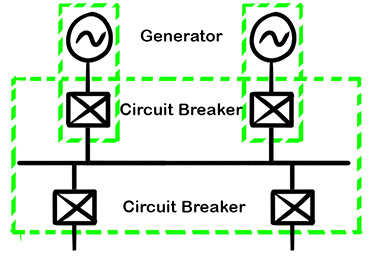
Therefore, the generator circuit breaker belongs to both the generator protection zone and the busbar protection zone. These two protection zones share the common region. We refer this common zone as an overlapping zone. This intentional overlap ensures that no part of the power system remains unprotected.
Transformer Protection Zone and Bus Protection Zone
Let us now consider the outgoing feeders connected to a step-up transformer. In other words, the generating bus connects step up transformers with the associated the circuit breaker. On the high-voltage side there is another circuit breaker with each step up transformer. If a fault occurs inside the transformer, both circuit breakers must trip to completely isolate the transformer from the system.
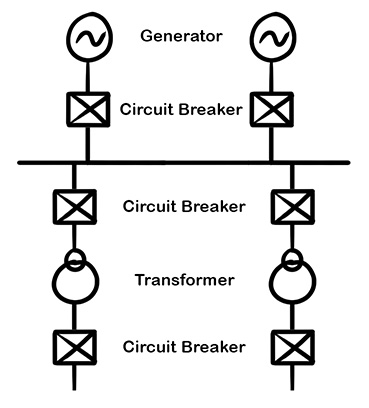
Again, the low-voltage side circuit breaker performs two functions:
- It participates in generating busbar protection.
- It participates in transformer protection.
Therefore, the protection zone of the transformer overlaps with the protection zone of the bus at that circuit breaker. This shared region forms another overlapping protection zone.
Overlapping Zones in a Station Bus Arrangement
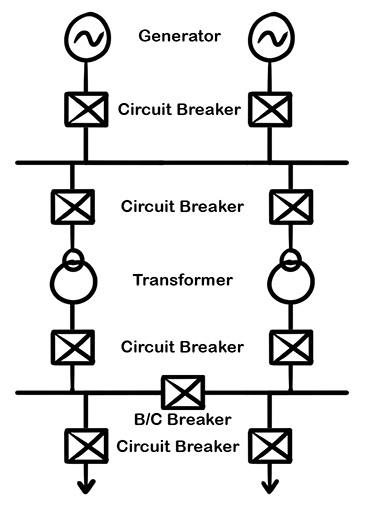
Consider a station bus supplied by two transformers. Each transformer connects the station bus with its own circuit breaker. The station bus has two sections connected by a bus coupler breaker. Each bus section also supplies outgoing feeders through dedicated circuit breakers.
Suppose a fault occurs in one section of the bus. To isolate the faulty section, the following breakers will trip:
- The transformer circuit breaker feeding that bus section
- The bus coupler breaker
- Any feeder circuit breakers connected to that section
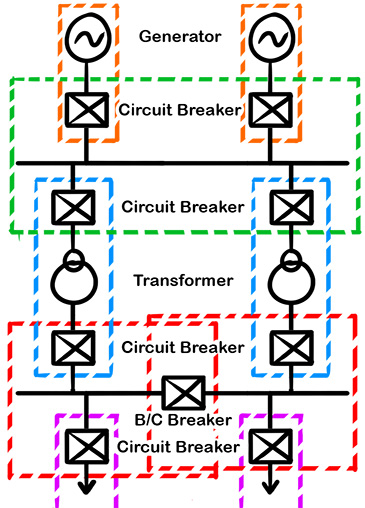
In this case, the transformer circuit breaker belongs to both:
- The transformer protection zone
- The bus section protection zone
Therefore, the circuit breaker forms an overlapping zone between these two protection areas. Similarly, a feeder circuit breaker belongs to both:
- The feeder protection zone
- The bus section protection zone
When a fault occurs on the feeder, the feeder breaker trips. When a fault occurs on the bus section, the same breaker also participates in isolating the bus. Hence, overlapping protection zones are present here as well.
Overlapping Between Two Bus Sections
Now consider a fault occurring in another section of the bus. To isolate the faulty section, the relevant transformer breaker, feeder breakers, and bus coupler breaker will trip. The bus coupler breaker belongs to the protection zones of both bus sections. Therefore, it serves as an overlapping element between the two bus protection zones.
Why Are Overlapping Zones Necessary?
From the above examples, we can clearly see that every piece of electrical equipment and every section of the network belongs to a specific protection zone. However, these zones intentionally overlap the adjacent zones. The reason is simple: overlapping zones eliminate any possibility of leaving a portion of the system unprotected.
Imagine a situation where separate circuit breakers are provided exclusively for the generator and the bus, without any overlap between their protection zones. In such a case:
- Generator differential protection would trip only the generator breaker.
- Bus differential protection would trip only the bus breaker.
Now consider the conductor section located between these two circuit breakers. If a fault occurs in this small section, it may not clearly belong to either protection zone. This could create uncertainty regarding which protection should operate first. The protection system would become more complex and less reliable.
By introducing overlapping protection zones, we can eliminate such unprotected gaps. At least one protection zone covers every portion of the power system. However, in many cases two or more adjacent protection schemes overlap.
Advantages of Overlapping Protection Zones
The major advantages of overlapping protection zones are:
- Complete coverage of the power system
- No unprotected portions between adjacent zones
- Improved reliability of the protection system
- Faster and more selective fault isolation
- Reduced chances of protection coordination problems
- Enhanced security and dependability of the electrical network
Conclusion
Protection zones form the foundation of modern power system protection. Each generator, transformer, feeder, and busbar has its own protection zone. So, the protection system can selectively clears the faults without disturbing healthy parts of the network. Obviously, it ensures that no part of the system remains unprotected. The adjacent protection zones overlap each other intentionally. These overlapping zones usually exist around circuit breakers. This allows the CB to serve multiple protection functions.
As a result, the entire power network remains covered by a continuous and reliable protection system, ensuring safe and stable operation under fault conditions.