
TACSR
TACSR is the simplest form of HTLS variants. It uses galvanized steel strands as reinforcement, similar to a simple ACSR conductor. However, it mainly differs in the current-carrying part of the conductor. Constructionally, a TACSR is similar to an ACSR conductor. It uses thermal-resistant aluminium alloy strands instead of normal hard-drawn pure aluminium. It is a zirconium aluminium alloy.
Zirconium in aluminium forms fine Al3Zr precipitates. These precipitate grains slow down the atomic movement within aluminium. Thereby, these reduce aluminium creep.
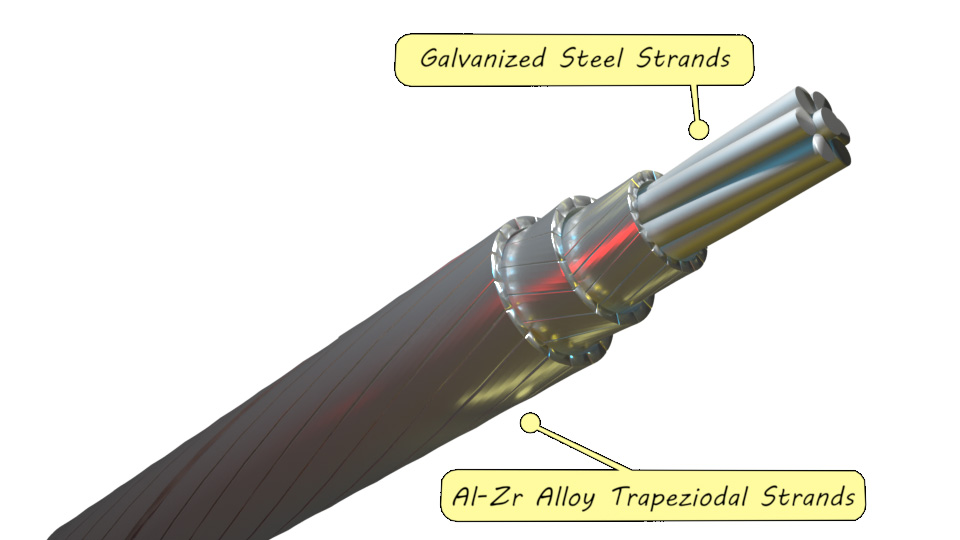
Normal aluminium starts creeping above 90°C. However, zirconium aluminium alloy creeps at much higher temperatures. Creep means the permanent elongation due to high-temperature operation. Since zirconium in aluminium improves the creep temperature of the conductor, TACSR belongs to the HTLS group. It is the simplest and lowest-cost variety of HTLS conductors.
The main advantage of TACSR is that the same towers and hardware can be reused when replacing old ACSR conductors. Although its current-carrying capacity is not as high as other HTLS conductors but it is still much higher than that of an ACSR conductor.
The normal temperature rise limit of this conductor is 150°C. However, the temperature increase limit for a short duration of operation is 210°C.
ACSS
ACSS stands for Aluminium Conductor Steel Supported. This is another conductor that has the same constructional features as a normal ACSR conductor. However, in an ACSR conductor, both the steel core and the outer aluminum layer share the mechanical load. During high-temperature operation, the difference in the thermal expansion coefficients of steel and aluminium significantly affects the sag of the conductor.
In contrast, in an ACSS conductor, the central steel core carries the entire mechanical load. The outer aluminium carries only the current. The outer aluminium layers do not take part in sharing the mechanical load.
There is a major difference between ACSR and ACSS conductors. In an ACSS conductor, we use softened, annealed aluminium instead of hard-drawn aluminium.
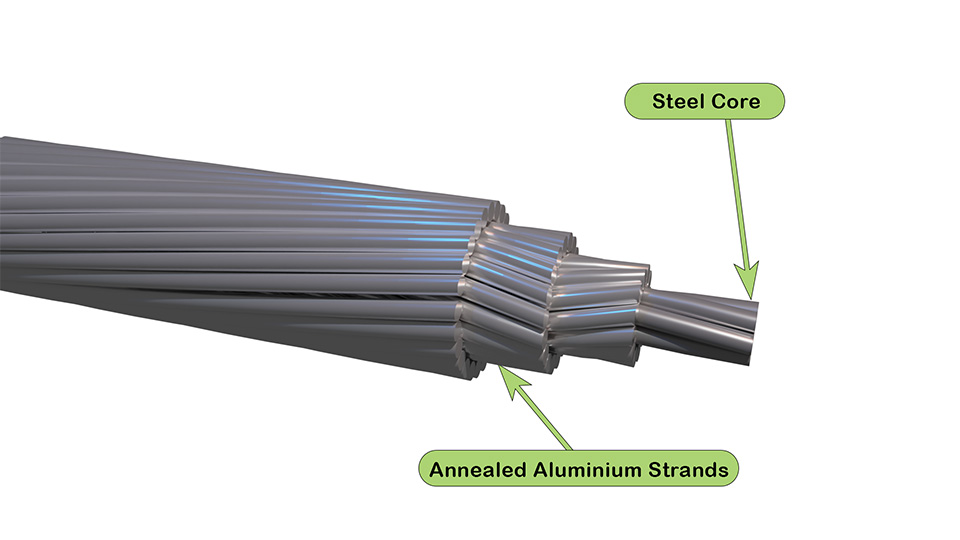
Annealing is a heat treatment by which a metal loses its creep property. As a result, the metal does not further elongate permanently during high-temperature operation. Thus, annealed aluminium strands carry the current but do not become elongated. On the other side, the central steel core carries the entire mechanical load permanently and continuously. As a result, the sagging characteristics of the conductor improve significantly, and the conductor can carry current up to 200°C without any significant permanent change in sag.
This is another cheap variant of an HTLS conductor. ACSS is also an ideal conductor for reconductoring existing ACSR transmission lines without changing the towers and other hardware.
STACIR
STACIR is a type of overhead transmission conductor. This conductor belongs to the HTLS group. STACIR stands for Super Thermal Aluminium Conductor Invar Reinforced. Here, the strands of aluminium–zirconium alloy form the current-carrying outer layers. Nickel–iron alloy forms the internal reinforced core.
Invar is an alloy of 64% iron and 36% nickel. Since the conductor contains Invar strands, we commonly call it an Invar HTLS conductor. Invar is not mechanically stronger than steel. However, invar has a negligible thermal expansion coefficient. Therefore, the sag becomes stable even at much higher operating temperatures. Otherwise, invar is similar to steel.
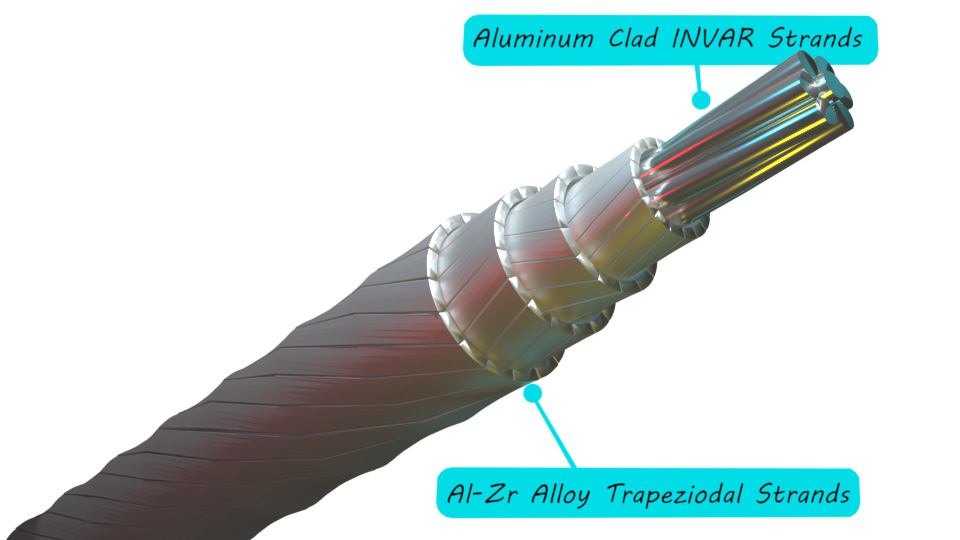
This STACIR conductor is most suitable for replacing old existing ACSR conductors. This is because invar has nearly the same mechanical characteristics as steel. We can easily use the same tower line of ACSR conductors. In other words, it does not require any modification or retrofitting of the existing transmission line towers.
Invar HTLS can carry nearly double the current of the equivalent ACSR conductor.
Gap Type HTLS
In gap-type HTLS conductors, we use super thermal-resistant aluminium alloy wires. A high tensile strength steel core forms the central reinforced core. A small gap is maintained between the steel core and the inner layer of aluminum strands. This small annular cavity is filled with grease. This arrangement helps to restrict the mechanical load to the steel core only. The grease between the steel core and the aluminium layer facilitates relative movement due to differences in elongation caused by the different thermal coefficients of aluminium and steel.
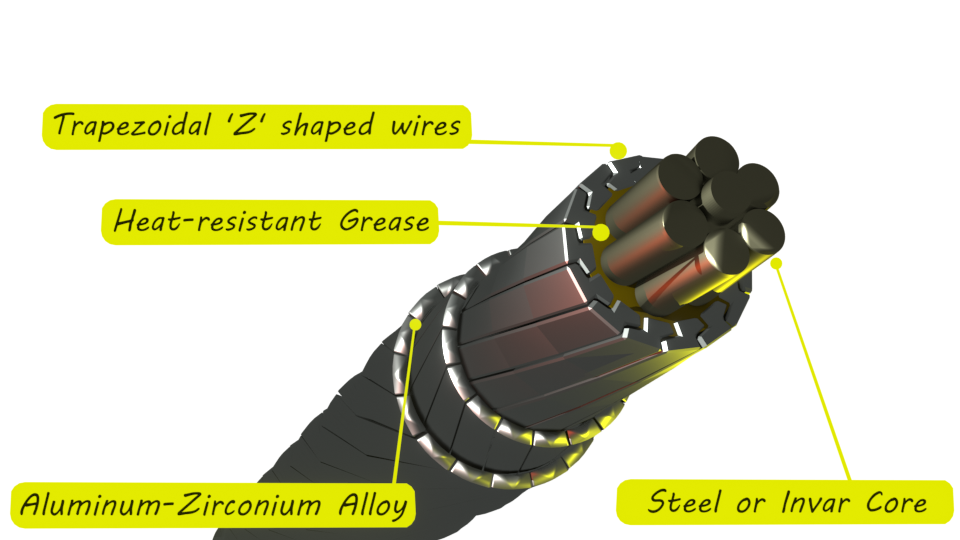
Gap-type conductors are costlier than the other discussed variants of HTLS. However, gap-type HTLS conductors have ampacity more than double that of an equivalent-size ACSR conductor.
Due to the different constructional features of gap conductors, they are not very suitable for replacing most existing conductors. Instead, they are more useful for new lines.
ACCC
ACCC conductors are the most expensive among other variants of HTLS. Actually, ACCC stands for Aluminium Conductor Composite Core. Here, the outer current-carrying layer consists of annealed aluminium strands. The central core is made of carbon composite or glass fiber.
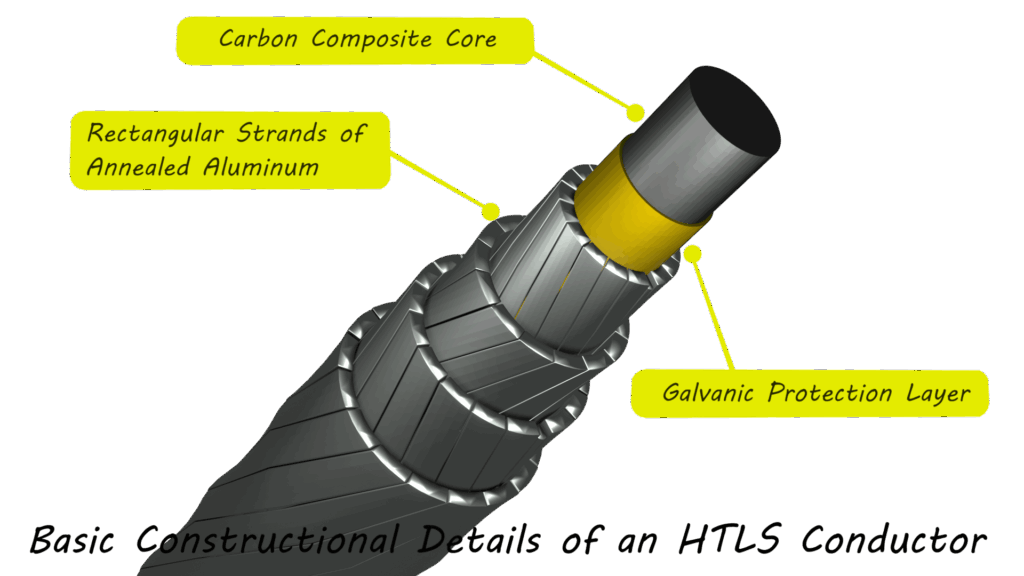
The composite core is about 25% lighter than the traditional steel core. Due to the absence of a conductive steel core at the center, ACCC conductors reduce line losses by about 40% compared to traditional ACSR transmission lines. They also significantly improve the sag characteristics of transmission lines. These conductors are very suitable for both reconductoring and new line applications.