
The full form of ACCC is Aluminium Conductor Composite Core. This is one of the most advanced HTLS technologies. Here, instead of a stranded steel core, we use a reinforced core made of carbon fiber. Sometimes, we also use glass fiber for reinforcement.
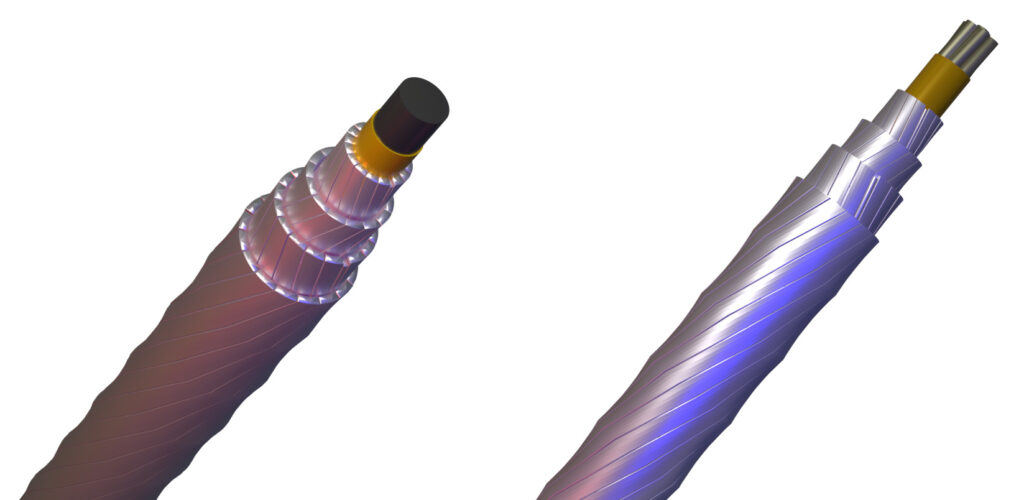
Construction of ACCC
The main advantage of ACCC among other HTLS conductors is that it has a much lighter weight than the other equivalent HTLS conductors. This is because the weight of the carbon composite core is much lower than that of the steel or invar core. The carbon composite core in ACCC conductor is either of a solid type or a stranded type. The core type depends upon the manufacturer’s design or customer requirement.
Like ACSS conductors, ACCC conductors carry 100% mechanical load through the carbon composite core. We place aluminium strands helically over the composite core. The aluminum strands carry 100% of the electrical load. This is because carbon fiber or glass fiber has no conductivity.
Galvanic Protection Cover
We use a plastic cover between the composite core and the inner aluminium strands layer. This cover prevents galvanic action between carbon and aluminium.
Aluminium Strands
For ACCC conductors, we can use either pure annealed aluminium or zirconium aluminium alloy for current-carrying strands. When we use zirconium aluminium alloy, the strands may share a portion of the mechanical load of the conductor. However, when we use annealed aluminium, because of its soft nature, it will not share any mechanical load of the conductor.
Although in both cases, the creep at high temperature is minimum or negligible. This is because both pure annealed aluminium and zirconium aluminium alloy are free from high-temperature permanent elongation, known as creep.
Both are categorized as aluminium conductors with composite core (ACCC). Since the core is lighter and has sufficiently higher mechanical strength, we can use a thinner core here. As a result, in ACCC conductor, we can increase the number of aluminium strand layers without increasing the overall diameter of the conductor. Hence, it increases the conductor’s ampacity.
Moreover, here we use trapezoidal cross-sectional strands instead of round cross-sectional strands. This is how we use the inter-strand gap to carry current. As a result, the overall ampacity of ACCC conductor becomes much higher than that of an equivalent ACSR conductor. The ampacity is also higher in ACCC compared to ACSS and TACSR conductors.
Disadvantages of ACCC
The main disadvantage of this conductor is that it is one of the costliest variants. Due to the carbon composite core, it requires specialized manufacturing processes. Also, it requires specialized hardware along with specialized fitting techniques for stringing.
Advantages of ACCC
The continuous operating temperature of the ACCC conductor is 180°C to 210°C. It can withstand a short-term emergency temperature of up to 240°C.
The overall weight of an ACCC conductor is 30–40% lower than that of an equivalent ACSR conductor. This makes the ACCC conductor suitable for long-span transmission lines. It imposes lower tower loading.
The conductor has a non-magnetic core. Therefore, it is free from magnetic losses. The carbon composite core has very high strength. Hence, the conductor can sustain higher tensile loads than an ACSR conductor.
We can string ACCC conductors on existing towers without retrofitting. It exhibits the lowest sag among HTLS conductors. It also shows negligible creep at high operating temperatures.