
The same rotating electrical machine can act as both a motor and a generator. A Flywheel Energy Storage System (FESS) works based on this feature of the rotating electrical machine. Surplus power accelerates the rotor of a motor. The same machine runs as a generator when the grid needs power. When grid power falls, the rotor continues rotating because of its inertia. However, it slows down while generating power. As a result, it returns the generated power to the grid.
Working Principle of a Flywheel Energy Storage System
Theoretically, the equation given below gives the energy stored in a rotating mass: E equals one-half times I times omega squared.
Here, ‘I’ is the moment of inertia (kg·m²), and ω is the angular speed (rad/s). Since energy rises with the square of speed, doubling the speed stores four times the energy, while doubling the mass only doubles it. Designers therefore push for speed rather than weight.
The limit is material strength. The hoop stress in a spinning rim grows as σ ≈ ρr²ω², so the maximum specific energy depends on the ratio of tensile strength to density (σ/ρ). This is why modern high-speed rotors use carbon-fibre composites, which allow far higher rim speeds than steel.
Main Components of a Flywheel Energy Storage System
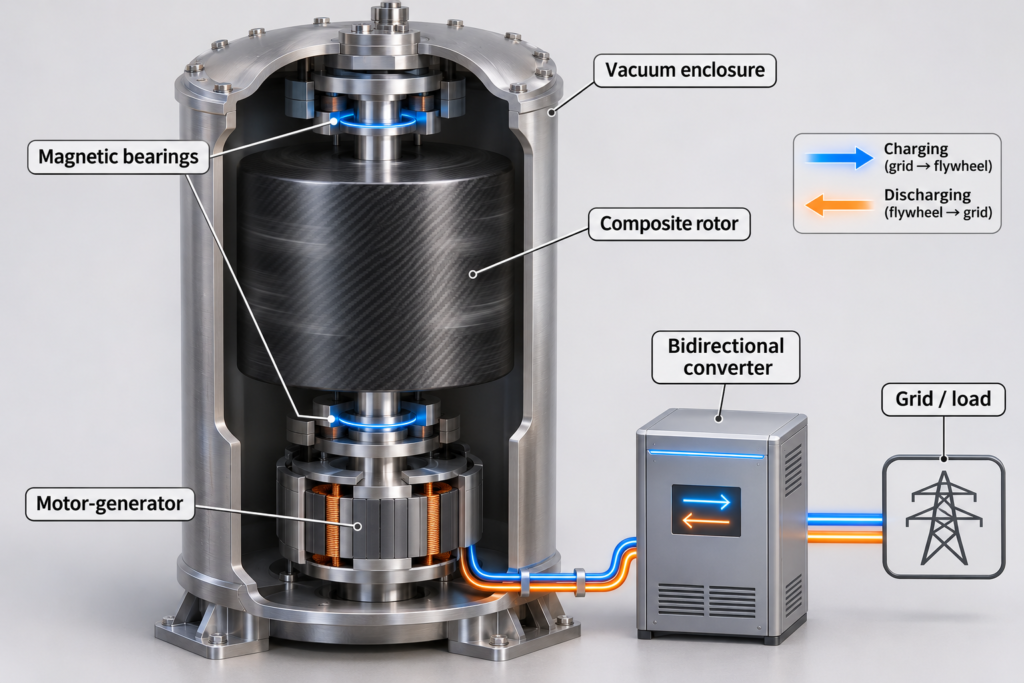
It mainly consists of a rotating machine that behaves as both a motor and a generator. Here, we generally use a permanent magnet synchronous machine. This machine has either a steel-core rotor or a composite-core rotor. For low-speed units of a few thousand rpm, we use a steel-core rotor. For high-speed rotors, we use a carbon-composite-core rotor. Its speed is about ten thousand rpm.
For a flywheel system, we generally use magnetic bearings. These significantly reduce friction and wear. However, we may use cheaper mechanical bearings, but these cause significant mechanical losses.
We also use a vacuum enclosure because it removes air windage. A bidirectional converter links the variable-frequency machine output to a DC bus and then to the fixed-frequency grid.
Advantages of a Flywheel Energy Storage System
This system responds very fast. It can deliver full power within milliseconds. This is ideal for short disturbances. A flywheel system has very high power density because it generates a large amount of power from a compact unit.
This system has a very long life. It runs hundreds of thousands of charge-discharge cycles with little degradation. It has a service life of around 20 years and a round-trip efficiency of about 85–90%.
Limitations
Bearing, windage, and electrical losses drain a few percent of the stored energy. Flywheel systems cannot deliver long-duration storage. They store much less energy per kilogram than lithium-ion batteries that is BESS. A failing high-speed rotor carries enormous energy, so the housing needs to be very strong and heavy.
Applications
It is ideal for delivering power for 10 to 30 seconds before the backup generator starts, making it suitable for an uninterruptible power supply (UPS). Data centres and hospitals use flywheels to ride through the 10–30 seconds before a diesel generator starts.
A flywheel rotates due to inertia, absorbing and releasing power second by second to balance supply and demand. Hence, it stabilizes the system’s frequency.