
A capacitor is a system where two conducting plates remain face to face with a dielectric medium in between them.
When we connect the capacitor across a voltage source, opposite charges accumulate on the two opposite plates. Obviously, the charge of one plate is positive with respect to the charge of the other plate. We call the plate with positive charge the positive plate and the other the negative plate.
The voltage that appears across the capacitor equals the voltage of the source at steady-state condition. We have mentioned here the steady-state condition. This term plays an important role in the behavior of a capacitor. Actually, when we just connect a capacitor across a voltage source, initially there is no charge on the plates.
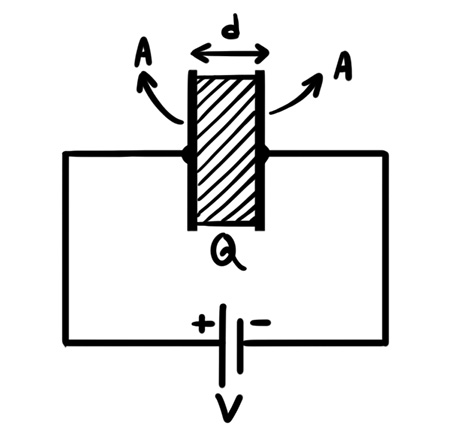
Suppose one plate of the capacitor is connected to the positive terminal of a battery. At the same time, we connect the other plate to the negative terminal of the battery.
As soon as the plate comes in contact with the positive terminal of the battery, the free electrons of the metallic plate move to the positive terminal of the battery. As a result, the plate becomes positively charged. Similarly, when the other plate touches the negative terminal of the battery, electrons from the negative terminal of the battery come and accumulate on that plate. Therefore, this plate becomes negatively charged.
This migration of charges from the battery continues until the potential difference between the plates becomes exactly equal to the potential of the battery. This is because, as long as charge accumulates on the plates, the potential difference between the plates increases.
This process stops when the voltage of the capacitor becomes equal to the battery voltage.
Derivation of Capacitance of a Capacitor
Suppose, for the development of voltage, +Q charge accumulates on the positive plate of the capacitor. At the same time, −Q charge accumulates on the negative plate of the capacitor.
Although the total charge of the capacitor isHowever, we consider the charge of the capacitor as Q. Obviously, as the charge on the capacitor increases, the voltage across the capacitor also increases. Therefore, we can say,or,Here, C is the constant of proportionality. We call this constant C the capacitance of the capacitor. This capacitance depends upon:
- the area of the conducting plates,
- the distance between the plates, and
- the permittivity of the dielectric medium placed between the conducting plates.
From equation (1),So, the unit of capacitance is Coulomb/Volt. We refer to this unit as Farad. We use the capital letter F as the symbol of the unit of capacitance.
Calculation of Capacitance of a Capacitor
Suppose,
- Area of each plate = A m²
- Distance between the plates = d m
- Permittivity of the dielectric medium = ε₀εᵣ
where,
- ε₀ = Permittivity of free space (vacuum)
- εᵣ = Relative permittivity of the dielectric medium
The charge on the positive plate is +Q coulombs. This means the plate is connected to the positive terminal of the battery. The charge on the negative plate is −Q coulombs. The negative plate is connected to the negative terminal of the battery. The battery is the voltage source of V volts. Therefore, the charge density of the plates isNow, if we consider that the area A is much larger than the plate spacing d, that is,Therefore, the electric field between the plates is uniform and perpendicular to the plates. Let the magnitude of the electric field be E. According to Gauss’s law,The potential difference between the plates is V. Therefore, the electric field can also be expressed asFrom equations (1) and (2),Hence,Again, we know that,From equations (3) and (4),Therefore,