
The electricity demand is increasing day by day. On the other hand, the land available for constructing new transmission lines is reducing continuously. Due to growing legal complexities, identifying or surveying a suitable transmission corridor has become a significant challenge.
Therefore, the only practical solution available is to transmit more power through the existing transmission lines. This may be done by enhancing their current-carrying capacity. This can be achieved by replacing existing ACSR with ACSS conductors. This replacement is a cost-optimal solution.
The ACSS conductor belongs to the HTLS family. However, it is a low-cost HTLS conductor. The cost of ACSS is low compared to other HTLS conductors.
What is an ACSS conductor?
The full form of ACSS is Aluminium Conductor Steel Supported. Like the TACSR conductor, the ACSS conductor can also sustain much higher temperatures than traditional ACSR conductors. The main difference between TACSR and ACSS conductors lies in the way mechanical load is carried.
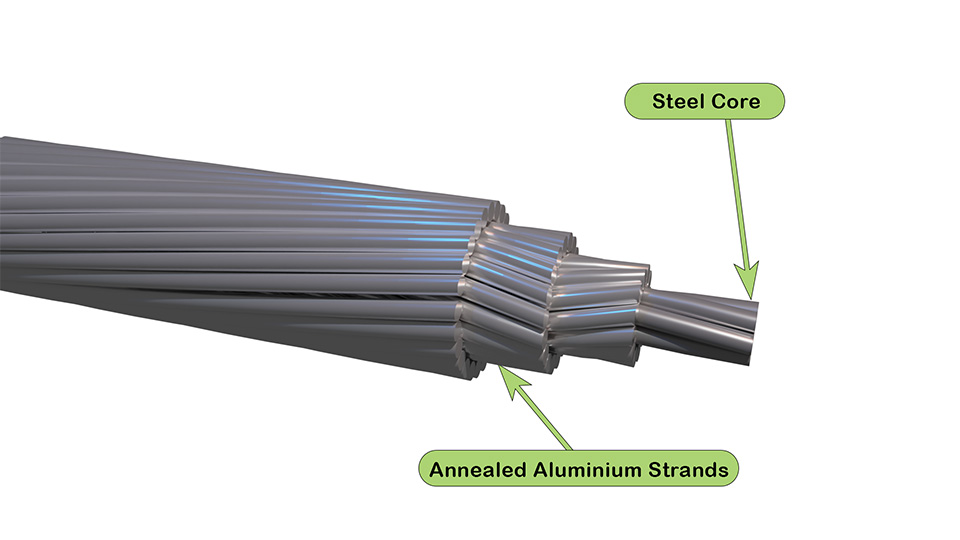
In an ACSS conductor, the entire mechanical load is carried by the steel-reinforced core. The outer aluminium strands do not carry any mechanical load. Outer aluminum strands only serve current-carrying purposes. In contrast, in a TACSR conductor, both the aluminium alloy outer layers and the central steel core share the mechanical load.
Construction of ACSS Conductor
Now, let us understand the construction of the ACSS conductor. In TACSR conductors, manufacturers use zirconium-aluminium alloy. This alloy prevents creep of the strands at high temperatures. It also has sufficient mechanical strength to share the mechanical load.
However, in an ACSS conductor, annealed soft aluminium is used to construct the outer conducting layer. This annealed aluminium is pure and has excellent electrical conductivity. However, it does not possess sufficient mechanical strength to share the mechanical load of the conductor. It is free from permanent elongation or creep, but it cannot sustain mechanical stress.
Since the steel core in an ACSS carries the entire mechanical load, annealed aluminium strands can be safely used over it to carry the required current without affecting sag much. In simple words, annealed aluminium prevents creep or permanent elongation, but its mechanical strength is significantly lower than that of zirconium-aluminium alloy.
Operating Temperatures of ACSS
The continuous maximum operating temperature of an ACSS conductor is normally up to 200°C. The short-duration emergency temperature limit may go up to 250°C. A higher operating temperature limit means higher ampacity. This is why ACSS can carry much higher current, almost double that of an equivalent-size ACSR.
Sag Performance
Now, let us discuss the sag performance of ACSS. Sag is the main parameter that determines the current-carrying capacity of an overhead conductor. When sag increases, ground clearance decreases. From a safety point of view, such an elongated conductor must be rejected and replaced. Therefore, the lifespan of a conductor depends on sag, and sag depends on permanent elongation.
In ACSS conductors, annealed aluminium is used. Annealed aluminium strands do not elongate significantly at high temperatures. This is because it has already been temperature-treated. The steel core continuously carries the mechanical load. As a result, the ACSS conductor provides stable sag performance even during long-term high-temperature operation.