
TACSR stands for “Thermal Resistant Aluminium Alloy Conductor Steel Reinforced”. It is a type of HTLS conductor. TACSR can carry higher current than conventional ACSR conductors. This is because its operating temperature is much higher than that of ACSR. However, it maintains similar mechanical practices with higher ampacity. Power utilities use TACSR mainly for uprating existing transmission lines without changing towers or insulators.
Need for TACSR Conductor
Growing electrical demand requires more power to be transmitted. ROW issues and the lack of availability of proper corridors make it very difficult to construct new UHV and EHV transmission lines. So, there is no option except to transmit higher power through the existing transmission corridors. Conventional ACSR conductors have temperature limits, typically around 75°C to 85°C. Beyond this limit, excessive sag occurs. TACSR overcomes this limitation. It maintains an acceptable sag even up to 150°C.
Construction of TACSR Conductor
TACSR construction is similar to ACSR. Only manufacturers upgrade the materials of the conductors. They use thermal-resistant aluminium alloy strands for conducting outer layers. The core uses the same galvanized steel strands for mechanical strength as ACSR. In TACSR, both the conductor and the rainforce portion share the mechanical load after stringing. In ACSR, aluminium strands lose their mechanical tension due to creep at high temperatures. The aluminium alloy of TACSR retains its mechanical properties even at much higher temperatures. Heat-resistant aluminium alloy has better creep resistance than pure aluminium.
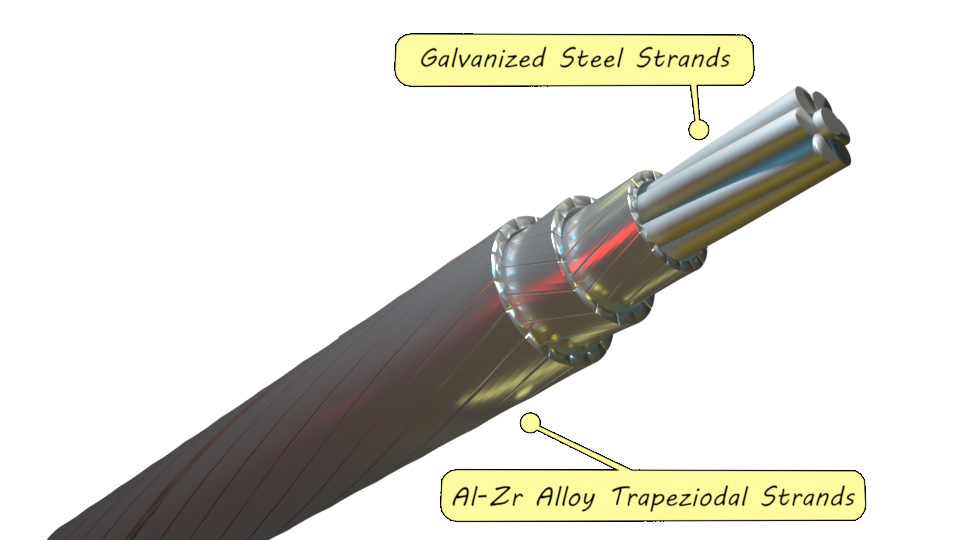
Core of TACSR
The layers of aluminium alloy strands are helically wound around the steel core. The core uses high-tensile galvanized steel to provide mechanical strength. The galvanization or zinc coating prevents the galvanic effect between steel and aluminum.
Operating Temperature and Current Capacity
TACSR conductors can operate continuously at temperatures up to 150°C. It also sustains up to 210°C for a specified short duration. Therefore, TACSR can carry current till the temperature reaches the limits. Hence, the ampacity of the conductor is much higher. It has a similar DC resistance to ACSR at normal temperature, but has a slightly higher resistance at higher temperatures.
Mechanical Characteristics
The tensile strength of TACSR is similar to that of ACSR. Although it has negligible creep at high temperature. Hence, it offers much stable sag at high temperatures. Due to a similar cross-section, it is compatible with existing ACSR line hardware. Sag in TACSR is much stable because the steel core carries most of the mechanical load, whereas the aluminium alloy also carries a portion of the load. This load sharing persists for a long range of temperatures, since aluminium alloy resists permanent elongation of strands. This makes TACSR ideal for line reconductoring projects.
Ease of Replacement
One major advantage of TACSR is ease of replacement. We can use the same towers and the same insulators. Also, we can use the same stringing equipment, tensioning practices. This reduces outage time and project cost.
Limitations
TACSR has a higher initial cost than ACSR. It also has slightly higher losses at elevated temperatures. Actually, it is not as advanced as gap-type HTLS or ACCC conductors.