

Before discussing the Rogowski Coil CT (Current Transformer), it is essential to understand the basic theory behind it.
When current flows through a conductor, it creates a magnetic field around that conductor. If we place a ring-shaped magnetic core around the conductor, the magnetic flux lines concentrate inside the core. When we wrap a copper wire around this ring, it induces a voltage across the coil. This is because the changing magnetic flux links with the coil.
The induced EMF across the coil depends on the rate of change of flux linkage through the core.
Theory of Rogowski Coil
Now, suppose we remove the iron or magnetic core. Let us examine what happens then.
Now, due to the absence of the magnetic core, the concentration of flux lines through the coil becomes lower. Some flux linkage still exists. Because the current is alternating, the flux around the conductor also alternates. As a result, the coil still experiences an induced EMF due to this time-varying flux. This induced emf may not be as strong as it would be in the presence of a magnetic core.
Here, the induced EMF across the coil is also directly proportional to the rate of change of flux linkage. Even though the flux concentration is lower without a core, a definite induced EMF still appears.
If the alternating current through the conductor increases, the peak of the AC waveform becomes larger. As a result, dΦ/dt also increases. Since the induced EMF across the coil is proportional to dΦ/dt, the induced EMF also increases.
So we observe that the current (I) through the conductor is proportional to dΦ/dt, which in turn is proportional to the induced EMF (e) across the coil.\[I \propto \frac{d\phi}{dt}\propto e\]Therefore, by sensing the induced EMF across the coil, we can easily determine or calibrate the current flowing through the conductor.
We refer to the air-cored coil placed around the conductor as a Rogowski coil. Additionally, we refer to the system of measuring current using this coil as a Rogowski Coil CT (Current Transformer).
Features of Rogowski Coil CT
The main features of are
The most important feature of a Rogowski coil CT is that it is extremely lightweight and easy to handle.
Construction of the Rogowski Coil CT
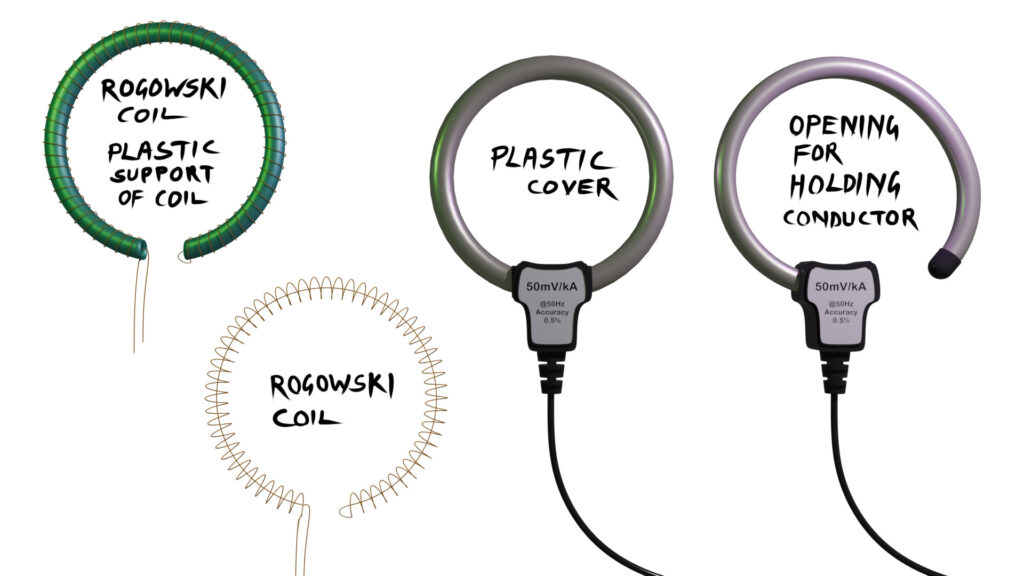
A Rogowski coil consists of an air-cored coil. This coil is made of enamel-insulated copper wire wound on a ring-shaped plastic support pipe. We wind a thin, enamel-coated copper wire around this plastic ring. The end of the coil is brought back to the starting point. This wire goes through the hollow plastic support pipe. So, this pipe also provides insulation between the wound wire and the return wire.
The entire assembly is then covered with another plastic layer. Obviously, it protects the coil from mechanical shock. The terminal connection wire of the coil is fitted inside a handle. Additionally, the handle carries the connecting cables to an amplifier circuit. This amplifier boosts the induced EMF. Then it shows the emf in terms of the current flowing through the conductor.
Openable Loop
A Rogowski coil is not a continuous closed loop. It has an opening that allows the user to place it around a current-carrying conductor.
Advantages
- The Rogowski coil CT is very lightweight and easy to use.
- We can install it where a switchgear does not have space for a traditional CT installation.
- We also use it for on-the-spot current measurements.
- The coil does not saturate, even at very high current levels. This is because it contains no magnetic core.
- It also maintains consistent performance at very high frequencies. For this reason, a Rogowski coil CT can accurately reproduce high-frequency disturbances of line current.
Limitations and Performance
Despite its convenience, the Rogowski coil CT offers lower accuracy than a conventional iron-core CT. This is because the air core provides weaker magnetic flux linkage.