
A solar panel does not give the same electric power all the time. Power changes with sunlight and temperature. To use the panel efficiently, we must extract maximum power. This is done using Maximum Power Point Tracking (MPPT). MPPT is used inside solar inverters. It mainly uses DC–DC converters.
What is MPPT?
MPPT is a control technique. It forces the solar panel to operate at the point of maximum power. At this point, the product of voltage and current is highest.\[P=V\times I\]The MPPT control technique continuously adjusts the operating voltage and current.
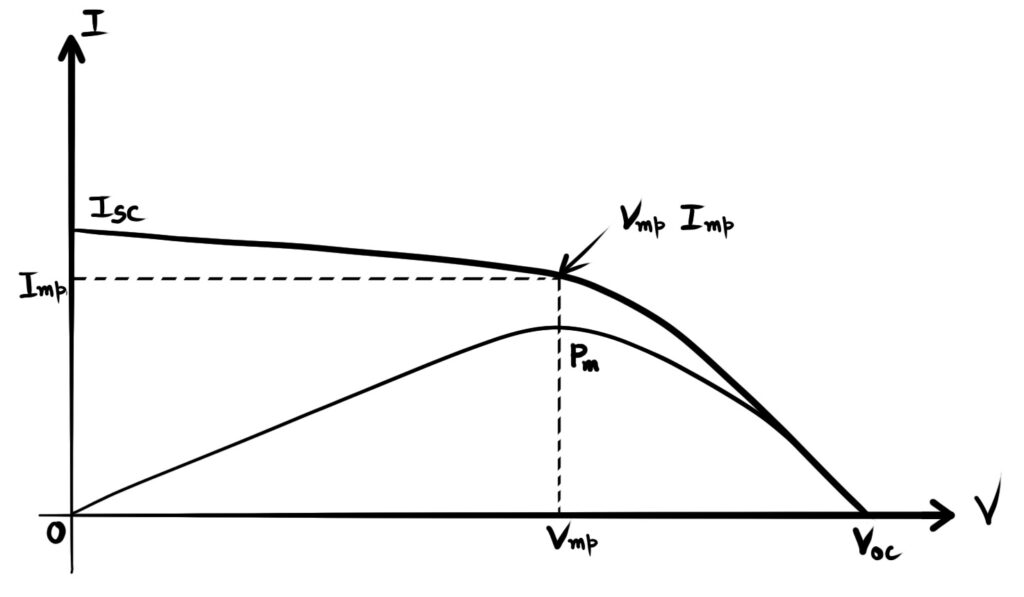
I–V Characteristics of a Solar Cell
A solar cell has a non-linear I–V curve. Current and voltage do not change linearly. This curve defines four important parameters. These are Voc, Isc, Vmp, and Imp. These parameters decide the power output of the solar panel.
Open-Circuit Voltage (Voc)
Voc is the maximum voltage of the solar cell. It occurs at a no-load condition. That means the circuit is open. In other words, the current is zero. Also, this happens when sufficient sunlight falls on the solar cell. \[\text{I = 0 at V = }V_{oc}\]Actually, the voltage developed across the cell depends upon the number of separated electrons and holes generated due to light energy, reaching the depletion layer.
Short-Circuit Current (Isc)
Now, if we short-circuit the cell, the current starts to flow through the external shorting path. At the optimum sunlight condition, this flow is also the maximum. Since the generation of separated free electrons and holes is maximum. This is nothing but the short-circuit current of the cell. Therefore, the current is maximum. Although the voltage developed across the cell will be zero here because of the external short circuit.
Actually, any electron generated due to incident sunlight propagates instantly through the external short-circuit path. So, no charge can stay even for an instant inside the solar cell. As a result, any uneven distribution of electrons and holes does not occur in the cell. Therefore, no potential difference appears across the cell. Hence, the voltage across the cell becomes zero. This is the reason we refer to this current as the short-circuit current of the cell.
Maximum Power Point
Now think about a load connected to the solar panel. Therefore, there is a current flowing through the load. Obviously, this current is less than the short-circuit current of the panel. The solar cell delivers this current to the load. At the same time, a voltage appears across the solar cell. It is needless to say that this voltage is less than the open-circuit voltage of the solar cell.
Now, if we increase the connected load, the current will increase. At the same time, due to the voltage regulation effect, the terminal voltage of the cell will drop. Obviously, that may reduce the ultimate output power of the solar cell.
On the other hand, if we reduce the connected load, the current decreases. At the same time, the terminal voltage gradually approaches the open-circuit voltage of the cell. Even though the output voltage increases, the output power becomes less due to reduced load current.
What we have seen is that reducing the current also reduces the power. Again, if we increase the current beyond a certain level, the power will also be reduced because of excessive voltage drop. Therefore, there may be an optimum current at an optimum voltage level at which the cell’s output power is maximum. This point on the curve is the maximum power point, or MPP.
In the curve, we have seen that the peak of the power curve, where dP/dV is zero, is the maximum power point. Normally, at a voltage of 70 to 80% of the open-circuit voltage Voc , and a current of 90 to 95% of the short-circuit current, Isc, the maximum power occurs. So we can write \(P_m=V_m×I_m\)