
There are mainly five basic types of operating mechanisms used in high-voltage circuit breakers:
- Spring closing and spring opening (Spring-Spring Mechanism)
- Pneumatic closing and spring opening
- Solenoid closing and spring opening
- Pneumatic closing and pneumatic opening
- Hydraulic closing and hydraulic opening
Among these five operating mechanisms, the spring-spring mechanism is the most commonly used by electric utilities. This is because it has a comparatively simple construction, fewer mechanical parts, occupies less space, and is more economical than the other operating mechanisms.
Disadvantages of Spring-Spring Mechanism
However, this mechanism also has a few disadvantages.
- The first disadvantage is that, due to the spring’s elasticity, there is a tendency for the moving contact to bounce slightly after completing the closing or opening operation. Therefore, an effective damping arrangement is required to minimise contact bounce.
- The second disadvantage is that after prolonged service, the spring may gradually lose some of its elasticity due to ageing and fatigue. As a result, it may not be able to produce the same closing or opening force as it did when it was new. This problem is generally not encountered in pneumatic or hydraulic operating mechanisms because they use fluid pressure instead of stored spring energy.
Spring Closing and Spring Opening Mechanism
In this mechanism, the closing spring is charged by an electric motor. The motor is connected to the spring through a system of gears, levers, and linkages.
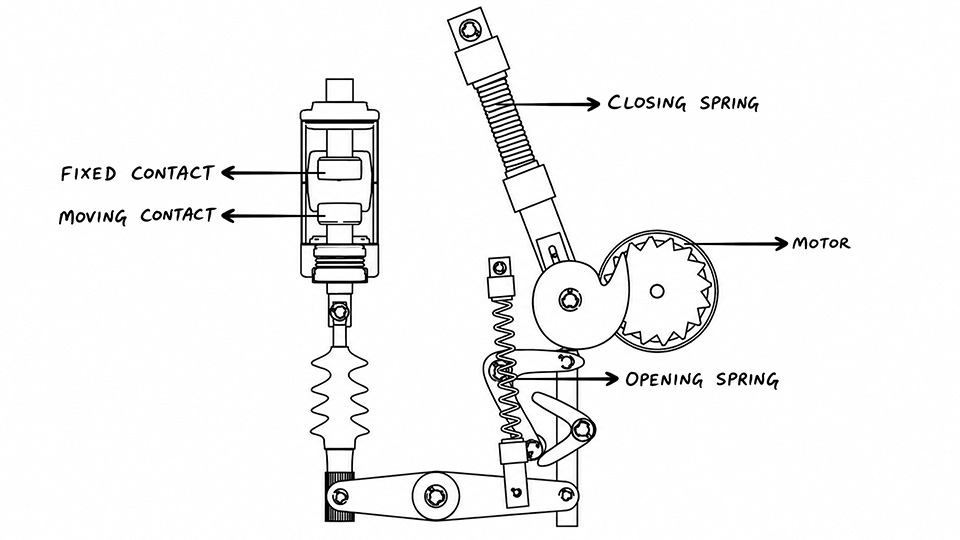
When the closing spring is in its relaxed or discharged condition, a limit switch energises the motor. The motor starts rotating and compresses the closing spring, thereby storing mechanical energy in it. Once the spring is fully charged, a mechanical latch locks the spring in its compressed position.
Spring Closing Mechanism
Whenever a closing command is given, either locally or remotely, the closing coil is energised. The plunger of the closing coil strikes the closing latch and releases the charged closing spring.
As soon as the latch is released, the closing spring expands rapidly. Since the moving contact of the circuit breaker is mechanically connected to the spring through gears, levers and linkages, the movement of the spring drives the moving contact towards the fixed contact, thereby completing the closing operation of the circuit breaker.
During this closing movement, another spring, known as the opening spring, is simultaneously compressed through the mechanical linkage. Therefore, while the closing spring is discharging, the opening spring is being charged. At the end of the closing operation, the opening spring is held in its compressed condition by another mechanical latch. Consequently, the circuit breaker becomes ready for the next opening or tripping operation.
Spring Opening Mechanism
Whenever an opening command or trip pulse is received, the trip coil is energised. Its plunger strikes the opening latch, releasing the charged opening spring.
The opening spring then expands rapidly. Since the moving contact is also mechanically connected to this spring, it pulls the moving contact away from the fixed contact, thereby opening the circuit breaker.
Spring Charging Mechanism
Immediately after the closing spring has discharged, the position of the limit switch changes. This automatically starts the charging motor once again. Therefore, irrespective of whether the circuit breaker remains in the closed position or has already opened, the motor immediately recharges the closing spring, ensuring that the breaker is ready for the next closing operation.
Pneumatic Closing and Spring Opening Mechanism
This mechanism is also comparatively simple, although it is now considered an older technology and is rarely used in modern high-voltage switchgear. In this arrangement, an air compressor draws atmospheric air through an air filter, compresses it to a high pressure, and stores it in an air reservoir.
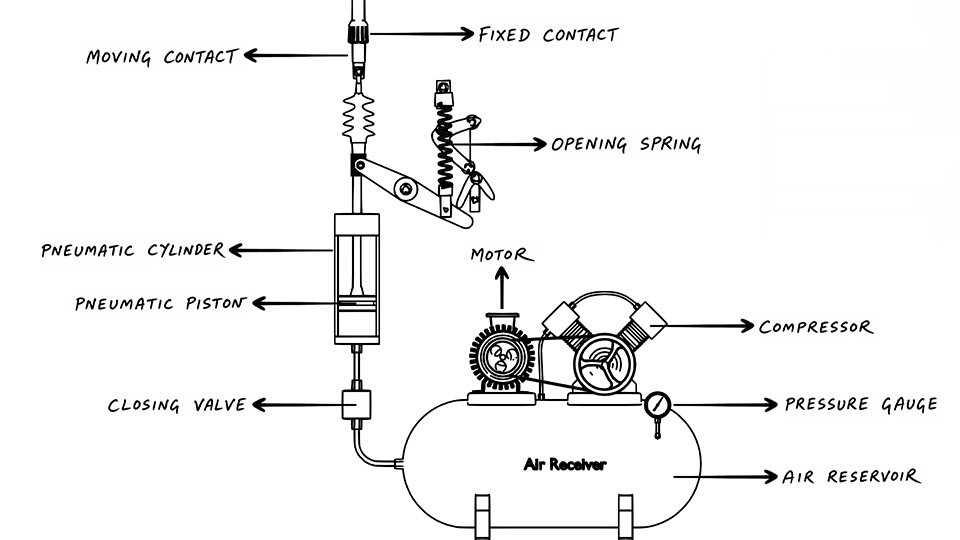
A pneumatic cylinder containing a piston is connected to the circuit breaker operating mechanism. Compressed air from the reservoir reaches this cylinder through a solenoid-operated control valve.
Whenever a closing command is given, either locally or remotely, the closing solenoid is energised. The solenoid operates the control valve, allowing compressed air from the reservoir to enter the pneumatic cylinder. The compressed air rapidly expands inside the cylinder and pushes the piston. The piston movement is transmitted to the moving contact through a system of gears, levers and mechanical linkages. As a result, the moving contact moves towards the fixed contact and the circuit breaker closes.
At the same time, exactly like the spring-spring mechanism, the opening spring is compressed during the closing operation. Once fully charged, it is held in position by a mechanical latch.
A trip coil is connected to the opening mechanism. Whenever a trip command is received, either from the local control panel or from a protection relay, the trip coil is energised. Its plunger releases the opening latch, allowing the opening spring to expand.
As the opening spring expands, it drives the moving contact back through the mechanical linkage, separating it from the fixed contact. Consequently, the circuit breaker opens.
Solenoid Closing and Spring Opening Mechanism
Now let us discuss the solenoid closing and spring opening mechanism of a circuit breaker. In this operating mechanism, a heavy-duty solenoid is used directly for closing the circuit breaker, while a pre-compressed spring is used for opening it.
The plunger of the solenoid is mechanically connected to the moving contact through a system of levers and gears. Whenever a closing command is given, the solenoid is energised from a 110 V or 220 V DC supply, depending on the circuit breaker design.
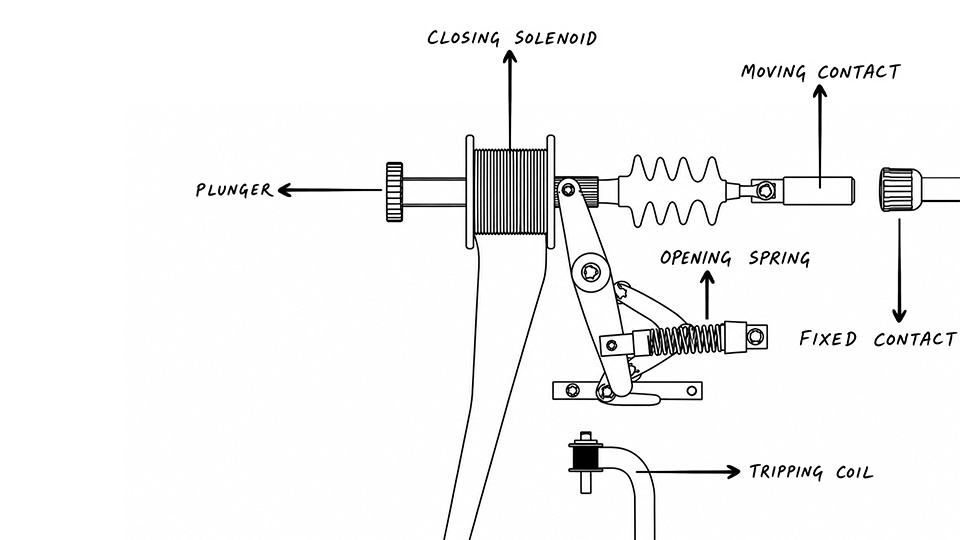
The number of turns and the current rating of the solenoid are selected so that it produces sufficient magnetomotive force (MMF) to pull the plunger inside the coil. As the plunger moves, it drives the moving contact and closes the circuit breaker.
During the closing operation, the tripping spring is compressed because it is mechanically linked to the moving mechanism. Once fully compressed, a latch locks the spring in its charged position.
When a trip command is given, the trip coil is energised. Its plunger releases the latch holding the compressed spring. The tripping spring then expands rapidly, pulling the moving contact back and opening the circuit breaker.
This mechanism is simple and reliable, but because a large solenoid is required to generate high operating force, it is mainly used in low-voltage air circuit breakers, especially 415 V ACBs.
Pneumatic Closing and Pneumatic Opening Mechanism
In this system, compressed air is used for both closing and opening the circuit breaker. The system consists of an air compressor, an air reservoir, control valves, piping, pneumatic cylinders, and solenoid-operated valves. The compressor draws atmospheric air, filters it, compresses it, and stores it in the air reservoir at high pressure.
When a closing pulse is applied, the closing solenoid valve opens. This creates a passage for compressed air to enter the pneumatic cylinder behind the piston. The high-pressure air pushes the piston forward. Since the piston is mechanically connected to the moving contact, the circuit breaker closes.
For the opening operation, another compressed-air line is connected to the opening side of the operating cylinder and the arcing chamber. When a trip pulse is applied, the tripping solenoid valve opens, allowing compressed air to flow at high pressure. The air pushes the piston in the opposite direction, causing the moving contact to separate and open the circuit breaker.
At the same time, the high-velocity compressed air flows through the arcing chamber, cooling and de-ionising the arc, thereby extinguishing it quickly. Thus, in this mechanism, compressed air performs both the operating function and the arc-extinguishing function.
Hydraulic Operating Mechanism
In this mechanism, high-pressure hydraulic oil is used for both closing and opening operations. The system consists of a motor-driven hydraulic pump, an oil reservoir, an accumulator, hydraulic control valves, piping, and a hydraulic cylinder with a piston.
The hydraulic pump compresses the oil and stores it in the accumulator under very high pressure. When a closing command is given, the closing control valve opens and allows high-pressure oil to enter one side of the hydraulic cylinder. The oil pushes the piston forward, and through a system of mechanical linkages, the moving contact closes the circuit breaker.
For the opening operation, a trip command energises another control valve. High-pressure oil is then directed to the opposite side of the piston. The piston moves backward, pulling the moving contact away from the fixed contact and opening the circuit breaker.
One important advantage of the hydraulic mechanism is that the hydraulic oil itself provides excellent damping. Therefore, no additional damping arrangement is normally required, resulting in smooth and shock-free operation.
However, this mechanism also has some disadvantages. There is always a possibility of oil leakage, and the hydraulic pump, accumulator, cylinders, and associated piping make the entire operating mechanism bulky, heavy, and expensive. Because of these drawbacks and the availability of simpler spring-operated mechanisms, hydraulic operating mechanisms have become almost obsolete in modern high-voltage circuit breakers.
Video on Operating Mechanisms of High Voltage Circuit Breakers