
An ideal current source is an imaginary source. We use it only for circuit analysis. It is a theoretical concept. An ideal current source supplies a constant current regardless of the load condition. The current does not change with the change in the connected circuit. No matter what circuit we connect, the source always delivers the same current.
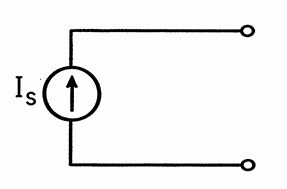
The symbol of an ideal current source is a circle with an arrow inside. The arrow shows the direction of current flow.
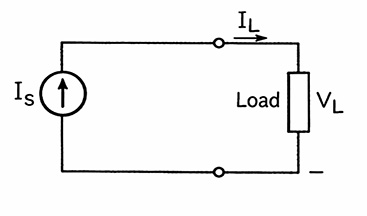
If we connect a load across an ideal current source, the current remains the same. Even if we short-circuit the source, it still delivers the same current. Now we remove the short circuit with a load resistance. When we change the load resistance, the voltage across the source changes according to Ohm’s law. Because the current is constant while the resistance varies. So the voltage changes, but the current stays constant. Therefore, an ideal current source provides a constant current irrespective of the voltage across it.
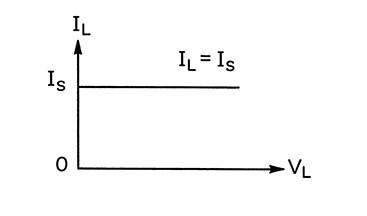
Its V–I characteristic is a straight horizontal line. This shows that the current remains constant while the voltage varies.
Practical Current Source
A practical current source, however, is different. In real life, every current source has internal resistance. A practical current source consists of an ideal current source connected in parallel with a high internal resistance, called shunt resistance. When we connect a load across a practical current source, the current divides between the internal resistance and the load.
When we short-circuit a practical current source, the short path offers almost zero resistance. So the entire source current flows through the short-circuited path. No current flows through the internal shunt resistance in this condition.
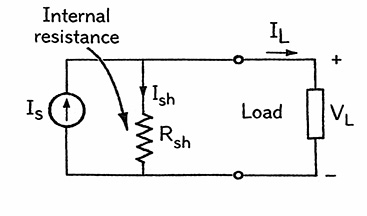
When we remove the short circuit and connect a load resistance, the situation changes. If we gradually increase the load resistance, some portion of the source current starts flowing through the internal resistance, and the remaining portion flows through the load. As a result, the load current decreases. This is why a practical current source cannot maintain a perfectly constant current through the load when the load resistance changes.
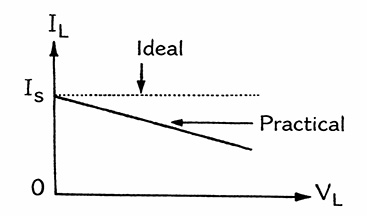
The V–I characteristic of a practical current source is an inclined straight line. This line shows that when the load resistance increases, the voltage across the load increases. At the same time, the load current decreases. The remaining part of the source current passes through the internal shunt resistance. This behavior clearly distinguishes a practical current source from an ideal current source. We can write the current equation of a practical current source as
Time Invariant Current Source
A time-invariant current source supplies a constant current. That means it does not change with time. The output current remains fixed and is usually denoted by a capital I.
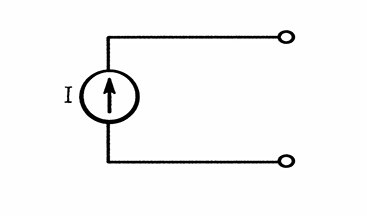
A DC source is a good example of a time-invariant current source. The magnitude of the current stays constant over time.
Time Variant Current Source
In contrast, a time-variant current source provides a current that changes with time. An AC source is a typical time-variant source. Because the magnitude and direction of an alternating current continuously change.
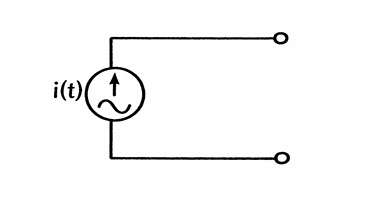
We represent the time variant current with the small letter ‘i’ as a function of time i(t).