
Key Properties of Transformer Oil and Why They Matter

Transformer oil plays two major roles inside a transformer. It strengthens the electrical insulation between live parts and between live and dead parts inside the transformer tank. It also removes heat from the core and windings by carrying the heat to the radiators. To perform efficiently, transformer oil must possess several important properties. Each of … Read more
Technical Parameters of Transformer Oil – A Complete Guide

Breakdown Voltage (BDV) of Transformer Oil Breakdown Voltage (BDV) indicates the voltage above which an oil electrically breaks down. According to IS 335, new unfiltered transformer oil should have a breakdown voltage above 30 kV (rms) when tested with a 2.5 mm gap. For filtered new transformer oil, it is greater than 60 kV (rms) … Read more

Nitrogen Injection Fire Protection System (NIFPS or NIFPES)

Nitrogen Injection Fire Protection System (NIFPS or NIFPES)

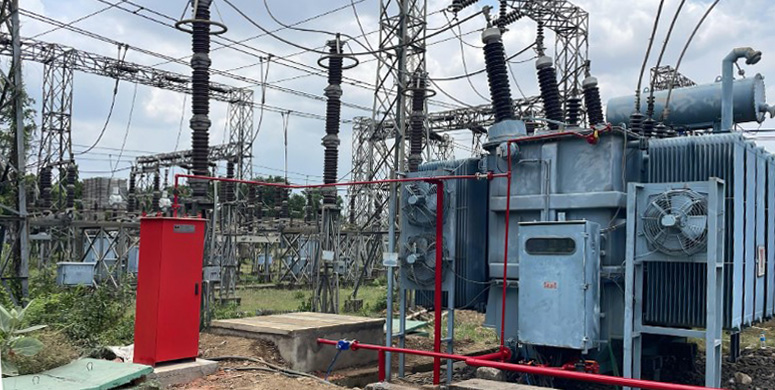
The Nitrogen Injection Fire Protection System (NIFPS) prevents and extinguishes fires in oil-filled transformers. Thereby, it safeguards critical power infrastructure. We also commonly call it the Nitrogen Injection Fire Prevention & Extinguishing System (NIFPES). This system operates on a “drain and stir” principle, effectively mitigating fire hazards through a coordinated sequence of actions. Working Principle … Read more

Stage Inspection of a Transformer

A power transformer has high cost, large size, and complex design. So, identifying defects at the final stage of manufacturing can lead to significant delays, expenses, and operational challenges. Therefore, standards always recommend performing different tests and inspections during various stages of manufacturing. That means the standards always prefer to perform stage inspections of a … Read more

Parameters of a Transformer (10MVA 66/11KV Transformer)

The clearance requirements for HV and LV terminals in the air are as follows:For 66 kV side, the phase-to-phase and phase-to-earth clearance should be 700 mm, and 660 mm respectively.For 12 kV side, the phase-to-phase and phase-to-earth clearance should be 280 mm, and 140 mm respectively. The following points should be noted for designing winding … Read more

What is Transformer Differential Protection? Complete Guide

The transformer differential protection belongs to the unit protection scheme. A differential protection scheme compares the vector sum of currents entering and leaving the protected equipment. In other words, it uses Kirchhoff’s current law. Under healthy and external fault conditions, the currents entering and exiting the zone are balanced. Only an internal fault in the … Read more

Restricted Earth Fault (REF) Protection of Transformer

Restricted Earth Fault (REF) protection is a special type of protection. This protection scheme is mainly applied to power transformers. This scheme is designed to detect only the internal earth faults of the transformer. It provides highly sensitive and selective protection for internal earth faults. Restricted earth fault protection is a unit protection scheme. REF … Read more

High Impedance REF Protection of Transformer- Complete Guide

There is a disadvantage in a low-impedance restricted earth fault scheme. Suppose, due to any fault, any of the line CTs comes under saturation. A spill current starts flowing through the earth fault relay. As a result, the relay may initiate mal-tripping to the transformer circuit breakers. Although the fault is not related to the … Read more

Backup Protection of Transformer – Over Current Earth Fault

A simple overcurrent (O/C) and earth fault (E/F) protection is essential for a power transformer. The O/C protection operates whenever the phase current exceeds a preset value. E/F protection responds to residual or zero-sequence current. Overcurrent and earth fault protection of power transformers uses simple IDMT or DMT relays. It cannot distinguish between internal and … Read more