
A Battery Energy Storage System (BESS) is one of the most modern technologies used in power systems to maintain the balance between electricity generation and demand. As renewable energy sources such as solar and wind are increasingly integrated into the power grid. Therefore, energy storage systems are becoming essential for maintaining grid stability and reliability.
Growing Need for Battery Energy Storage
Across the world, governments are encouraging the use of renewable energy. Actually they try to reduce dependence on conventional fuel-based power plants. For example, India has set a target of 500 gigawatts of renewable energy capacity by 2030.
However, renewable energy sources are intermittent and unstable. Solar power plants generate maximum electricity during sunny afternoons but produce almost no power after sunset. Similarly, wind turbines generate electricity only when wind speeds are high, which varies throughout the day and across seasons. Because of this variability, renewable power generation often fluctuates.
At the same time, electricity demand is not constant. In most power systems, peak demand occurs in the evening, typically between 6 p.m. and 10 p.m. Ironically, solar power generation is nearly zero during this period. On the other hand, when solar plants produce maximum energy during the afternoon, the demand is relatively low.
This mismatch between power generation and demand creates the need for energy storage systems. A Battery Energy Storage System (BESS) stores excess energy produced during low-demand periods and supplies it back to the grid during peak demand hours.
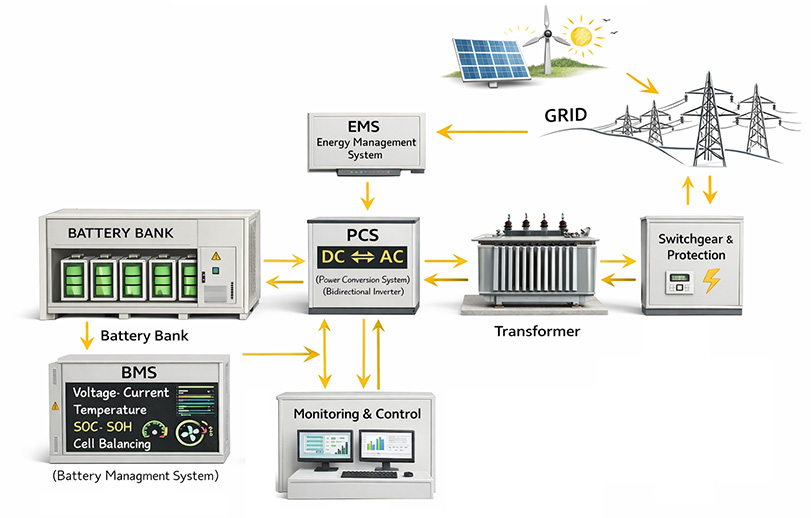
Basic Components of a BESS
A typical Battery Energy Storage System consists of three main components:
- Storage Battery
The battery bank is the core component of the system. It stores electrical energy in the form of chemical energy and releases it when required. - Power Conversion System (PCS)
The PCS includes a rectifier (charger) and an inverter. The rectifier converts AC power from the grid into DC power to charge the battery. The inverter converts the stored DC energy back into synchronized three-phase AC power. So that the grid can take the power. In modern systems use IGBT-based converters for both rectification and inversion. Because they allow fast and efficient switching with response times of less than 5 milliseconds. - Energy Management System (EMS)
The EMS acts as the control center of the BESS. It continuously monitors grid parameters such as voltage, frequency, and phase angle. Then it determines whether the battery should operate in charging mode or discharging mode. It then sends control signals to the PCS accordingly.
Auxiliary Systems in BESS
In addition to the primary components, several auxiliary systems are required for safe and efficient operation.
- Battery Management System (BMS)
The BMS monitors the voltage, current, and temperature of each individual battery cell. It helps maintain optimal performance and ensures the safety of the battery bank. - Fire Protection System
Because batteries store large amounts of energy and contain electrolytes, there is always a risk of fire hazards. Therefore, BESS installations include advanced fire detection and suppression systems. - Cooling System
Batteries generate heat during both charging and discharging. Most large-scale systems use lithium-ion batteries. Lithium-ion batteries operate efficiently within a temperature range of 20°C to 40°C. The cooling system maintains the battery temperature within this safe operating range.
Role of Transformer in BESS
Battery banks usually produce low-voltage DC power. The PCS converts this into low-voltage three-phase AC power. However, grid voltages are much higher. Therefore, a power transformer is installed between the PCS and the grid.
The power transformer performs two important functions:
- Steps up the PCS output voltage to match the grid voltage when the BESS supplies power to the grid.
- Steps down the grid voltage when the grid feeds power to charge the battery.
Switchgear and protection systems are also applied to protect the transformer from faults and also to protect the entire BESS system.
Conclusion
A Battery Energy Storage System (BESS) plays a crucial role in modern power systems by improving grid stability, renewable energy integration, and power reliability. The system mainly consists of a battery bank, Power Conversion System (PCS), and Energy Management System (EMS), along with auxiliary components such as BMS, cooling systems, fire protection systems, and transformers.
As renewable energy penetration continues to increase, BESS technology will become an essential component of future smart grids and sustainable power systems.