
Inrush current in a transformer is caused by the saturation of the core when a high flux is produced at the instant of switching on the transformer. We will explain this phenomenon in the following discussion. Also we shall discuss the necessary theory so that the concept becomes clear.
Steady State Flus in a Transformer
Before discussing the inrush current in a transformer, we should understand how the flux varies with the applied voltage in a transformer.
In a transformer, the magnetizing current lags the applied voltage by 90o. This happens because the magnetizing current is a pure inductive current. From our basic knowledge, we know that the magnetic flux is directly proportional to the magnetizing current. Therefore, the flux in the core varies in the same rhythm as the magnetizing current. This means the flux also lags the applied voltage by 90o.
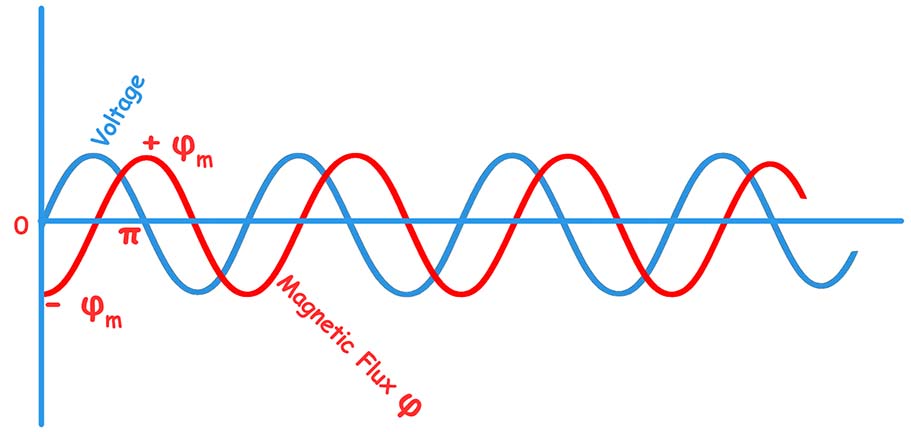
If we draw the waveforms of voltage and magnetizing flux in a transformer, we will observe an important relationship. At the first zero crossing of the voltage, the flux will be at its negative maximum value. At the end of the first half cycle of the voltage, the flux will reach its positive maximum value. The manufacturers design the transformer core that it can easily carry this maximum flux without becoming saturated.
Switch on a Transformer
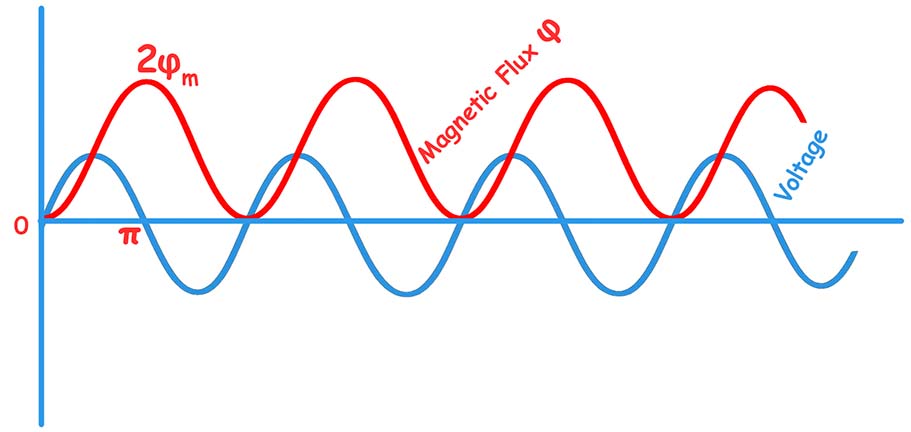
Now consider a situation when we switch on the transformer. At the initial condition, the core is not magnetized. Suppose the transformer primary makes the circuit at the zero crossing of the voltage. We consider this situation because it represents the worst switching condition. At that instant, there is no flux in the core because the core is initially not magnetized. Therefore, the flux will start building from zero. So, at t = 0, instead of the flux having its negative maximum value, it will have a zero value.
From this point, we can mathematically show that by the end of the first half cycle of the voltage waveform, the flux will reach to the twice its maximum value.
Mathematical Proof
Let us consider as the function representing the flux in a transformer core. The induced voltage across the transformer winding can be written as
Where N is the number of turns in the transformer winding. Therefore, we can write
Now, we integrate both sides with respect to t. Then we obtain
The applied or induced voltage across the transformer winding is sinusoidal. Therefore, we can write
Where Vm is the amplitude of the voltage waveform. Now substitute this expression of V(t) in equation (i). Then we get
After integration, we obtain
Where, and it is the maximum value or amplitude of flux waveform.
Now we apply the initial condition to determine the value of the constant C. During switching on, we assume that the transformer core is initially demagnetized. Therefore, the flux at the instant of switching is zero. So, we can write
Substituting this condition into the equation (ii), we get
From this equation, we obtain
Now substitute this value of C in the equation (ii). Then we get
Now let us put in this equation. Then we obtain
Since, , we get,
From this result, we can clearly see that at the end of the first cycle of the voltage waveform, the flux reaches twice its normal maximum value.
Core Saturation
Manufacturers design the transformer core to carry the maximum flux without saturation. They do not design the core to carry double flux. Otherwise, the size and cost of the core will increase significantly. Since the core is not designed to carry such a high value of flux, the transformer core becomes saturated when this condition occurs. After saturation, the primary winding draws a much higher current from the source in order to produce the required extra flux in the core.
As a result, the current drawn by the transformer suddenly increases. This current may reach ten to twenty-five times the normal rated current of the transformer. This large transient current is known as the inrush current of the transformer.