
Why are stress cones used in cable termination?
When a high-voltage cable is cut for termination, the metallic sheath or screen of the cable is also cut. As a result, a sharp edge is created at the cut end of the sheath. At this sharp edge, the electric field becomes highly concentrated, which produces high voltage stress at that point. This excessive stress can weaken the insulation and may lead to insulation breakdown.
To reduce this problem, a stress cone is installed at that location. A stress cone is usually made of graded insulating and semiconducting materials, and it works similarly to a graded capacitor. The stress cone distributes the electric field uniformly and reduces field concentration at the cut end. Therefore, the voltage stress at the cable termination point decreases, and the chance of insulation failure is reduced.
What are the advantages of XLPE insulation over PVC insulation?
XLPE has several advantages over PVC. XLPE stands for cross-linked polyethylene. Cross-linking provides higher dielectric strength than PVC. XLPE is also lighter than PVC. Due to its higher dielectric strength, the insulation thickness of XLPE cable is less than that of PVC. XLPE is also stronger and more durable than PVC.
What are the advantages of PVC insulation over XLPE insulation?
PVC has some advantages over XLPE. PVC is more flexible than XLPE. So, where a flexible underground cable is required, PVC is preferred instead of XLPE. Due to its higher flexibility, PVC cables can be bent more easily. So, PVC cables usually have a smaller bending radius than XLPE cables.
Another advantage is related to water treeing. XLPE can suffer from water treeing. If any crack or void forms in XLPE insulation, moisture can enter inside. Due to high voltage stress, over time, this moisture forms tree-like paths inside the insulation. These grow day by day and weaken the insulation. Hence, these increase the chances of partial discharge.
PVC does not have this water treeing problem. Also, PVC has better fire resistance. PVC stands for polyvinyl chloride. When PVC burns, it releases HCl gas, which helps to suppress the fire. Because of this, PVC is self-extinguishing. Normal XLPE does not have this property, although fire-retardant XLPE is now available in the market.
How is a 33KV Cable Constructed?
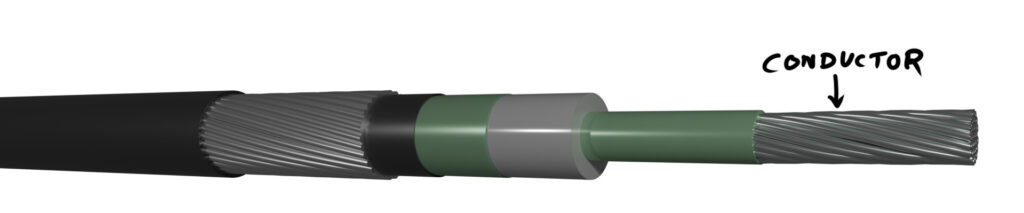
Conductors
A 33 kV underground cable normally uses an aluminium conductor. The conductor is stranded. The strands comply with the Indian Standard IS 8130. They are H4 grade, class-2, compacted circular type. H4 grade aluminium has a tensile strength of more than 150 N/mm². This is the highest grade of aluminium.
Conductor Screen
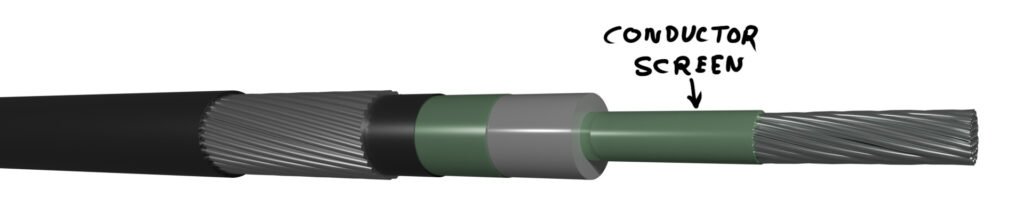
A thin semiconductor screen is applied over the conductor. This is a semiconductor XLPE screen. Carbon is mixed with XLPE to make it semiconducting. There are ridges due to strands on the conductor surface. High electric fields can concentrate at these portions. The semiconductor layer distributes the electric field evenly on the conductor surface.
XLPE Insulation
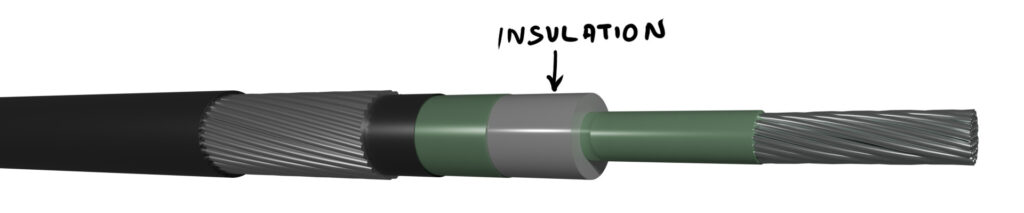
An XLPE insulation layer is placed over this screen. The thickness depends on the voltage grade. For example, a 33/33 kV cable has thicker insulation than a 33/19 kV cable. So the voltage grade mainly depends on the thickness of the XLPE insulation.
Insulation Screen
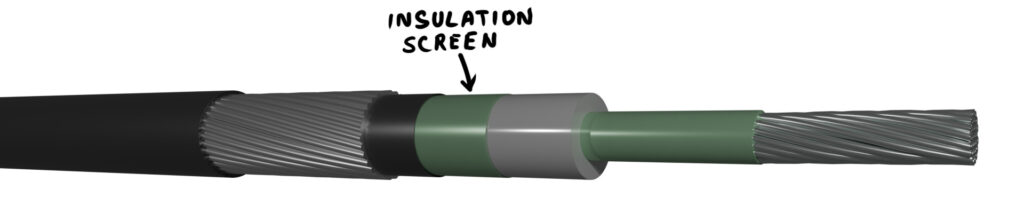
An insulation screen is applied over the insulation. This is also a semiconductor carbon – XLPE layer. It is a thin layer.
Inner Sheath
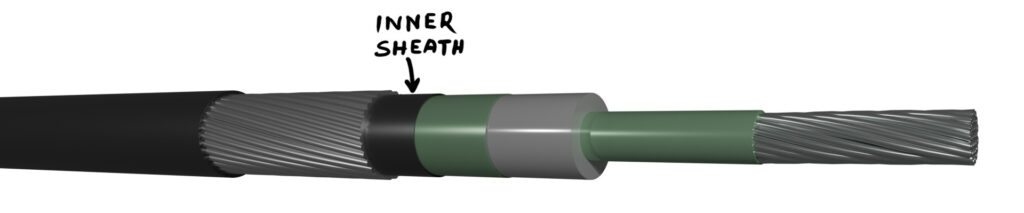
If it is a single-core cable, aluminium wire armour is applied over this screen. This armour is treated as part of the insulation screen. For three-core cables, an inner sheath is used. The inner sheath is made of PVC. It uses ST2-type PVC compound. Single-core cables normally do not need an inner sheath. The inner sheath is used only in multi-core cables. Although, we have shown in our image below, the inner sheath of a single core cable.
Armour Layer
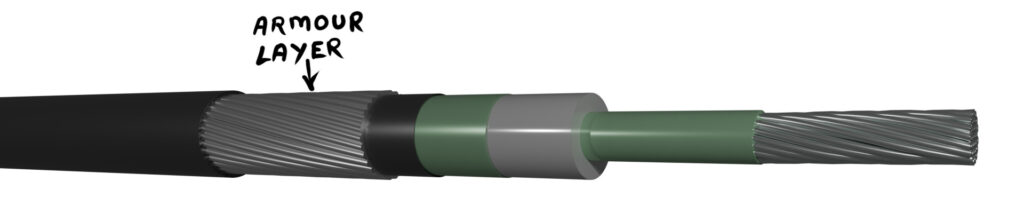
Armour is applied over the inner sheath. The armour is galvanized round steel wire. Hard-drawn aluminium wire armour is used for this purpose. The armour provides mechanical strength. It also provides a return path for fault current. The armour wires are laid closely in spiral form. The armour must have enough cross-sectional area. So it can carry maximum fault current within temperature limits.
Outer Sheath
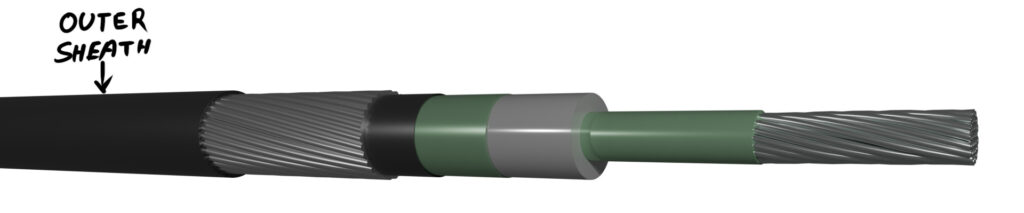
On top of the armour, a black outer sheath is applied. This is an extruded outer sheath. Fire-retardant PVC of ST2-type is used. It follows the IS 5831 standard.
Why are conductor and insulator screens required in high-voltage power cables?
The conductor is stranded. A stranded conductor does not have a smooth outer surface. It has small grooves and gaps between strands. Because of these grooves, the electric field is not uniform. At high voltage, uneven high electric fields are created. If this electrical stress acts directly on the insulation, partial discharge (PD) can occur. Over time, this can damage the insulation.
To avoid this, a semiconductor layer is placed between the conductor and the insulation. A semiconductor is not a full conductor nor a full insulator. Due to its semiconducting property, it smooths and distributes the electric field evenly. So the electrical stress on the insulation reduces. This semiconductor layer is called the conductor screen.
For a similar reason, a semiconductor screen is placed over the insulation. After the insulation, the potential suddenly drops. This can cause uneven electric field distribution. The semiconducting insulation screen helps control this field. It makes the voltage gradient smooth. Therefore, it is called the insulation screen.
When is a lead sheath preferred for underground cables?
The lead sheath is technically preferred over the aluminium sheath in some cases. Because lead is less corrosive than aluminium. Lead is almost an inert metal. It generally does not react with other chemicals. So, in moist soil or chemically corrosive soil, a lead sheath is very suitable.
However, the lead sheath has some disadvantages. Lead is heavier and softer than aluminium. The weight of a lead-sheathed cable is also higher than that of an aluminium-sheathed cable. The resistivity of lead is higher than that of aluminium. So, for the same short-circuit current-carrying capacity, the lead sheath has to be made thicker than an aluminium sheath. Because of this, the bending radius of a lead-sheathed cable is higher than that of an aluminium-sheathed cable.
Lead can have toxic effects when used underground. Lead from the sheath can contaminate soil and groundwater if it leaches out. Because of these environmental and health risks, lead-sheathed cables are restricted in some countries.
Although an aluminium sheath is cheaper than a lead sheath, it has its own disadvantages. Aluminium is more corrosive than lead. Its resistance to water and chemicals is lower than that of lead. So, in dry soil and for economic reasons, aluminium-sheathed cables are often preferred. We use aluminum sheath cables mainly within substations. However, for long transmission lines and chemically aggressive soils, lead-sheathed cables are preferred.
Link of the video on the interview Questions on High Voltage Cables