

We mostly use self-supported towers for electrical EHV power transmission. A self-supported tower differs from other types because of its construction features. This tower does not require any stay wire or guy wire to keep it stable in the vertical direction. We generally use lattice-type towers made from galvanized iron (GI) angles of different sizes and lengths. Workers assemble these angles with nut-bolts to form the lattice structure of the tower. Because the tower is very large, it cannot be fully assembled in advance. Instead, workers assemble the tower at the site during erection, following the tower’s structural drawings.
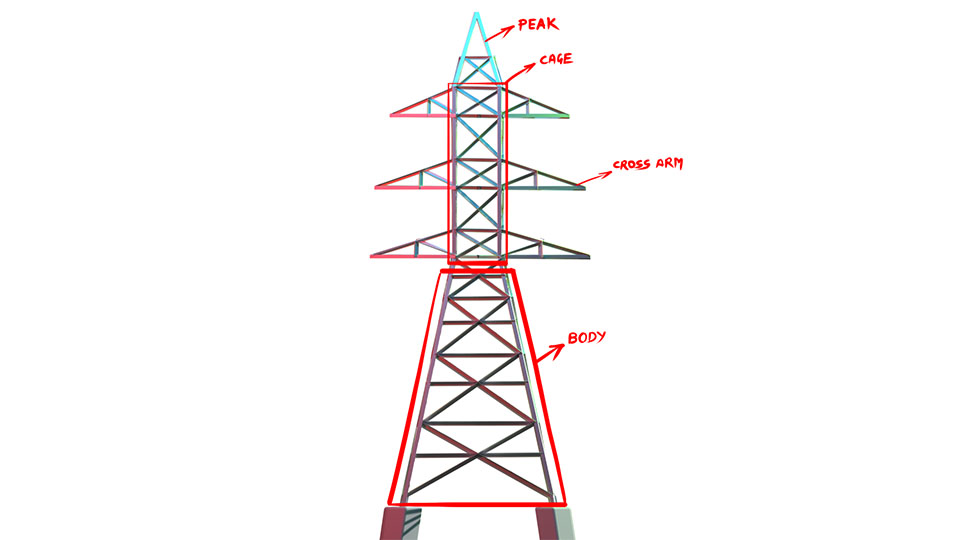
A self-supported tower contains several important parts. We will discuss them one by one in the following sections of our article. These parts include the peak, cage, cross-arm, tower body, extension, top anchor bolt, stud and base plate assembly.
Peak of Transmission Tower
The peak is the triangular lattice structural part placed above the top of the tower cage. In a horizontal tower configuration, we place the peak above the boom at the two extreme ends. The peak supports the ground wire or OPGW. The height of the peak depends on the required clearance to maintain between the live conductor and the earth wire or OPGW. The height of the peak also depends on the angle needed for the Direct Stroke Lightning Protection (DSLP) scheme of the tower line.
Cage of Transmission Tower
The portion between the peak and the tower body is the cage assembly. In vertical towers, the cage usually has a square cross-section. It may remain uniform or taper along the vertical length depending on the mechanical load. The tower legs support the cage at the top, and the cage holds the cross-arm.
Cross-Armof Transmission Tower
The cross-arm carries the conductors using insulator strings. The voltage level of the transmission line mainly determines the length of the cross-arm. Sometimes the cross-arm length also depends on the angle at which the conductor changes direction at tension points. Sometimes, for large deviation angles, we use rectangular or trapezoidal cross-arms with pilot strings on the outside to maintain safe clearance for live conductors.
Tower Body
The tower body is the main structural section. It starts from the ground (concrete plinth) level and ends up at the bottom of the cage. It supports the cage at the top. Depending on bending forces and other loads, the tower body may have a square or rectangular cross-section.
Tower Extension
Sometimes at some special locations we need to use taller towers than its standard design to maintain required ground clearance. A body extension increases the height of the tower to achieve the required minimum ground clearance for the conductor. In some special cases, towers may use extensions up to 9 meters even more. The vertical length of extension part is normally multiple of 3 meter. We install the body extension at the bottom of the tower so the standard tower stands on the extended structure. This means the extension always goes at the bottom, not at the top of the tower body.
How to Determine Tower Height
To calculate the height of a transmission tower, we must consider:
- Required minimum ground clearance
- Maximum allowed sag including creep
- Length of the suspension insulator string with hanger
- Vertical spacing between the phase conductors
- Position of the ground wire to achieve angle of lightning protection.

- H1 represents the minimum ground clearance of the bottom conductor at the mid-span position.
- H2 represents the maximum allowable sag of the conductor.
- H3 represents the length of the suspension string along with its hanger and suspension clamp.
- H4 represents the minimum phase-to-phase clearance between conductors.
- H5 represents the clearance required between the live conductor and the ground/earthwire (GSS).
From the image, we can clearly understand how to combine these heights to calculate the total height of the tower. The total height of the tower equals:
H = H1 + H2 + H3 + (H4 − H3) + H4 + H5
This simplifies to:
H = H1 + H2 + 2H4 + H5