
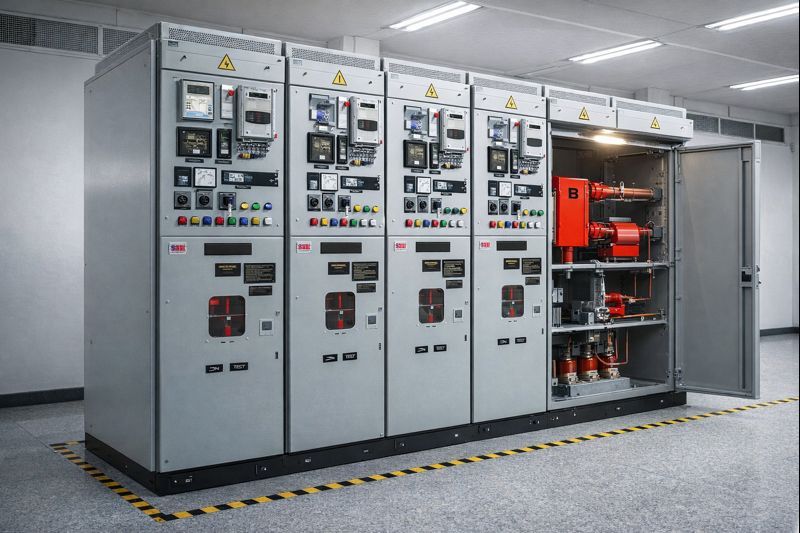
Metal enclosed indoor switchgear is a medium-voltage electrical switchgear system. It is an indoor-type switchgear system. In a metal-enclosed switchgear, all live components remain enclosed within grounded metal compartments. The voltage ratings of this indoor switchgear system range from 3.3 kV to 36 kV. Obviously, it requires less space compared to outdoor switchgear.
All the components of a metal enclosure remain insulated according to their voltage ratings. So, designers can reduce the electrical clearance from the inner metal wall to the components much smaller. This provides a significant compactness to the metal-enclosed switchgear.
An indoor metal-enclosed switchgear offers better protection from environmental effects. This is mainly for two reasons. We always install the switchgear under a roof. Additionally, all the live parts and insulation systems remain inside metal compartments.
Since each enclosure has direct earth connections with the earthing system, it provides high safety to the operators.
Uses of Metal-Enclosed Indoor Switchgear
Modern substations, industries, and renewable energy projects mainly use LV to MV indoor switchgear systems. Electrical power utilities always prefer indoor switchgear for their 11 kV, 22 kV, and 33 kV voltage levels. Also, we can find the uses of metal-enclosed indoor switchgear for other lower voltage levels. The table below shows the typical uses for different voltage ranges.
| System Voltage | Common Usage |
|---|---|
| 3.3 kV | Motors, auxiliaries |
| 6.6 kV | Industrial distribution |
| 11 kV | Primary distribution substations |
| 22 kV | Utility and industrial networks |
| 33 kV | Sub-transmission and large industries |
Construction of Metal Enclosed Indoor Switchgear
There are mainly separate compartments in 33KV and 11KV switchgears. These are the busbar compartment, circuit breaker compartment, cable and CT compartment, and control and relay compartment. This design confines faults, improves safety, and allows maintenance without exposing live parts.
Bus Configuration of Metal Enclosed Indoor Switchgear
The most common bus configuration for 11 kV and 33 kV indoor switchgear is the single bus with a bus sectionalizer. Here, a bus sectionalizer circuit breaker divides a single bus into two sections. Both sections of the bus should be electrically balanced. All similarly rated incomers and outgoings are divided equally into two sections. This mainly improves the reliability. Here, one section can remain energized during the maintenance of the other section. This is the way it provides better reliability than a plain single bus.
Each section has a three-phase potential transformer. There should be an arrangement to divert the PT of one section to another section when required.
Interlocking Scheme
Each medium-voltage metal-enclosed indoor switchgear has a typical interlocking scheme. This interlocking exists between the incomers and the bus sectionalizer circuit breaker. The interlocking scheme ensures that two incomers never operate in parallel unintentionally. The bus sectionalizer circuit breaker can be closed only when at least one incomer is in the open condition. As a result, there is no possibility of paralleling two incoming sources. The table below shows two incomers and the sectionalizer circuit breaker under different operating conditions.
| Incomer-1 | Incomer-2 | Bus Section CB |
|---|---|---|
| Closed | Open | Closed |
| Open | Closed | Closed |
| Closed | Closed | Open |
This interlocking is essential because it prevents the direct electrical connection between two power sources. In medium-voltage circuit breakers, we normally use an electrical interlocking scheme. However, in some cases, we may use a mechanical interlocking scheme using a castle key.