
An inductor is any type of coil of a conductive wire. We all know from our childhood that when a current flows through a coil, it becomes a magnet. It means that whenever a current flows through the coil, it produces a magnetic flux surrounding it. Obviously, if we change the amplitude of the current, the magnetic strength of the coil changes. When the current increases, the magnetic field strength increases. Again, when the current decreases, the magnetic field strength decreases. That means the magnetic field strength of the coil varies proportionally with the current. In other words, the magnetic flux of an inductor varies proportionally with the current.
Behaviour of an Inductor on DC
During Switching On a DC Source
When we connect a coil across a battery, constant current flows through it. In other words, after connecting an inductor with a DC source, the inductor produces a constant flux surrounding it. Now, let us think about the situation of switching on the DC source connected with the inductor. Just before switching on the DC source, there was no current through the inductor. Hence, the flux of the inductor was also zero. At the instant just after the completion of the switching-on operation, the current tries to increase rapidly. As a result, the flux surrounding the inductor tries to rise accordingly. Thus, there will be a rate of change of flux linkage in the inductor.
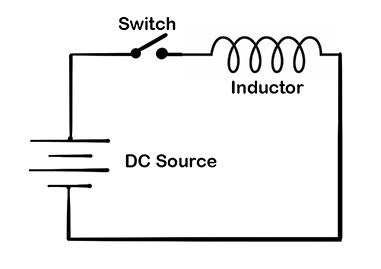
Application of Farrady’s Law
According to Faraday’s law of electromagnetic induction, this changing flux induces an emf across the inductor. Obviously, this emf is the result of the change in current caused by the DC switching operation. Again, the current is caused by the input voltage of the DC source. So, the induced emf across the inductor opposes the input voltage. So, the direction of the induced emf will be opposite to the source voltage. This is why we call the induced emf back emf. Since the source voltage and the back emf are equal and opposite to each other, no current flows through the circuit. The inductor behaves as an open circuit just after switching on the DC source.
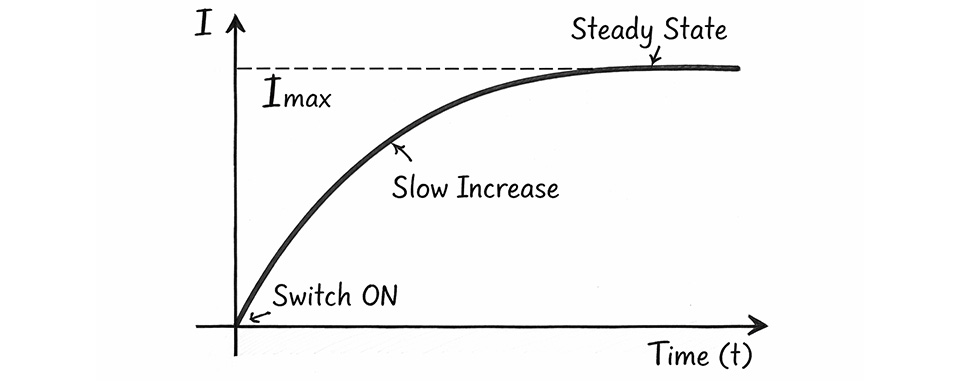
So, the current can not instantly reach its steady-state value. The inductor introduces inertia in the circuit against sudden changes in current. After a certain instant, the current reaches its steady-state value. Therefore, there will be no more change in flux. That means the flux becomes constant. As a result, the back emf vanishes. So, the inductor becomes a short circuit.
During Switching Off a DC Source
When we switch off the DC source, again the current comes down to zero from its steady state value. This change also produces a rate of change of flux linkage. This again introduces back emf in the coil, and hence ultimately opposes the rapid decay of current to zero. So, the current takes a certain time to reach zero after the instant of switching off the source.