
Breakdown Voltage (BDV) of Transformer Oil
Breakdown Voltage (BDV) indicates the voltage above which an oil electrically breaks down. According to IS 335, new unfiltered transformer oil should have a breakdown voltage above 30 kV (rms) when tested with a 2.5 mm gap. For filtered new transformer oil, it is greater than 60 kV (rms) when tested with a 2.5 mm gap.
According to IS 1866, in service oil should maintain a high Breakdown Voltage (BDV). The BDV must be in the range of 40–60 kV when tested with a 2.5 mm gap.
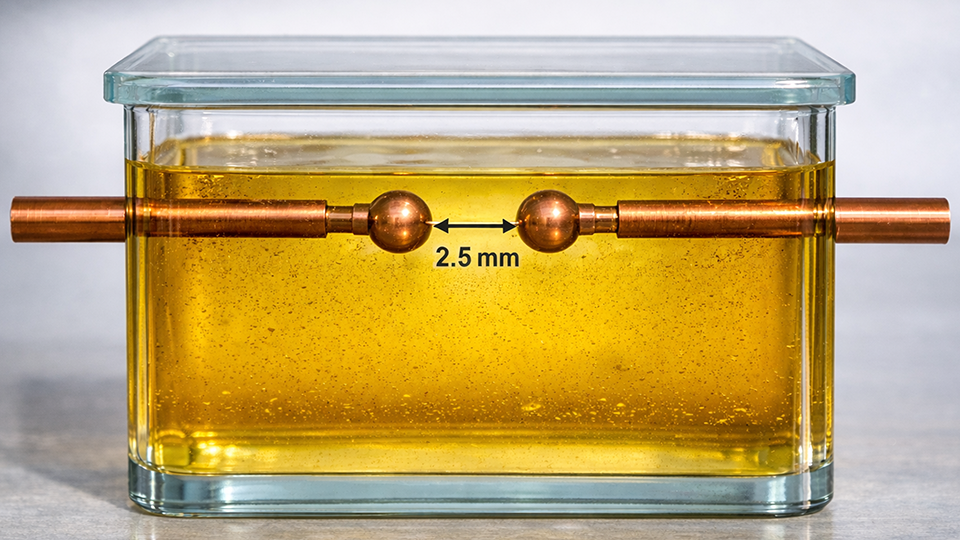
Breakdown Voltage (BDV) is one of the most significant properties of transformer oil. Obviously, moisture content in the oil degrades the BDV of the transformer oil. Also, the conductive contaminants in the oil reduce the BDV value.
Dielectric Dissipation Factor (Tan δ) of Transformer Oil
Dielectric dissipation factor (tanδ) determines dielectric losses in the oil. We measure it as the tangent of the phase-angle between the applied voltage and the resulting current through the oil. Obviously, the oil-filled space between the tank and winding, along with the metal parts of the winding and tank, behaves as a capacitor. A higher tanδ means greater ohmic current compared to capacitive charging current due to applied voltage. Obviously, the energy dissipates as heat. The dissipation factor assesses how conductive the transformer oil is.
According to IS 335, tanδ of new oil at 90°C is typically ≤0.002. Again, as per IS 1866 (in-service), in-service oil should keep tanδ low. A common warning threshold is around 0.1 (i.e., tanδ <0.1). Values above 0.05 often indicate significant contamination. A rising tanδ indicates oil degradation.
Resistivity (Specific Resistance) of Transformer Oil
Low resistivity means the oil is more conductive. According to IS 335, a new oil must be resistant enough. For example, resistivity is typically greater than 35×1012 Ω – cm at 90°C. Additionally, it is more than 1500×1012 Ω – cm at 27 °C. Again, according to IS 1866, an in-service oil should have greater than 1×10¹² Ω – cm at 27°C and greater than 0.1×10¹² Ω – cm at 90°C. As the standard notes, resistivity and tanδ are both very sensitive to polar contaminants.
The standards recommend the resistivity to be measured at both 27°C and 90°C. This is because it confirms the resistive performance of oil is consistent at both normal room temperature and the maximum temperature limit. In other words, it confirms the performance of oil in both no-load and full-load conditions of transformers.
Interfacial Tension (IFT) of Insulating Oil
Interfacial Tension (IFT) is the force required to detach a platinum ring from the oil surface. Obviously, IFT decreases as polar oxidation products accumulate in the oil. According to IS 335, a well-refined new oil has a minimum 40 mN/m IFT at 27°C. Additionally, as per IS 1866, an in-service oil, IFT should remain commonly about 15 mN/m. Values below ~20–25 mN/m indicate heavy contamination.
IFT is a sensitive indicator of oil purity. A low IFT means degraded oil. Monitoring IFT (along with tanδ and resistivity) helps detect ageing before breakdown occurs.
Moisture Content (ppm)
The quantity of dissolved water in the oil. We measure it in parts per million i.e., ppm. Water generally comes from the ambient. Although even small water content can dramatically affect dielectric performance. High moisture also accelerates paper insulation decay and corrosion. Maintaining low ppm is vital for insulation life and BDV.
According to IS 335, a new oil should contain water less than 50 ppm. On the other side, IS 1866, an in-service oil should have water content less than 20 ppm.
Acidity (Neutralization Value) of Transformer Oil
This is the acid number measured in mg of KOH per gram of oil, required to neutralize all acids in the oil. It quantifies oxidation byproducts (organic and inorganic acids) in the oil. IS 335 recommends acidity less than 0.03 mg KOH/g for new oil. According to IS 1866, the threshold of acidity is 0.3 mg KOH/g for in-service oil. If it becomes more than 0.3 mg/g, the standard recommends replacing the oil.
Viscosity of Transformer Oil
The kinematic viscosity (cSt) of the oil, typically at 27 °C, indicates fluidity. Lower viscosity oils flow more easily, aiding cooling circulation. According to IS 335, new oil must have a viscosity less than 27 cSt at 27 °C. Additionally, IS 1866 applies the same viscosity limit for in-service oil. Viscosity also affects cooling efficiency. Because high viscosity obstruct free flow of oil. Hence, high viscosity affects the heat transfer, causing hotspots.
Pour Point
The lowest temperature below which the oil stops free flowing. Obviously, it indicates how the oil behaves in cold conditions. As per IS 335, new oil must have a pour point ≤– 6 °C. IS 1866 follows the same pour-point for in-service oil. Additionally, some utilities standaries the minimum pour as – 10°C for used in-serivice oil. A low pour point ensures the consistent cooling performance of oil even in cold climates.
Flash Point
This is the lowest temperature at which the oil emits enough vapor to ignite momentarily. IS 335 recommends that the flash point must be greater than 140°C. The flash point of in-service oil should be at least 125 °C as per IS 1866. A high flash point means the oil is relatively non-volatile and safer around hot equipment.
| Parameter | IS 335 (New Oil) | IS 1866 (In-service Oil) |
|---|---|---|
| Breakdown Voltage (BDV) (2.5 mm gap) | > 30 kV (unfiltered), > 60 kV (filtered) | 40–60 kV |
| Tan Delta (Dissipation Factor) at 90°C | ≤ 0.002 | < 0.1 (warning) |
| Resistivity at 27°C | > 1500 × 10¹² Ω-cm | > 1 × 10¹² Ω-cm |
| Resistivity at 90°C | > 35 × 10¹² Ω-cm | > 0.1 × 10¹² Ω-cm |
| Interfacial Tension (IFT) at 27°C | ≥ 40 mN/m | ≈ 15 mN/m (minimum expected) |
| Moisture Content (Water) in oil | < 50 ppm | < 20 ppm |
| Acidity (Neutralization Value) | < 0.03 mg KOH/g | ≤ 0.3 mg KOH/g |
| Viscosity at 27°C | < 27 cSt | < 27 cSt |
| Pour Point | ≤ –6°C | ≤ –6°C (many utilities prefer –10°C) |
| Flash Point | > 140°C | ≥ 125°C |
Video on Technical Parameters of Transformer Oil