
Transformer oil plays two major roles inside a transformer. It strengthens the electrical insulation between live parts and between live and dead parts inside the transformer tank. It also removes heat from the core and windings by carrying the heat to the radiators. To perform efficiently, transformer oil must possess several important properties. Each of these properties directly affects the performance and service life of transformers.
Dielectric Strength of Transformer Oil
There is a maximum voltage gradient above which the oil undergoes electrical breakdown. This is the most commonly measured property of transformer oil. We measure the dielectric strength of oil by applying voltage in the KV range between two probes immersed in the oil. We maintain a gap between the probes of either 2.5 mm or 4 mm, depending on the requirement. Then, we increase the applied voltage gradually. The applied voltage at which breakdown occurs in the oil is the rated dielectric strength of the transformer oil. We express this property in kV, and we also mention the electrode gap used during testing, usually 2.5 mm or 4 mm.
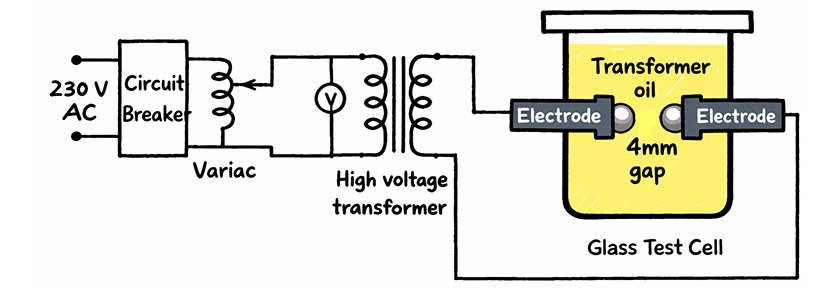
This dielectric strength ensures the strength of insulation between windings and the tank. Also, the paper insulation of the core and windings soaks up and retains the oil. So, the poor dielectric strength affects the paper insulation system of the transformer.
Many factors degrade the dielectric strength of oil. Obviously, the presence of moisture, dirt, suspended particles, oxidation products, and sludge affects the dielectric strength of oils.
Thermal Conductivity of Transformer Oil
Thermal conductivity is the ability of oil to transfer heat away from windings and the core. The oil absorbs the heat and carries it to the cooling surfaces (radiators). Proper thermal conductivity prevents overheating. Therefore, it enhances the power handling capacity of transformers.
Chemical Stability of Transformer Oil
It is the ability of oil to resist chemical reactions. High chemical stability increases the service life of the oil. Chemically stable oil prevents corrosion of the internal parts of the transformers. Stable oil reacts little with internal components such as copper, steel, insulation paper, or sealing materials. Stable oil prevents oil degradation and acid formation. Obviously, this protects insulation paper from rapid ageing. The good chemical stability makes the performance of the oil consistent for many years.
Moisture Tolerance of Transformer Oil
Insulating oil must be ideally moisture-free. Moisture is the worst contaminant in transformer oil. Even a small amount of water significantly reduces the insulation strength of oil. Increased moisture accelerates paper insulation damage. Moisture enters due to leakage, poor sealing, breathing action, or improper handling during maintenance. Low moisture content maintains high dielectric strength and reduces partial discharge risk. Also, it prevents acid and sludge formation. Moisture-free oil also prevents cellulose insulation from breaking down.
Oxidation Stability
The oil must resist oxidation in the presence of oxygen and heat. Oxidation forms acids and sludge in oil. Sludge obstructs the oil movement. Therefore, it reduces the cooling effect of oil. On the other hand, acids in the oil degrade the quality of the oil. Again, the presence of acid makes the oil more susceptible to chemical reactions.
Viscosity
The viscosity of oil must remain as low as possible. In a transformer, oil must circulate freely to transfer heat effectively. If the viscosity is too high, oil circulation becomes slow. Consequently, it creates hot spots inside the windings. In other words, low viscosity ensures natural and forced oil circulation. Overall, low viscosity improves cooling efficiency. Also, the high viscosity becomes a bigger issue in cold climates.
Flash Point
The high flash point prevents the oil from fire hazard. Higher flash point improves reliability during high short-circuit faults. Because high short circuit currents cause extreme heating.
Pour Point
Pour point is the lowest temperature at which the oil can still flow. Below this temperature, oil becomes thick or may stop flowing. The low pour point ensures proper oil circulation in cold weather. So it maintains the cooling performance intact even in low-temperature winter conditions. Oil used in cold regions should have a low pour point. This is why most utilities use naphtha-based oil for hilly and cold areas.
Dissipation Factor (Tan δ / Power Factor)
Dissipation factor (tan δ) indicates dielectric loss in oil. Therefore, tanδ indicates the insulation condition of oil. Ideally, transformer oil should behave like a perfect insulator. However, contaminants such as moisture, acids, and oxidation products increase dielectric losses. A low dissipation factor means the oil has good insulating quality and minimal losses.