
A Nickel Cadmium battery is a rechargeable chemical battery. It uses nickel oxyhydroxide as the positive active material. Also, it uses cadmium as the negative active material. Compared to other battery technologies it provides stable voltage, long cycle life, and reliable performance even under heavy load and low temperatures.
Ni-Cd Battery Composition
A Ni-Cd battery has two electrodes like other all batteries.
The positive electrode (cathode) contains Nickel Hydroxide Ni(OH)2 at its discharged state. Although at charged state it becomes Nickel Oxyhydroxide (NiOOH).
Conversely, the negative electrode (anode) contains cadmium hydroxide – Cd(OH)2 at the same discharged state. Thereafter, it becomes pure cadmium – Cd at the charged state of the battery.
Chemical Reactions in a Nickel Cadmium Battery
The reaction during discharge (battery supplying power) is as given below
2NiOOH + 2H2O + Cd → 2Ni(OH)2 + Cd(OH)2
Here, nickel oxyhydroxide changes to nickel hydroxide. Additionally, cadmium changes to cadmium hydroxide. This reaction releases energy to supply devices.
During charging the reaction goes in reverse.
2Ni(OH)2 + Cd(OH)2 → 2NiOOH + 2H2O + Cd
The charging reaction shows that electrical energy forces the chemicals back to their charged state. here, the nickel hydroxide becomes nickel oxyhydroxide. At the same time, cadmium hydroxide becomes cadmium.
Electrolyte of Nickel Cadmium Battery
In a Ni – Cd battery cell, potassium hydroxide (KOH) in deionized water serves the purpose of electrolyte. Here, we often add a small amounts of Lithium Hydroxide (LiOH). This added LiOH improves cycle life, high and low temperature performance. It improves the operation temperature range from –40°C to +70°C.
The alkaline electrolyte does not react with battery materials or the steel container. Also, the electrolyte is not part of the chemical reaction. So, it does not cause corrosion. It only carries ions between electrodes.
Features and Benefits of Ni-Cd Batteries
These describe what makes Ni-Cd batteries technically strong and reliable.
- Robust and Reliable Design: Ni-Cd batteries are constructed strongly and do not fail suddenly.
- Reliable in Harsh Environments: They work well even in difficult industrial or outdoor conditions.
- Wide Operating Temperature Range: They can operate from –40°C to +70°C, making them suitable for extreme climates.
- Long Service Life: They provide over 20 years of service at normal room temperature (+25°C or +77°F).
- Low Heavy Metal Content Compared to Lead-Acid: They use less toxic material than lead-acid batteries. Efficient Manufacturing: Made using recycled components and low-carbon electricity in EU factories.
Construction of a Nickel Cadmium Battery
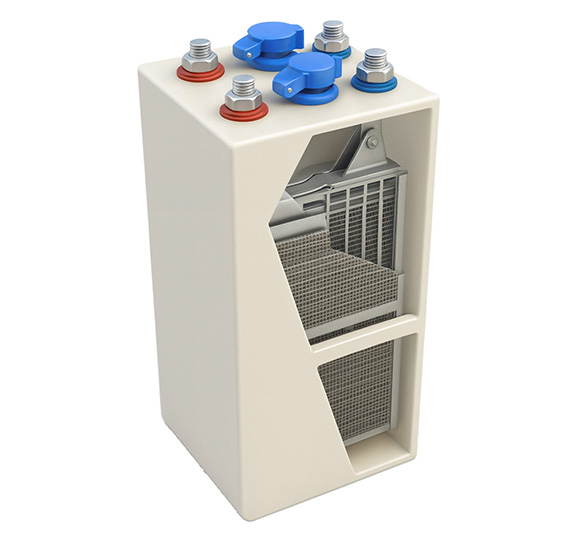
Positive Plate (Nickel Electrode): The positive plate contains nickel oxyhydroxide (NiOOH). Manufacturers usually place this active material into a porous nickel-plated steel grid. This structure increases surface area and improves chemical reaction.
Negative Plate (Cadmium Electrode): The negative plate contains cadmium (Cd). This plate also uses a porous metal grid to hold the active material. The design helps current flow smoothly during charge and discharge.
Pocket Plate Design
Ni-Cd batteries use a pocket plate design. Here active material is sealed into metal pockets. These metal pockets ensures long life, mechanical strength, and resistance to vibration.
The construction begins with nickel-plated steel strip with many tiny punched holes. The nickel-plating prevents corrosion of steel from the moisture. The strip is double-perforated, meaning it has rows of small holes on both sides. These holes allow electrolyte penetration and support ion movement during charging and discharging.

Each of the perforated sheets is folded from its side edge as shown. Two specially folded can be locked together to form a steel pocket. The we insert active materials. Encapsulating the active mass protects it from shedding (falling off).

A number of such pockets are mechanically crimped or interlocked. This forms a series of pockets. The locking mechanism ensures the pockets stay uniform in shape and thickness.

A rectangular metal frame holds such neatly fitted perforated pockets assembly. It forms a complete electrode plate.

A stack of alternating plates with separators between them forms a plate stack. Positive and negative plates are arranged alternately.

Two current collector tab are attached to the top so that the plate assembly.
Separator
A thin, microporous separator is placed between the two alternative plates. It prevents the electrodes from touching each other. However, it still allows the electrolyte to move freely through it. Typically, manufacturers use nylon, polypropylene, or similar materials.
Container
A plastic container encloses the plates and electrolyte. The container also holds vent plugs for gas release during overcharge. The battery has positive and negative terminals at the top of the container.