
The induction cup relay works by electromagnetic induction. It makes torque inside a light metal cup.
The cup turns the moving contacts fixed to it. Finally, the relay closes its contact. It offers quick and reliable protection because of its lightweight metal cup rotor and stronger magnetic field.
Definition of Induction Cup Relay
The relay produces a rotating magnetic field from the single-phase input signal, like the stator of an induction motor. Then, the relay converts rotating magnetic fields into the motion of the lightweight aluminium cup. Thus, it senses faults and operates fast. Mathematically, torque T depends on current I and flux \(\phi\). That means \[T \propto I \cdot \phi\]\[T = k \cdot I \cdot \phi\]Here, k is a constant. Since the magnetic flux is also proportional to the input current I, the torque often follows the square law. That means
\[T \propto I^2\]\[T = k’ \cdot I^2\]
Consequently, the relay is sensitive to current magnitude, not the direction of the current.
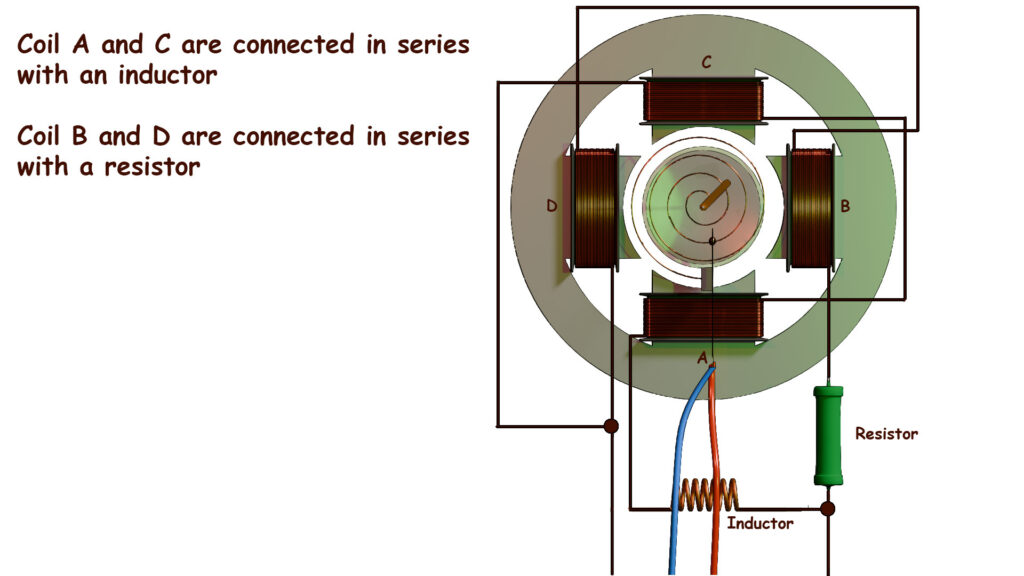
Construction of Induction Cup Relay
The relay has four coils labeled A, B, C, and D. Coils A and C are connected in series through an inductor. Coils B and D connect in series through a resistor. Therefore, the two coil pairs produce different phase shifts. Next, a hollow aluminum cup sits on a spindle at the center. A spring gives a restraining torque \(T_s\). Also, the moving contact assembly is attached to the cup spindle. So, when the cup turns, the moving contacts move the contact.
Working Principle
First, AC currents flow through all coils. Because of that, two flux systems form. Moreover, the inductor branch delays the current. Meanwhile, the resistor branch has less delay. Thus, the fluxes are out of phase and appear to rotate. This rotating flux induces eddy currents in the cup. Then, the interaction between flux and eddy currents produces torque. As a result, the cup turns against the spring. When torque T exceeds spring torque \(T_s\), the relay trips. \[T > T_s\]Finally, the contact closes and the protection circuit acts.
Advantages of Induction Cup Relay
- It provides high torque for a small rotating cup mass. The mass distribution of the cup-shaped lightweight rotor is advantageous for smooth rotation.
- Also, it responds faster as the magnetic field is stronger compared to an induction disc relay.
- Its lightweight rotor cup and more uniformly distributed magnetic field provide more sensitive and stable operation.
- Moreover, the construction of an induction cup is mechanically more stable due to its balanced weight distribution in the shape of the rotor and stator.
- Additionally, it can withstand mechanical shocks more efficiently than an induction disc relay because of its more robust design.
Uses of Induction Cup Relay
- Directional overcurrent protection.
- Distance and differential protection.
Drawbacks
- It needs AC sources only.
- Also, it has moving parts that require care.
- Furthermore, coil phasing and alignment must be correct.
- Finally, modern numerical relays often replace it.