
The corona effect is a natural electrical phenomenon. It occurs on EHV and UHV transmission lines. It may also occur inside substations on the live parts of high-voltage equipment.
Cause of the Corona Effect
The voltage level of transmission lines and live equipment is very high in EHV systems. Therefore, the electric field intensity surrounding the conducting metallic parts of the EHV system is also extremely high. The electric field strength, or voltage gradient, is maximum on the surface of the conductors. However, it does not vary linearly with distance from the conductors. Instead, it has a maximum value on the conductor surface and decreases nonlinearly with distance.
Air has its own dielectric strength. Dielectric strength means voltage-withstand capability. Typically, the dielectric strength of air is around 30 KV/cm. Electric field intensity is also expressed in the same manner, that is, voltage per unit distance.
Sometimes, the electric field intensity exceeds the dielectric strength of the air surrounding a high-voltage conductor. This may also happen due to a reduction in the dielectric strength of air caused by the presence of moisture and dust. When the electric field intensity comes below the dielectric strength of air, the air breaks down and becomes ionized. As a result, the air starts to conduct electricity locally. This local discharge is called the corona effect.
Engineers have to design power system equipment while considering the corona effect. Because local discharge causes continuous power loss in the system. As a result, the efficiency of the transmission system is reduced.
Definition of Corona Effect
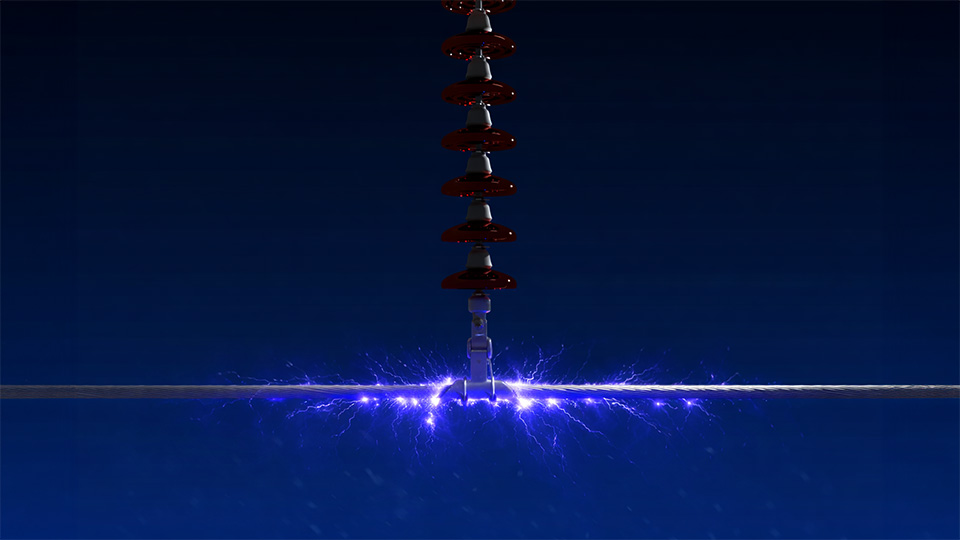
A corona is a localized electrical discharge around a conductor due to ionization of the surrounding air caused by a high voltage gradient near the surface of the conductor.
The corona phenomenon produces a faint glow on the conducting parts of the system, accompanied by a typical hissing sound. These effects are visible and audible, respectively, mainly during silent nights when a person stands near or below a transmission line.
Reasons for the Corona
The normal dielectric strength of air is about 30 kV/cm (peak value). This value decreases when the moisture and dust content in the air increases beyond normal limits. Sometimes, due to high voltage, the voltage gradient or electric field at the conductor surface exceeds the breakdown strength of air. As a result, air particles become ionized. The ionized medium surrounding the conductor provides a path for electrical discharge through air. This is a type of partial discharge in air.
The electric field intensity is inversely proportional to the square of the radius of the conductor. Therefore, a smaller radius results in a higher electric field. Consequently, the chances of the corona effect increase.
Similarly, rough surfaces on conductors increase the corona. Atmospheric conditions also play an important role. During rainy or foggy seasons, or when dust particles are present in the air, the dielectric strength of air reduces. As a result, corona may initiate at lower voltages, or its intensity may increase. That is why during rainy and foggy conditions, both the glow and the hissing sound of corona become more pronounced.
Methods to Reduce the Corona Effect
There are many methods to reduce corona in high-voltage systems.
For voltage levels above 220 kV, bundled conductors are commonly used instead of a single conductor, even if the current-carrying capacity of a single conductor is sufficient. A bundled conductor increases the effective cross-sectional area. An increase in effective cross-sectional area increases the effective diameter. Therefore, it reduces the corona effect.
Engineers use round-shaped conducting parts as much as possible in high-voltage systems. Because a round shape eliminates sharp corners. Sharp corners reduce the radius of curvature and thereby increase the electric field intensity at the corner, which enhances the corona effect.
Also, manufacturers grind and polish the rough surfaces of connectors as much as possible to minimize surface irregularities.
Lastly, manufacturers use corona rings. The corona ring gets the same voltage as the connector. Due to uniform voltage distribution between the corona ring and the connector, a high voltage gradient cannot develop at the connector surface. As a result, the corona effect reduces.
Therefore, considering the corona during the design of high-voltage conducting parts of the system is very important.