
A Controlled switching device facilitates the close – open operation of the CB contacts at a pre-determined point of the electrical reference signal waveform to minimize switching surges.
Controlled Closing with CSD
The controlled closing triggers closing mechanism of a single phase pole contacts of CB at a desired voltage point-on-wave angle of that phase. In this way it closes the circuit breaker poles one by one instead of closing all poles at a time. This synchronized operation reduces voltage or current transients during closing.
Controlled Opening with CSD
The CSD controls the contact separation of the poles of a CB one by one according to the current waveform of the respective phase. This is how, it controls the breaking by considering the arcing time to minimize transient voltage.
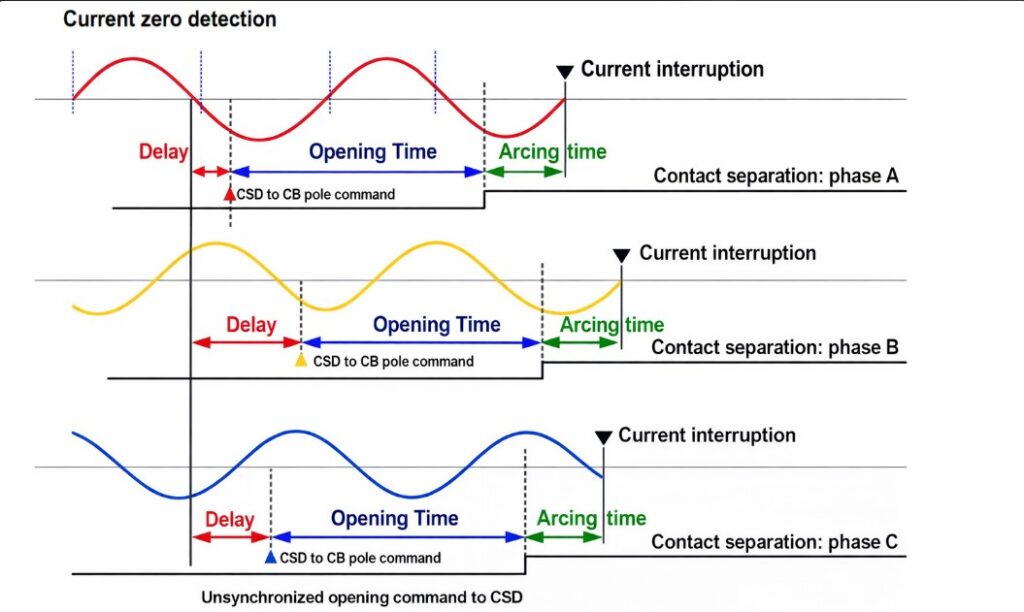
The CSD monitors current through the CB as a reference. It takes the signal from the current transformers associated with the CB. The CSD detects periodical current zero crossing of the current signal. We set the arcing time in the CSD from the data sheet of the CB. Depending on the pre determined arcing time the CSD triggers the pole opening. The CSD does it such a way that the current finally interrupt only on its natural zero crossing.
When C&R panel issues an opening command, the command first reaches to the CSD. Then, the CSD makes the command delayed. Actually, it waits to adjust the time and then sends the command to each individual CB pole separately to open each phase independently.
Red Phase Opening
First, we will consider the red phase waveform. Opening time is a predetermined time which we can get from the data sheet of the circuit breaker. Also the arcing time we can get from the same data sheet. Then, we have to set these values in the CSD. Then the CSD itself calculates this delay time. It pinpoints the time so that the current can naturally interrupt at the natural current zero after arcing.
Opening time is the time between, the circuit breaker mechanism initiates the contact separation and the opening command has reached the tripping coil. Actually the tripping coil first receives the trip pulse, then there is some mechanical delay due to latch movement, gear rotation, and all those things. After that time delay only, the breaker contacts can start physical separation from each other. We get the the opening time in the data sheet of the circuit breaker.
So, after that time, the physical contacts start separating from each other, and the arc starts. And how long the arc will continue is called the arcing time. At the natural zero crossing, the arc will end and finally extinguishes to interrupt the red phase current.
Blue Phase Opening
Now come to the blue phase. There is also the same time delay after which the CSD will send the trip signal to the tripping coil of the blue phase pole. After the opening time, the CB pole initiates physical separation of the contacts. After the arcing time, the blue phase current is finally interrupted at its natural current zero crossing.
Yellow Phase Opening
At yellow phase, after the precalculated delay, the CSD sends a tripping pulse to the tripping coil. It initiates the physical separation of the contact. After the physical separation of the contacts, arc will start. At the end of the arcing time, the current crosses zero. Therefore the arc ends, and the yellow phase current is finally interrupted.
So we have seen that due to the CSD operation, all the three phase currents will interrupt at their natural zero crossing. So the chance of restriking voltage occurring across any of the poles of the circuit breaker is minimized or eliminated. This is how a CSD operates during the opening operation of a circuit breaker.