Normally, two kinds of overvoltage may appear in an electrical system.
Power Frequency Withstanding Voltage
One type is power-frequency overvoltage. In a three-phase system, a fault in one phase can increase the voltage in the healthy phases to an elevated value. This condition can continue until the clearance of the fault. Also, due to sudden tripping or switching off of a large load, the voltage of the system may rise to an abnormal overvoltage. It is also temporary. However, this overvoltage condition can last for a short duration due to the inherent normalizing time of the system. Normally, any such overvoltage condition does not exceed a few seconds. Because protective and automated systems clear and normalize the abnormalities within this time.
Therefore, the insulation system must withstand a specified overvoltage at power frequency for a specified duration. Therefore, we refer to this level as the power-frequency withstand voltage. Since it is a power-frequency voltage, we express it in RMS value. Standards typically recommend a duration for withstanding overvoltage of up to 60 seconds.
🔌 One Minute Power Frequency Withstand Voltage
(Dry & Wet, kV RMS)
| Nominal System Voltage (kV) | Highest System Voltage (kV) | Equipments (Other than Transformers & Reactors) | All Transformers & Reactors |
|---|---|---|---|
| 400 | 420 | 630 | 570 |
| 220 | 245 | 460 | 395 |
| 132 | 145 | 275 | 230 |
| 33 | 36 | 70 | 70 |
Impulse Voltage
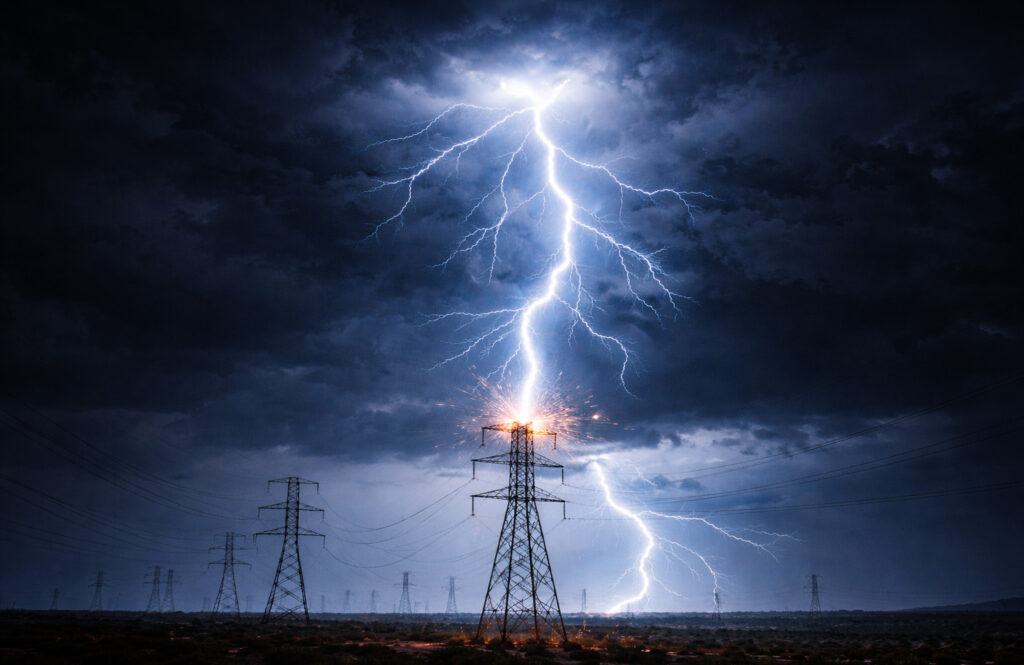
Another type is impulse transient overvoltage. This type of overvoltage is very sudden and short in duration. Its magnitude can be much higher than the power-frequency withstand voltage. However, it lasts only for a few microseconds or for a few hundred microseconds. Lightning or switching operations usually cause this type of overvoltage.
Impulse due to Direct Lightning Strokes
Transmission systems may be exposed to the open atmosphere. Therefore, a lightning strike can directly hit the electrical system. A direct stroke can cause destructive over voltageson the system.
Impulse due to Indirect Lightning Strokes
Lightning can also hit a nearby structure or object. In both cases, the system experiences a large transient voltage disturbance. Besides the direct strokes, when lightning strikes nearby, a very large current flows between the earth and clouds. This large current creates strong electromagnetic effects. Due to induction, it can cause a transient overvoltage in the nearby power system. We also treat this as a lightning overvoltage.
Impulse due to Switching Operation
During switching operations, overvoltages can also appear. Sometimes, current chopping occurs during improper switching. When current chopping happens, the sudden interruption of current produces a switching overvoltage.
A switching impulse lasts longer than a lightning impulse. However, it is still very short and steep. Its duration is usually a few hundred to a few thousand microseconds. The amplitude of a switching impulse is generally lower than that of a lightning impulse, but the energy is significant due to its larger duration.
Basic Insulation Level (BIL)
Therefore, an insulator must be able to withstand both lightning impulses and switching impulses along with the one-minute power frequency overvoltage.
We design insulators based on three main criteria:
- Power-frequency withstand capability
- Lightning impulse withstand capability
- Switching impulse withstand capability
Together, these define the insulation strength of equipment. This combined rating is called the Basic Insulation Level (BIL) of the insulator.
⚡ Lightning Impulse (BIL) Withstand Voltage
(1.2/50 μs, kVp)
| Nominal System Voltage (kV) | Highest System Voltage (kV) | Equipments (Other than Transformers) | All Transformers |
|---|---|---|---|
| 400 | 420 | 1425 | 1300 |
| 220 | 245 | 1050 | 950 |
| 132 | 145 | 650 | 550 |
| 33 | 36 | 170 | 170 |