
In this article, we will discuss the very basic concepts of ideal and practical voltage sources.
Voltage Source
First, we will discuss the voltage source. Obviously, let us first discuss the ideal voltage source. After that, we will move to the practical voltage source.
Ideal Voltage Source
An ideal voltage source, as the name indicates, delivers a constant voltage. The terminal voltage of the source remains fixed irrespective of its loading conditions. In other words, regardless of the circuit condition across the source, it always delivers the same constant voltage.
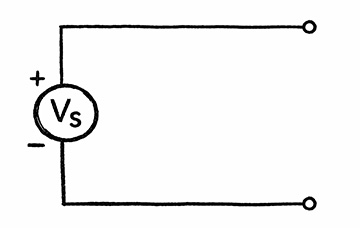
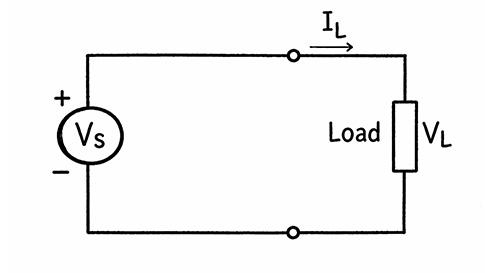
Suppose there is a voltage source. We connect across it a simple resistance. If we decrease or increase the resistance, the current through it also changes. However, the source’s terminal voltage remains constant. In other words, the source gives a constant voltage irrespective of the current delivered to the circuit.
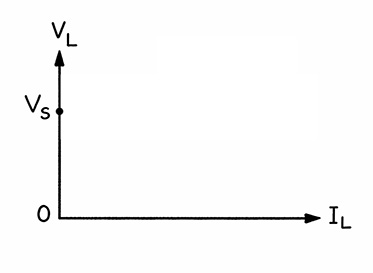
Let us draw the V–I characteristics of an ideal voltage source. The x-axis represents the current through the load resistance. Whereas the vertical y-axis represents the voltage. Here, VS represents the terminal voltage of the source under open-circuit conditions.
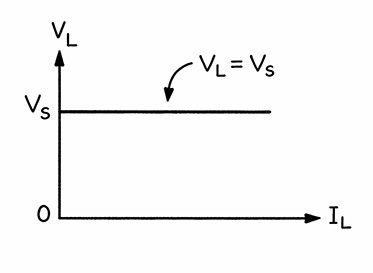
Now, we connect a load to the source and increase the load. In other words, we gradually reduce the connected resistance. As a result, the current through the load increases linearly. However, the terminal voltage of the source remains constant at VS. So, we get a straight line parallel to the x-axis. This line indicates that at any current, the source gives the same voltage VS.
Practical Voltage Source
Now consider a practical voltage source. It is needless to say that all electrical devices have their own internal resistance. Obviously, a voltage source also has internal resistance. The internal resistance will be in series with the source. So whenever the load current increases, it increases the internal voltage drop across the resistance.
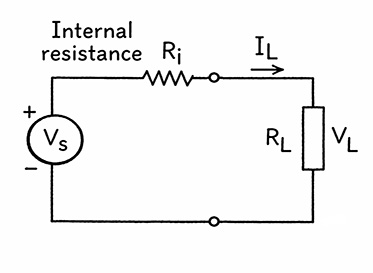
Therefore, the terminal voltage of the voltage source will be less than the internal source voltage due to the internal series resistance Ri. So, we can write the terminal voltage of the source as
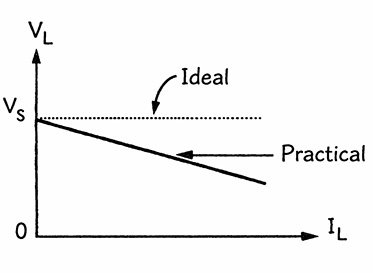
The only difference between an ideal voltage source and a practical voltage source is that in an ideal voltage source, the internal resistance Ri is always zero.
Time Invariant Voltage Source
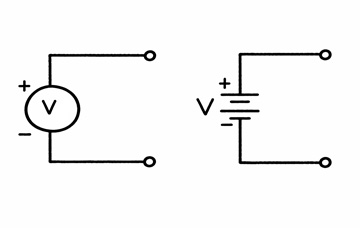
We can classify voltage sources into two categories. One is a DC voltage source. This is a time-invariant voltage source. These sources give a constant voltage. The voltage delivered by these sources does not vary with time. A battery is an ideal example of a constant, time-invariant voltage source.
Time Variant Voltage Source
The example of a time-varying voltage source is an AC voltage source. It is a time-varying voltage source because the voltage delivered by this type of source varies in a sinusoidal, triangular, or square alternating waveform. It is time-varying because the instantaneous value of voltage varies with time in all alternating waveforms.
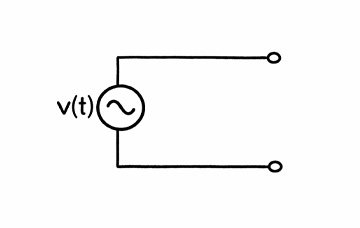
We denote a constant voltage with a capital V. On the other hand, we normally denote a time-varying voltage with the small letter v as a function of time t. That is v(t).
Final Thoughts on Voltage Sources
Understanding the difference between ideal and practical voltage sources is crucial for circuit analysis and design. While ideal sources help in theoretical study, practical sources reflect real-world behavior where internal resistance always plays a role.