Scientists have proposed various theories to explain how electric charges form and separate inside clouds. In reality, charge formation and separation inside clouds are very complex natural phenomena. Engineers mainly need to know that charge separation occurs in thunderstorm clouds. In general, the negative charge concentrates in the main lower part of a thundercloud. In contrast, the positive charge concentrates in the upper part. Although some positive charge also often concentrates in a small zone near the bottom of the cloud.
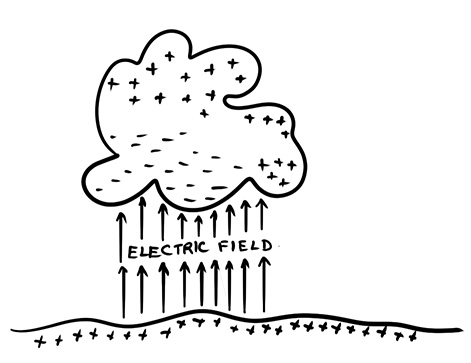
This charge distribution at the lower part of the clouds induces opposite charges on the Earth’s surface. This creates strong electric fields between the cloud and the ground.
The size of a cloud is much smaller compared to the Earth’s surface. The electric charges concentrate inside the smaller cloud. Because of this, the electric field inside the cloud is much stronger than the electric field near the Earth. As a result, an electric discharge starts inside the cloud rather than from the ground.
Initial Discharge or First Stroke
The high field of the charged reasons of the cloud ionizes the surrounding air. This causes localized discharge. This means it creates stepped leaders, which carry charge from the cloud into the air. The current in a stepped leader is small, usually around 100 A. It is not the final lightning stroke. It initiates the low-resistive path for the bulk discharge. Stepped leaders move toward the ground in a random path. They advance in short steps, each step being about 10 to 80 meters long. Their average speed is nearly 150,000 meters per second, which is around 0.05% of the speed of light.
As a stepped leader comes close enough to the ground, it faces strong electric fields due to oppositely charged ground objects. At this point, the lightning jumps to the object (tree, building, lightning rod, or ground). The length of this last jump is called the striking distance. This breaks the dielectric of air in between and provides a conductive path from ground to cloud through the stepped leaders.
Return Stroke or Second Stroke
The return stroke is a very bright channel of light. Actually, now discharging occurs upward from the ground to the cloud, following the same path created earlier by the downward stepped leader. This return stroke carries the main lightning current. The current in a return stroke is significantly large. The average value is about 24KA. This current flows from the Earth up to the cloud to neutralize the charged region inside the cloud.
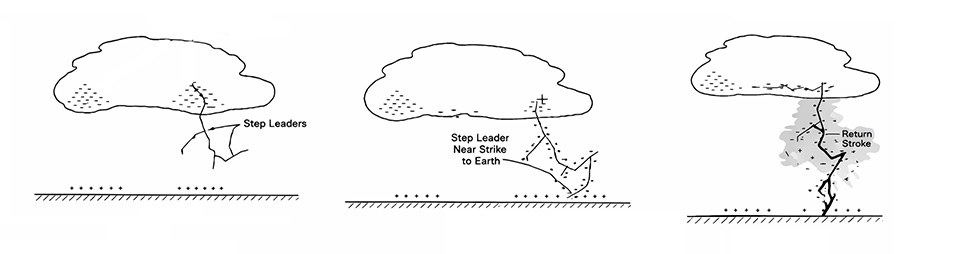
The return stroke travels at a very high speed, but it is still slower than the speed of light. Its speed depends on atmospheric conditions and is roughly 10% of the speed of light. The amount of negative charge that comes down from the cloud is equal to the positive charge that flows up from the Earth. Because the return stroke moves much faster than the stepped leader, it carries a much larger current.
Relation between Striking Distance (S) and Return Stroke Current (I)
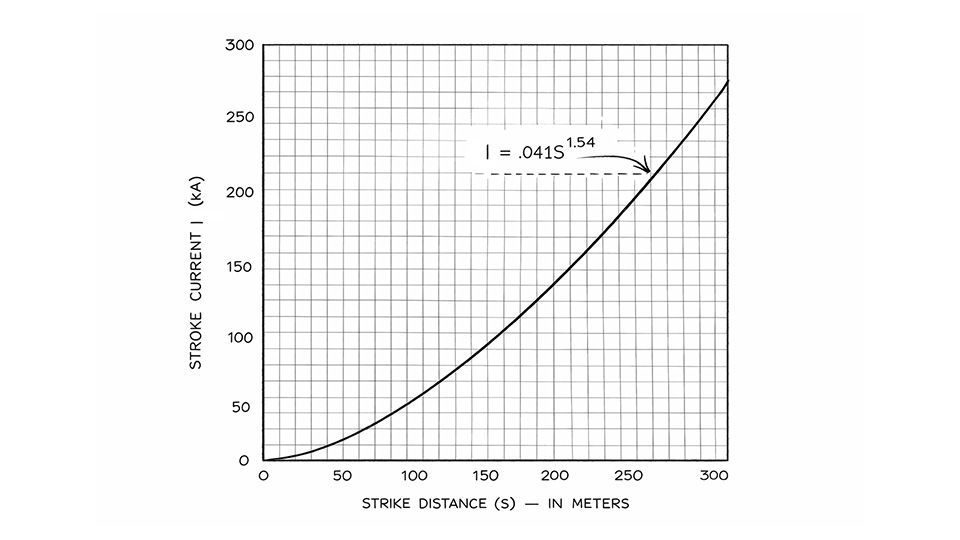
Obviously, the striking distance (S) depends on the field intensity between the tip of a descending lightning leader and the object tip. Again, the discharging current (I) after final attachment depends upon the field intensity to be neutralized. Hence, there is a relation between the magnitude of the return stroke current (I) and the striking distance (S). Several equations have been proposed for this relation. But the most common among those is
I = 0.041S1.54
This is as per IEEE.